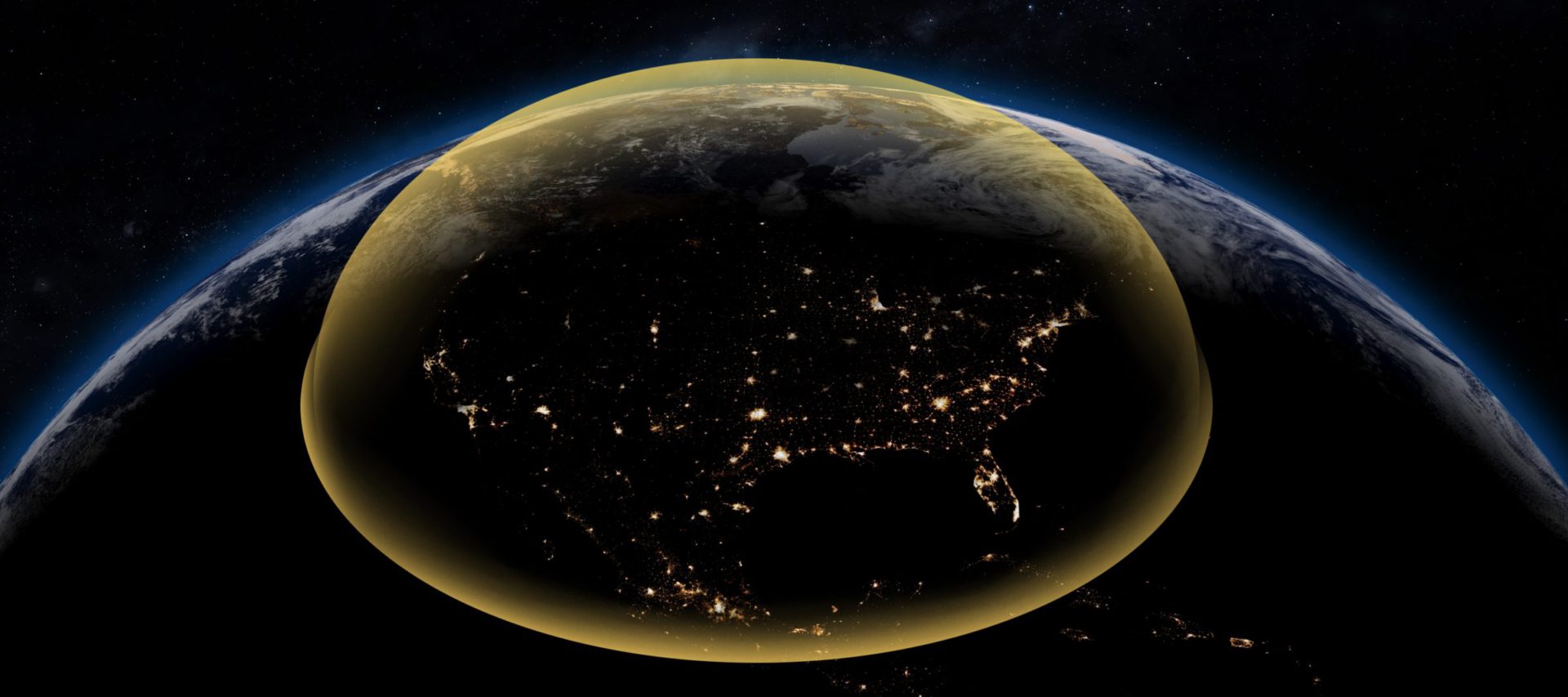
The Trump administration has announced a new global strategy for the United States. Instead of acting as the leader of a global alliance of democratic nations previously known as the Free World, the United States will henceforth focus its military efforts on “defense of the Homeland.” The centerpiece of this strategy will be the creation of a vast new defense system called Golden Dome, which, come what may elsewhere, will keep America safe and secure by shielding it from intercontinental ballistic missile attack.
The primary component of Golden Dome will be a system of satellites in low Earth orbit, each carrying one or more small fast interceptor rockets that it can shoot downward to knock out an enemy missile by direct impact before it reaches space. Low-Earth-orbit satellites constantly move around Earth at very high speed. So in order to ensure that a sufficient number of guard satellites are in place nearby to take out a barrage of enemy missiles wherever and whenever they are launched, thousands of them will be needed, operating simultaneously all around the world, at all times. The price tag for this huge armada of orbiting warcraft and its extensive spread of supporting ground control infrastructure has been pegged by the program’s proponents at $175 billion. But it’s a good bet that the ultimate cost will be many times this figure, with the Congressional Budget Office estimating up to $830 billion, and some estimates running well into the trillions.
Still, if it could really protect America from destruction, Golden Dome might be worth the cost, regardless. The problem is that it won’t. On the contrary, by diverting massive amounts of funds from urgently needed defense priorities, and encouraging abandonment and destruction of America’s essential system of defense alliances, Golden Dome will make us far more vulnerable.
It Won’t Work
Let’s start at the beginning. Golden Dome won’t work. This is so because the first thing any adversary undertaking a nuclear attack on the United States would do would be to explode a nuke in space. The electromagnetic pulse resulting from such an explosion would disable thousands of the Golden Dome guard satellites, as well as most of the rest of the reconnaissance, communication, and GPS satellites the U.S. military depends upon to operate. The enemy would then be free to hit us at will. Of course, we would still be able to retaliate with our own nuclear missile forces. But that would also be the case — as it is now — if we had no Golden Dome.
You might think that Golden Dome is designed to prevent precisely this sort of attack. The problem is that only a single nuke out of possibly thousands being launched by an enemy would need to slip through and reach suborbital space, or be prepositioned in Earth orbit, for the entire system to fail. This means that it has to achieve not only an implausibly high success rate but perfection. Advocates, at best, acknowledge this kind of problem as something that still needs to be figured out.
In short, Golden Dome is a boondoggle. The only thing right about it is its name. This was derived from Iron Dome, the highly cost-effective ground-based Israeli system for countering short-range conventional missiles, but appropriately changing its metaphor from a strong, cheap metal to an alternative that is famously expensive, heavy, and weak.
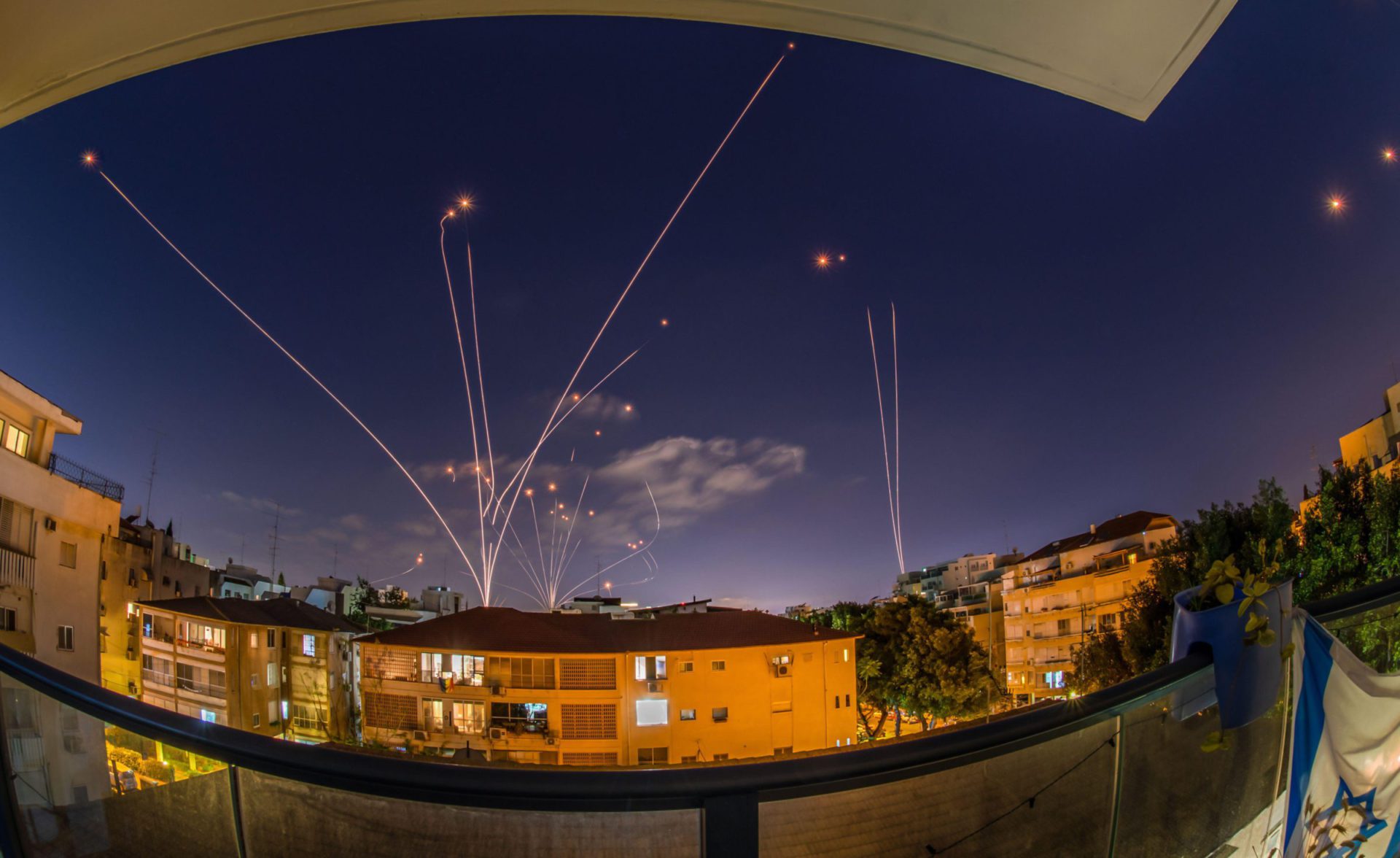
Israel’s Iron Dome defense system intercepts incoming missiles. Oren Ravid / Alamy
To the extent we can be, we are protected now from nuclear attack, as we have been since the Soviets got the bomb in 1949, by the deterrent effect offered by our ability to retaliate. A comparable capability protects our principal adversaries from us. As a result, the nuclear arsenals of each side have canceled each other out. Instead of nuclear war, the outcome of the impending struggle between the democracies and the autocracies will be determined by other means, including conventional warfare, commercial competition, and the battle of ideas.
It is in these areas that we have become dangerously vulnerable.
The Russian invasion of Ukraine has unleashed the first large-scale conventional war between strong opponents in three quarters of a century. In the course of this conflict, war has been revolutionized by the introduction of the small Unmanned Aerial Vehicle (UAV) as a major military system. The United States has yet to come to grips with the implications of this revolution.
Currently both Russia and Ukraine are producing combat UAVs costing only hundreds of dollars each in quantities of millions per year. In contrast, the U.S. military has been living in a past world, producing only tens of thousands of UAVs at costs of up to hundreds of thousands of dollars each. Not only that, but while the drone technologies being used in the UAV war in Ukraine are being improved and altered by both sides on time scales measured in weeks, the American military procurement system remains enmeshed in bureaucratic processes that preclude innovation at anything approaching such a rate.
Furthermore, if one extrapolates the application of the types of technologies in play in the UAV war, including robotics and AI, to other types of combat systems, it becomes evident that massive portions of the American military system have been rendered obsolete. For example, it would be straightforward to develop underwater drones the size of half-scale torpedoes that could be dropped in the ocean by aircraft or deployed from ships. Unafraid to give away their position by actively pinging with their sonar, such cheap drones could readily hunt down and destroy the multi-billion-dollar nuclear missile submarines that now comprise the U.S. Navy’s proud fleet of capital ships.
The day of the small, relatively cheap air superiority drone jet fighter is also near at hand. Not only tanks but the Army’s fleet of helicopters could soon become sitting ducks. To deal with such new realities, we are going to have to rethink and rebuild our Navy, Air Force, and Army as fast as we can, and it’s going to cost a lot.
We are also going to have to expand our space forces, because, in addition to drones and AI, the other key technology that has played a decisive role in the Ukraine war has been spacecraft. While space assets have been used in all of America’s wars since Vietnam, in a very real sense the Ukraine conflict is the first space war, as it is the first war in which space assets have played a decisive role. It is due to access to superior space assets, including satellite reconnaissance, communications, and guidance for munitions, that, despite being outnumbered four to one, Ukraine has been able to fight Russia to a standstill. This has made it apparent that in any conflict between more evenly matched opponents, the side possessing space superiority would unquestionably win.
In this context, some of the technology proposed for Golden Dome could play a useful role. America needs fighter satellites to protect our space assets from enemy anti-satellites, and to eliminate enemy reconnaissance, communication, and navigation satellites supporting adversarial operations against our ground, naval, and air forces in the event of a conventional war.
However, the numbers of fighter satellites required to protect our space assets from conventional attack would be orders of magnitude lower than the fantastical armada of guard satellites Golden Dome would have to employ in a futile effort to patrol the world in a nuclear war.
It makes sense to deploy fighter satellites as part of a balanced program of rebuilding our armed forces across the board to be able to fight and win — and thereby deter — a modern conventional war. Spending trillions on a Golden Dome fantasy, and in the process robbing the funds needed to face the real threats at hand, does not.
It’s Not Like Reagan’s Star Wars
Golden Dome has been compared by its proponents to President Ronald Reagan’s 1980s Strategic Defense Initiative, also known as Star Wars, which by posing a challenge that the Soviets could not meet arguably contributed to the collapse of their evil empire. There is some truth to this, inasmuch as Golden Dome’s overall technical design — a fleet of orbiting guard satellites armed with small high-speed interceptors to knock out enemy ICBMs during their boost phase — is based on the “Brilliant Pebbles” concept that was advanced as the basis for SDI.
However, while the technical designs of Golden Dome and SDI may appear similar, the strategic concepts underlying the two programs could not be more different.
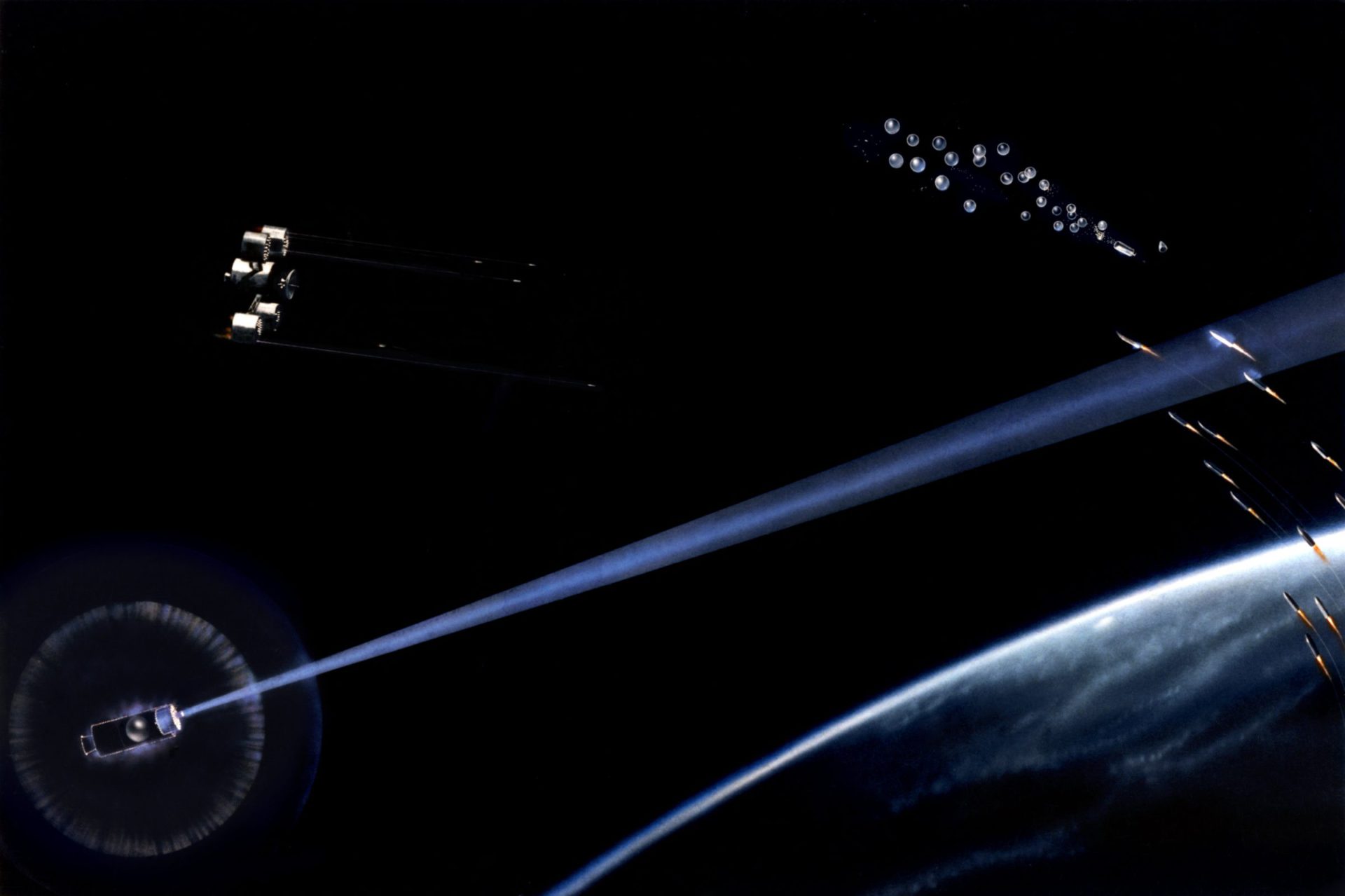
An artist’s rendering of a satellite laser weapon system — part of President Ronald Reagan’s Strategic Defense Initiative, or Star Wars Dept. of Energy / Science Photo Library
The Strategic Defense Initiative was proposed by a president representing a party, and ultimately an entire long-lasting bipartisan political establishment, that was solidly internationalist. There was never any serious reason for concern that Ronald Reagan or the United States was about to abandon its European or Asian allies and withdraw to hide in fortress America. Quite the contrary, Reagan’s America had 350,000 troops stationed in Europe, ready to defend that continent with any means required, up to and including an ample arsenal of nuclear weapons. If anything, SDI reinforced that posture further by making it clear that the threat of Soviet nuclear strikes on our homeland would not deter us from defending our allies.
In contrast, the United States today has only 67,000 military personnel left in Europe, including a mere 27,500 U.S. Army soldiers, with yet more troop withdrawals from Eastern Europe currently underway. Consequently, the Trump administration’s commitment to defending that continent is far from clear. On the contrary, Trump and other senior figures in his administration have made it clear that they have no stake in repelling Russia’s invasion of Ukraine — an enterprise, which, if successful, would greatly increase Russia’s material and technical power and advance its armies to the borders of NATO allies Poland, Hungary, and Romania. This fecklessness is undermining the policy of collective security and deterrence that has served to prevent a general war for the past 80 years. Going further, many of those in the MAGA camp have called for the U.S. to pull out of NATO altogether. J. D. Vance made a point of publicly meeting with Germany’s NATO-skeptical AfD party in the middle of the country’s election season. Others close to the administration actively campaigned for it. Indeed, the Trump administration seems to be going out of its way to divest the United States of its allies, launching trade wars and making threats of annexation against even our longest and closest of friends.
Reagan’s SDI was a plan to strengthen the Western alliance. Trump’s Golden Dome is an illusory Maginot Line in the sky, promising false security to those who would desert the cause.
It’s an Invitation to Abandon Our Allies
Golden Dome is a waste of funds because it won’t work. But even more pernicious is its seductive offer for America to abandon her allies. The table below shows the breakdown of global GDP normalized to the purchasing power in each country or bloc — a useful shorthand for economic and therefore geopolitical strength.
The table shows that, normalized to purchasing power, the Free World — that is, the United States and its European, Asian, and other democratic allies — outproduces the Chinese-led CRINK bloc — China, Russia, Iran, and North Korea, plus some minor autocracies — by $92 trillion to $51 trillion, or 80 percent. But without our friends, China plus its CRINK allies could outproduce the United States by a hefty $51 trillion to $31 trillion, or nearly 65 percent.
But even worse, should the United States retreat from the world and allow the Chinese-led axis to intimidate those we abandon into joining its bloc, their combined economic resources could potentially overpower ours by as much as six hundred percent.
Together with our allies, we have the material and technological resources needed to deal with the enormous challenge we face. Without them we do not.
Furthermore, not only would an isolated America be outnumbered, outproduced, and impoverished by adversaries able to dictate the terms of world trade, but we would also be rendered blind by the loss of human intelligence provided by our allies. If we want to be able to have any advance idea of what North Korea, Russia, Iran, or China might be cooking up against us, we need to have South Korea, Ukraine, Israel, and Taiwan in our corner. To be able to promptly detect adversarial movements once they are actually underway, we need to have bases, radar systems, and electronic listening posts in many other countries all around the world. Abandoning such allies would be the equivalent of ripping out our eyes and ears.
In short, if the United States takes the bait offered by Golden Dome and decides to go it alone, our adversaries will be able to utterly crush us. They will outclass us both militarily and commercially, and be able to dictate both the rules and the outcomes of global business competition.
The isolationists say they don’t want the United States to bear the costs of being the world’s policeman. Yet the cost of allowing the China–Russia axis to be the world’s policeman would be infinitely worse.
That is why it is strategic insanity for the United States to seek security in withdrawal from the world, and why our adversaries have pulled out all the stops, mobilizing an unprecedented global array of puppet political parties, agitators, social media trolls, and bots to applaud and encourage any belief that might lead to such a fatal decision.
We must not allow ourselves to be so misled. There is no safety to be found by trying to hide under a golden dome. If we are to remain free, we must continue to be no less than what we have had the honor of being for the past 80 years: the watchers on the walls of world freedom.
Between SpaceX’s breakthroughs and Trump’s inaugural promise, we have a once-in-a-generation opportunity. But it can’t be realized as an eccentric’s project or a pork banquet. Here’s a science-driven program that could get astronauts on the Red Planet by 2031.
The new cold war means a race with China over AI, biotech, and more. This poses a hard dilemma: win by embracing technologies that make us more like our enemy — or protect ourselves from tech dehumanization but become subjects to a totalitarian menace.