Can You Solve a Lifestyle Epidemic Without Lifestyle Gurus?
When you’ve got a “diseases of civilization” crisis, you’re gonna get some weirdos.
In 1997, the World Health Organization released a report declaring an obesity epidemic. In both developed and developing countries, with almost no exceptions, rates of obesity had been rapidly rising, often doubling in the span of a few decades. Obesity, the authors note, “is now so common that it is replacing the more traditional public health concerns, including undernutrition and infectious disease, as one of the most significant contributors to ill health.”
Almost thirty years later, the report looks both prophetic and quaint. Its concerns have proved to be warranted — type 2 diabetes, non-alcoholic fatty liver disease, certain cancers, heart disease, and a host of other ailments caused or exacerbated by obesity have indeed replaced malnutrition and infectious disease as the primary causes of ill health in many countries. But the scope of the problem has grown so drastically that a return to the rates that alarmed researchers in 1997 would now be an astounding achievement. To take just one example, by 2020 Colorado, consistently the American state with the lowest rate of obesity, had a higher prevalence than Mississippi, the state with the highest, did in 1990. The trend has been persistent; nowhere has it been meaningfully reversed. Like ennui and Taylor Swift, obesity is an unavoidable consequence of modernity.
But two recent developments have raised the possibility that fatalism should no longer be the default. The first of these, Robert F. Kennedy, Jr.’s Make America Healthy Again movement, has been one of the loudest factions in both Donald Trump’s presidential campaign and his administration. While it is easy to dismiss MAHA for its many outlandish views and bombastic conspiracy-mongering, doing so risks denying a potent political reality: the modern food environment has sickened a significant portion of the populace, including millions of children, and people want the government to do something about it. Individual hand-wringing about the consequences of poor nutrition has coalesced into public calls for radical change.
Even more potent than a nascent political movement is the advent of weight loss drugs that actually work. After decades of flailing, drug companies have developed an effective pharmaceutical treatment for obesity. Rather than waiting for the uncertain work of politics to bring about changes in public health, weight loss drugs offer an injectable solution. The consequences of living in a broken food system can be alleviated by a quick trip to the doctor’s office.
MAHA, and Ozempic and its cousins, are both responses to the same problem. But they diverge in their diagnosis.
The drug companies do not explicitly articulate what’s gone wrong, but the critique implicit in their solution is radical. The drugs work because they help people avoid not certain unhealthy foods but overconsumption of all food. The default diet as a whole is the poison. But, like many poisons, at a low enough dose it’s not that harmful, and weight loss drugs help reduce exposure to within the safe limit.
Kennedy’s diagnosis of the problem has been a little less than clear too. In the past he has often blamed the food system at large for increases in obesity and related diseases. “Ultra-processed food is driving the obesity epidemic,” he posted in October 2024. He went on to claim that government subsidies for their main ingredients, corn, soy, and wheat, are systemically perpetuating the epidemic. But now that Kennedy has political power, his focus has been much narrower. Rather than pursuing ambitious reforms, he has focused on a particular sort of contamination. Food companies have cozied up to regulators, crafting loopholes permitting them to add artificial colors and flavors, emulsifiers and preservatives — hidden, novel ingredients that have sickened us all. His main solution has been to encourage food companies to tweak their ingredient lists. This narrowing of his focus has him engaging in a mirror of the behavior he previously critiqued; in his role as a government official, he now gives cover to the merchants of sugar and fat so long as they remove some more obscure and disfavored ingredients from their products.
If Kennedy is correct that stripping the food system of hidden technology — the hundreds of compounds used by food scientists to enhance the color and flavor of everything from bread to burritos — will be a significant boon to public health, then the surprisingly tame policy response he has pursued as Health and Human Services Secretary makes sense. But if his prior, more ambitious critique is correct — if the problem is the more ubiquitous hedonic technology of the modern food system itself — then his fixation on dyes in breakfast cereal is not just inadequate but a big distraction. The only solutions that would make a real difference would be either drugs capable of dampening desire as a whole or radical systemic change.
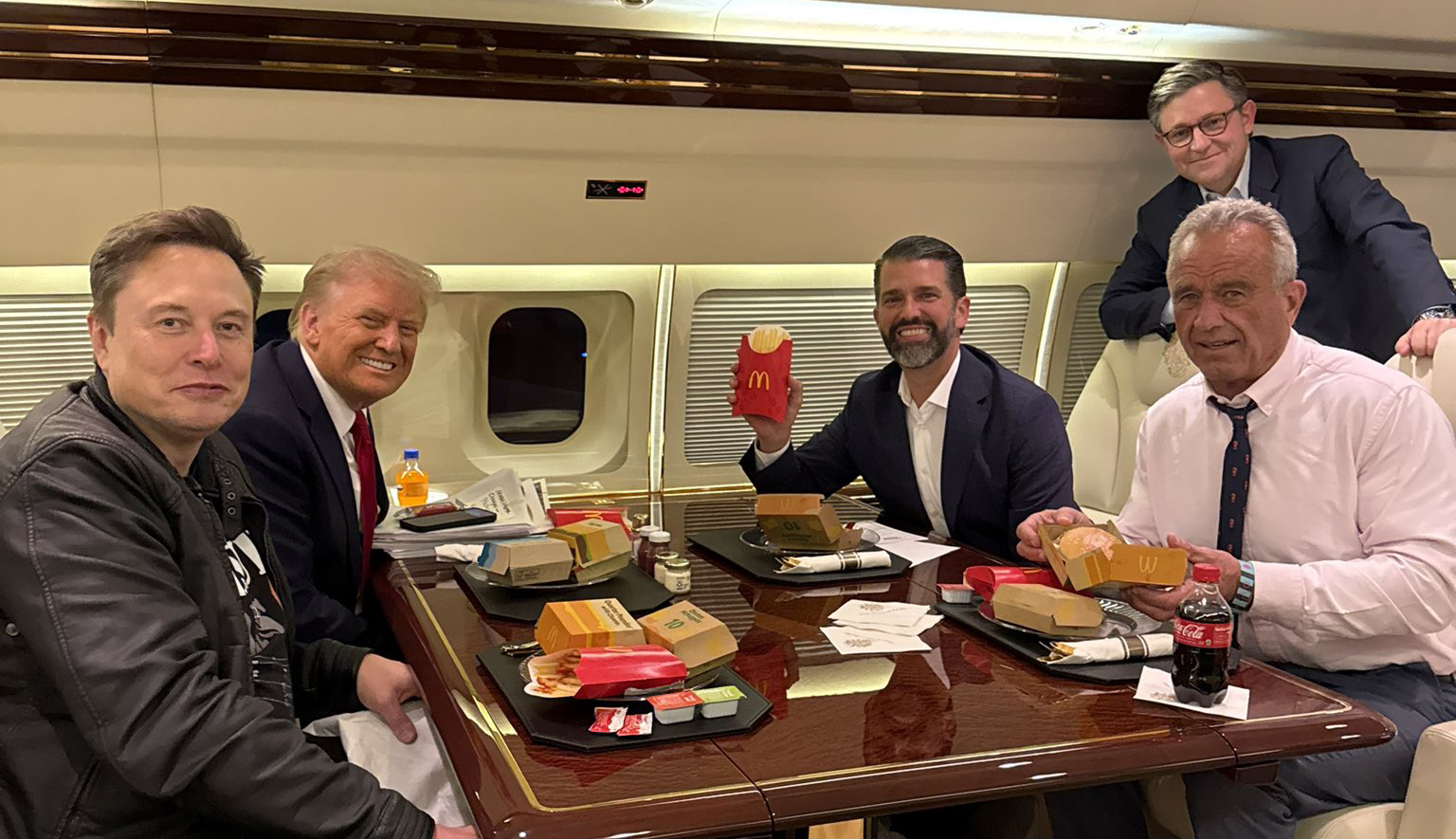
Since joining the Trump administration, Robert F. Kennedy, Jr. has often looked more like a standard-issue politician than the leader of a revolution. Shortly after the election, he posed with Trump, Elon Musk, and a tableful of McDonald’s aboard Trump Force One. During his confirmation hearing, Kennedy emphasized that he did not want to impose new regulations on farmers, but to incentivize them to use healthier practices. Noting his boss’s fondness for cheeseburgers and soda, he also said he had no interest in limiting consumer choice, but simply wished to provide the American people with clearer information.
The exception to his accommodating stance was additives. He evinced real passion when pointing out that American junk foods, whether McDonald’s fries or Froot Loops, contain far more polysyllabic ingredients than their European counterparts. His message, in effect, was that you could have your Twinkie and eat it too if Hostess just tweaked the recipe a little.
An early demonstration of what MAHA counts as a victory came when the burger chain Steak n’ Shake announced that it would start cooking French fries in beef tallow rather than seed oil, a decision Kennedy celebrated by joining Sean Hannity at one of the chain’s locations for an advertorial. In March 2025, he posed with the heads of major food companies, announcing plans to work with them to MAHA-ify their products. A regulatory victory arrived in April in the form of a plan to remove artificial red food coloring from the entire food supply.
Given the heavy emphasis on dyes, cleaning up the food system has so far been literally superficial, with brief forays into sweeteners. In April and May, PepsiCo and Tyson announced plans to rapidly move from artificial to natural colors, or at least to market options free from food dyes. President Trump himself weighed in, taking credit for convincing Coca-Cola to replace corn syrup with sugar. “You’ll see. It’s just better!” he posted. Most of the ice cream supply may soon be MAHA-friendly, or at least free from artificial dyes. In perhaps his greatest triumph to date, in July Kennedy was finally able to congratulate Kellogg’s for bringing Froot Loops into MAHA’s good graces by switching from artificial to natural colorings, an example he urged other companies to follow.
While a relentless focus on the picayune may look strange to the uninitiated — are Froot Loops colored with beet powder really so much healthier? — it makes sense within MAHA. It would be too tidy to say Kennedy divides the world into natural (good) and unnatural (bad), but in his view the unnatural components of our food are the problem. The hidden technology of Blue No. 2 and Red No. 3 lurking in the fine print of ingredient lists are sickening us at least as much as the sugar at the very top.
There may not be a strictly logical reason why a belief that dyes and artificial flavorings are pernicious villains of the food system should correlate with a distrust of vaccines, EMFs, and novel weight loss drugs, yet they resonate. They play a paranoid chord. Shadowy actors in industry employ means of manipulation so sophisticated that almost no one recognizes them for what they are. They inject impurities into our bodies and into the body politic. Casting additives as the problem allows Kennedy to tell a story that is cinematically thrilling and politically tractable. It is also of dubious truth.
Each time they cajole a company into replacing an artificial ingredient with a natural one, Kennedy and MAHA celebrate it as the removal of nefarious hidden technology that is corrupting the food system. But a much more convincing, if also more dire, idea is that the food system itself constitutes a hedonic technology — one that is so effective that it dysregulates the metabolisms of almost everyone who comes into contact with it, killing many, crippling more, and doing at least some damage to all the rest. The additives that MAHA obsesses over may be a part of the problem, but they are a distraction from the primary cause.
So low is the baseline set by the Standard American Diet, which goes by the apt acronym SAD, that any significant divergence from it, whether keto or vegan or Mediterranean, will be an improvement. There is robust evidence that every diet works. There is evidence too that very, very few people are able to sustain an alternative diet, whether keto or vegan or Mediterranean. SAD has become the standard for a reason, and that reason is not a conspiracy, at least not the sort Kennedy imagines. There has been a campaign of sabotage, but our biology has been waging it against itself shoulder to shoulder with Kraft.
Dietary science is notoriously complex and often unreliable. But both observational and small but compelling controlled trials support the idea that ultra-processed food encourages excess calorie intake when compared to a less processed diet. By trying out combinations of flavors, identifying the ones people prefer, and then repeating the process for a few decades, food companies have created the conditions for chronic overconsumption. Doritos are an inevitable consequence of applying the most basic sort of scientific method to the question of what people want to eat. Food most of us cannot resist packs the shelves and checkout lines, is advertised to us constantly, is served in school cafeterias, convenience stores, and restaurants — and so, predictably, most of us eat too much.
Kraft has teams of food scientists diligently working to develop hyperpalatable snacks, confections of fat and sweet and crunch, that tap into intrinsic systems of taste and hunger more effectively than a plate of chicken and rice rounded out with spinach and a pinch of salt. They don’t need to resort to the secret manipulations of intentionally engineering subtly addictive substances when openly concentrating what attracts us will create foods that are too hedonic. We prefer the combination of cheap, tasty, and convenient to simpler, blander foods that are more time-consuming to prepare. So much is this true that average Americans consume over half of their calories in the form of ultra-processed food, according to CDC data.

This is not to say that MAHA’s fixation on additives has no merit. Stir canola oil, cornmeal, and salt together in a bowl and the result is an unappetizing mush. But make batter out of the cornmeal and fry it into chips, then sprinkle on monosodium glutamate, and you’ve worked a bit of black magic, especially if you also add the powdered essence of ranch dressing to the mix plus a dash of Red 40 and Yellow 5. Given that manipulations are part of what makes foods more appealing, casting a jaundiced eye at all of the trace ingredients that heighten the flavor or color or texture makes sense. But if the concern is encouraging overindulgence, a flavoring powder made from actual cheese might not be any better than powder made with an artificial cheddar flavor.
The difficulty of doing long-term diet research on humans means we typically don’t know with any confidence the exact effects of any single additive when consumed over decades, let alone of dozens of additives consumed in combination. Troubling trends like the increasing prevalence of colorectal cancers in young populations and of autoimmune conditions in everyone justify concern.
But when Kennedy appends the caption “MAHA is winning” to yet another Steak n’ Shake post, this time about the availability of glass-bottled, sugar-sweetened Coke to accompany the tallow-cooked fries, he is missing the forest for the trees, or the soda for the sweetener. Perhaps sugar is indeed marginally better for you than corn syrup, and perhaps tallow is marginally healthier than soy oil, though only weak evidence supports either contention. But regardless of the sugar source, Coke is liquid calories, and regardless of the frying medium, fries taste so incredible that most of us can keep eating them forever. When Kennedy celebrates small changes to junk food, he is playing into the hands of the very food companies he was blaming for the crisis of health in America not so long ago.
Despite being a scion of one of America’s most prominent political families, Kennedy has always fancied himself a maverick. He distrusts power, whether corporate or governmental, and he saves his most vitriolic outrage for instances in which the two have become incestuously entangled. At the outset of his tenure as HHS Secretary, Kennedy’s background made it impossible to predict what he would do. Even in an administration notable for finding staff in unusual places, he stands out. He was a Democrat until about two minutes ago. He once suggested that corporations that spread climate denial “should be given the death penalty” by revoking their legal right to exist. He primaried a sitting president. The list of conspiracies he does not believe is significantly shorter than the list of those he does. Like President Trump, he has a habit of defying the political consensus, but, unlike his boss, he appears to do so out of genuine conviction.
His standing as a true outsider makes his capitulation to industry all the more frustrating. To hear MAHA tell it, food companies and regulators have misled and misfed the public by cultivating an aura of healthfulness around junk; extra-sugary cookies get a big label announcing they are “low fat,” and half the chips in the snack aisle are “All Natural.” But now the industry’s need for covertly neutering the watchdogs has been done away with. Simply swap out an artificial dye for a natural one or corn syrup for sugar and the government’s most prominent and powerful voice on the topic of health will give a free advertisement for whatever junk you’re selling the American people.
In contrast to the endless parsing of dyes and diglycerides favored by MAHA, weight loss drugs employ a brute-force approach to change. By making food categorically less appealing, they promise to reshape both the diet and the bodies of anyone willing to take them. Their names have been focus-grouped to the edge of absurdity: Ozempic, of course, but also Wegovy, Mounjaro, Zepbound, and so on, in a litany of generically aspirational corporate gobbledygook. The currently available drugs, as well as the thirty-nine and counting drugs in development, are glucagon-like peptide-1 receptor agonists, or GLP-1s. Though the biology is complex, the most significant effect isn’t. By slowing digestion and also acting on other bodily systems involved in satiety, they decrease the sensation of hunger.
If the fundamental problem of too many calories packaged into forms that are too delicious and ubiquitous should be viewed as a hedonic technology, then GLP-1s are an anti-hedonic response. They are not an injectable vomitorium, a cheat that allows the patient to indulge in gluttony without physical consequence. Instead, they dampen the appeal of food, making the irresistible resistible. An unhealthy diet, with all its consequences, is the default, a deck stacked against making rational and healthy choices, and weight loss drugs reshuffle it.
For his part, Kennedy fears that GLP-1s, in making food less appealing, will make everything up to and including being alive less appealing as well. Appearing on Greg Gutfeld’s show in October 2024, he said, “the EU right now is investigating Ozempic for suicidal ideation … because it suppresses all the reward pathways, so it makes you want to do everything less.” While it’s easy to follow the logic that an anti-hedonic drug powerful enough to blunt the appeal of a Big Mac might be powerful enough to blunt the appeal of continued existence, this obvious concern has been studied quite a bit. So far the data are reassuring, with the balance of evidence finding no increased incidence of suicide among people using weight loss drugs.
Another point of concern often raised by MAHA is the high cost of GLP-1s. It is true that no responsible government should agree to provide them to everyone who needs them at the current market price.
But several other potential issues, though less straightforward than death and taxes, also warrant consideration. In a society saturated with images of bodies that have been surgically and digitally altered to extremes, appetite-suppressing drugs could abet the obsessive pursuit of an impossible standard. Furthermore, GLP-1s have not been studied as a tool for weight management long enough for us to be sure of their efficacy five and ten years out.
There are medical concerns too. Some evidence has shown elevated resting heart rates in patients taking the drug. And ensuring that patients do not lose too much muscle presents a challenge.
The more difficult question, now that the use of weight loss drugs is widespread, is which direction our collective inertia will take us in when confronting the need to make difficult changes. Providing people with the tools necessary to resist the most harmful excesses encouraged by the food system is better than not providing those tools, but this compromise also highlights a failure to address the true cause of the issue. There’s a farcical quality to overengineering the most pleasurable qualities of food to the point that they become irresistible — and then inventing a drug to make that same food less appealing.
And yet for the over one hundred million Americans with their health compromised by obesity, GLP-1s offer immediate help that nothing else does. According to data from Gallup, the drugs already appear to be the main driver of U.S. obesity rates dropping the past three years in a row, after skyrocketing for decades. If the prospect of giving millions of Americans lifetime prescriptions as a way of combating a systemic problem bothers you, you are not alone. But while that future might not be ideal, it would be preferable to one in which obesity and the many serious medical conditions that accompany it remain the norm.
With the benefit of almost three decades of hindsight, we can say that the 1997 WHO report announcing an obesity epidemic was more insightful than we knew. In most rich countries across the globe, rates of obesity have been steadily climbing. Indeed, the absence of success in preventing this increase, despite immense variation from one country to the next in culture, economy, and form of government, points to just how challenging the problem is. But, despite the difficulty, the goal remains obvious: a food system that does not sicken the majority of the populace.
While Kennedy has diluted the once-potent message underlying the MAHA movement by focusing on tweaking junk food to hopefully make it slightly less bad, he has also done a few things that could contribute to more meaningful reform. He has spoken strongly about cleaning up school lunch programs. The government feeds about 30 million children, and it should be concerned with their health for both moral and pragmatic reasons. When it feeds them it should do so with good food.
Though they have not been released as of this writing, Kennedy has also promised to radically simplify the official governmental dietary guidelines from their current 160 pages to a much more manageable four, with an emphasis on eating whole foods. This is the document the general public and non-specialist doctors are supposed to read to know what a healthy diet looks like, and the way it has become a bloated, unusable mess exemplifies the feckless response of public health officials to a burgeoning epidemic.
Another guideline, the “Make Our Children Healthy Again” strategy report released by the government in September, laudably notes at the start that the American diet of highly processed foods is making us obese and sick. But noting the problem is not the same as addressing it, and so the report becomes yet another demonstration of Kennedy’s broader failure. In keeping with his pretense that small tweaks will make a big difference, the report’s response to the problem with processed foods is to encourage industry to continue removing additives and to arrive at a “U.S. government–wide definition for ‘Ultra-processed Food’ to support potential future research and policy activity.”
Kennedy should go much further. He should set about changing the parts of the government he has control over, and advocating for change in those parts he does not. For starters, here is a sketch of a few proposals for ambitious reform:
There are three possible futures for the food environment in America. First, things could continue much as they have for the past thirty years, with obesity and related illnesses being the norm and weight loss drugs being limited by regulations and cost. Second, the food system could remain largely unchanged, but GLP-1s could significantly reduce the harm it does. And third, a less hedonic food environment could bring about real improvement in the baseline level of health.
No model exists for reaching this third and best future. The government cannot force it into being. So far the public has not voluntarily created it. But combine a clearer food policy that is made with no attempt to accommodate industry, a growing recognition that processed foods need not be the default, and drugs that let people reverse much of the damage caused by decades of poor diet, and it becomes a more realistic possibility than it has ever been before.

Keep reading our
Winter 2026 issue
Dinergoths • Empty cities • Obesity wars • Killing sports • Subscribe
Exhausted by science and tech debates that go nowhere?