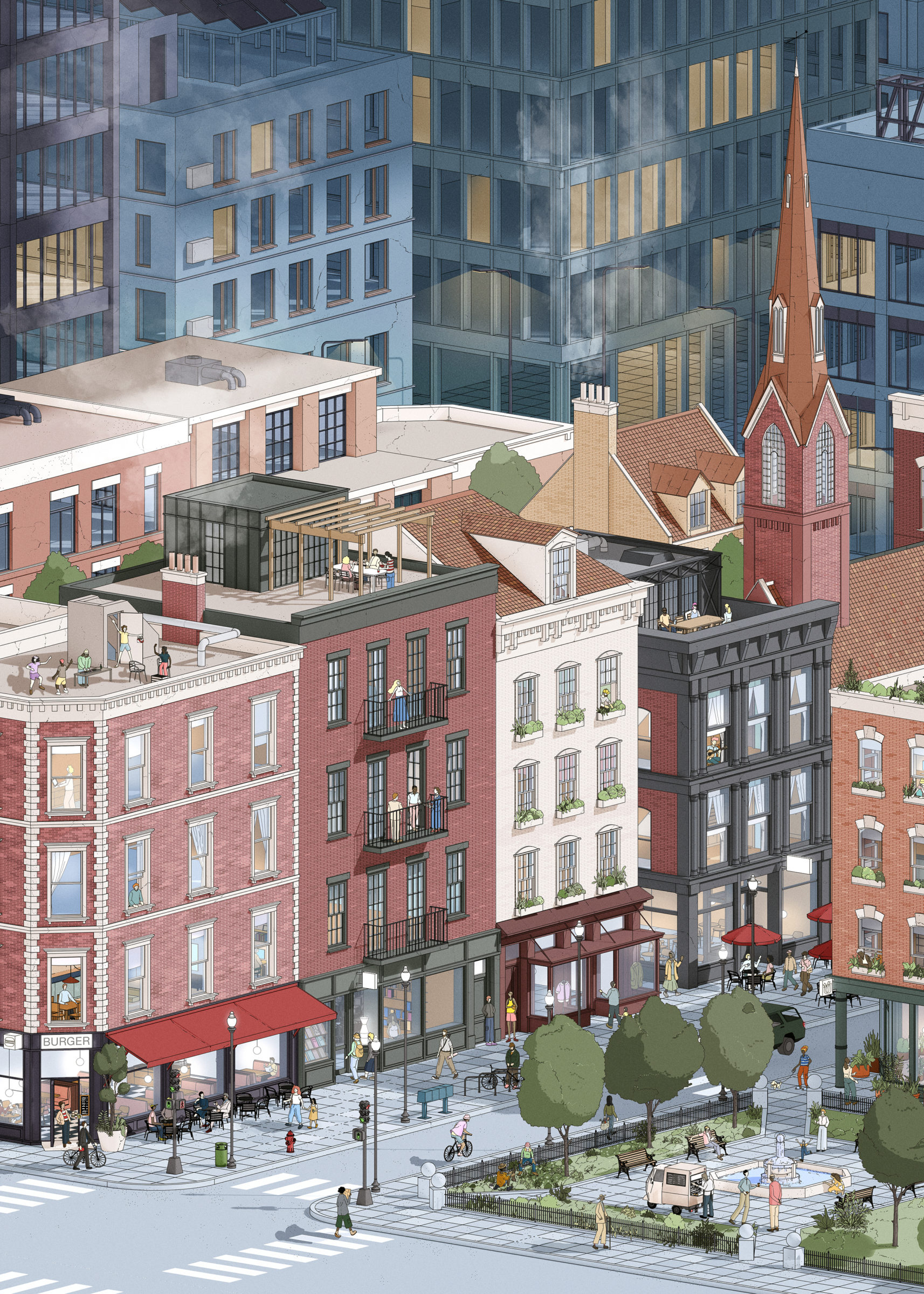
Much of life in 2020s America takes place nowhere in particular.
We are used to thinking about American life as divided between city and country. But actually, only a sliver of the population lives in real urban neighborhoods — neighborhoods that are dense enough to have multiple restaurants, shops, parks, and points of interest you can walk to, and have enough character to attract visitors and inspire civic pride. Yet at the same time, only about one in five people live in rural areas, amid the varied and often beautiful American countryside.

Instead, the majority reside in the suburbs or exurbs, places that are not physically noteworthy in one way or another but are rather some form of urban sprawl, with neither the amenities of a real town nor the access to nature of country living. Many American “neighborhoods” are not neighborhoods in a traditional sense. They are mainly places to commute in and out of.
As for the towns, most households are tied to them insofar as they are subject to their taxes and eligible to send their children to their schools — but not much more than that. Typically, people choose a town because it is within a reasonable drive of a job, and they could qualify for a mortgage on a house there.
The house itself may resemble the American ideal, with a yard and a white picket fence. But the broader subdevelopment looks like many elsewhere, whether New England, the Sun Belt, or the Pacific Northwest, and the members of the household will spend a lot of time driving to get anywhere. For their needs and entertainment, they will go to shopping centers with chain stores and restaurants similar to those all around the country.
Most Americans now live in “nowheresville,” as urban critic James Howard Kunstler has called this kind of nondescript place. But this wasn’t always the case. America’s built environment has evolved away from neighborhoods over the course of decades.
How did this happen?
Much of the public attention in explaining the rise of Nowheresville has focused on local land-use laws. In recent years, the movement known as New Urbanism has successfully elevated the criticism that it is too hard to build developments recognizable as neighborhoods because of zoning and building codes that essentially preclude any dense mix of residential, retail, and government buildings.
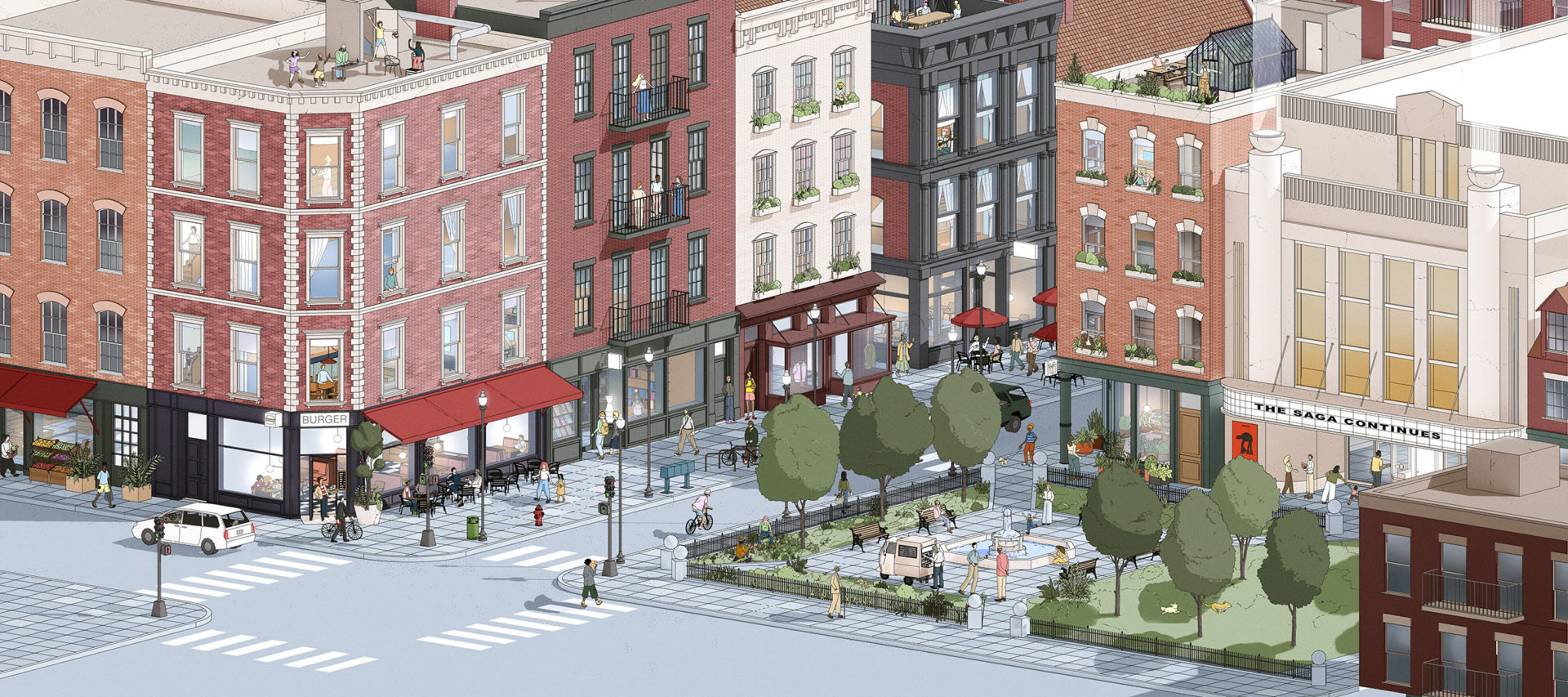
In 2022, a meme went viral featuring an image of a main street from the show Bob’s Burgers with the caption: “This kind of smart, walkable, mixed-use urbanism is illegal to build in many American cities.”
And it’s true — many towns would effectively ban, for instance, having apartments above a burger place by putting strict limits on residential units in the central business district. Or they might make this kind of apartment building infeasible by requiring it to have a certain amount of off-street parking, or a certain number of units set aside for low-income renters. It would likely be prohibited for the storefronts to come right up to the sidewalk, or for the bay windows to jut out.
Yet, as significant as those laws are, they are only half the story. The other half of the story — which has received much less public attention — is that the financial system makes it very hard to build traditional mixed-use neighborhoods. Rules promulgated by federal agencies and government-run corporations put mixed-use development at a disadvantage. So, too, do finance industry practices that have developed over decades in response to government regulations.
At the same time that it disadvantages traditional neighborhoods, the whole set of rules — the scaffolding of the financial system — makes it easy to fund the alternatives, the single-use projects, whether the strip mall, the hotel off the highway, or, above all, the single-family housing tract.
“If you change the financing structure to highly benefit single-use products, well, that’s what gets built. It’s enough to tip it over, just like that,” said Ward Davis in a video interview. Davis is founding partner of High Street Real Estate & Development, an Arkansas real estate company focused on traditional-style development.
Few realize the profound effects of financial rules on the built environment. That includes many in the industry — planners, bankers, developers, builders, and architects — whose routines, institutions, and practices have been shaped for generations by policies from Washington, D.C.
Another common idea among those who lament the rise of Nowheresville is that American developers are simply choosing not to build interesting or lovely neighborhoods anymore. But problems with finance, more than design, are the reason for this. There is actually no shortage of architects capable of designing the beautiful homes, stores, restaurants, churches, and other buildings that make up charming streets. But the legal and financial systems give preference to large developments separated by building type.
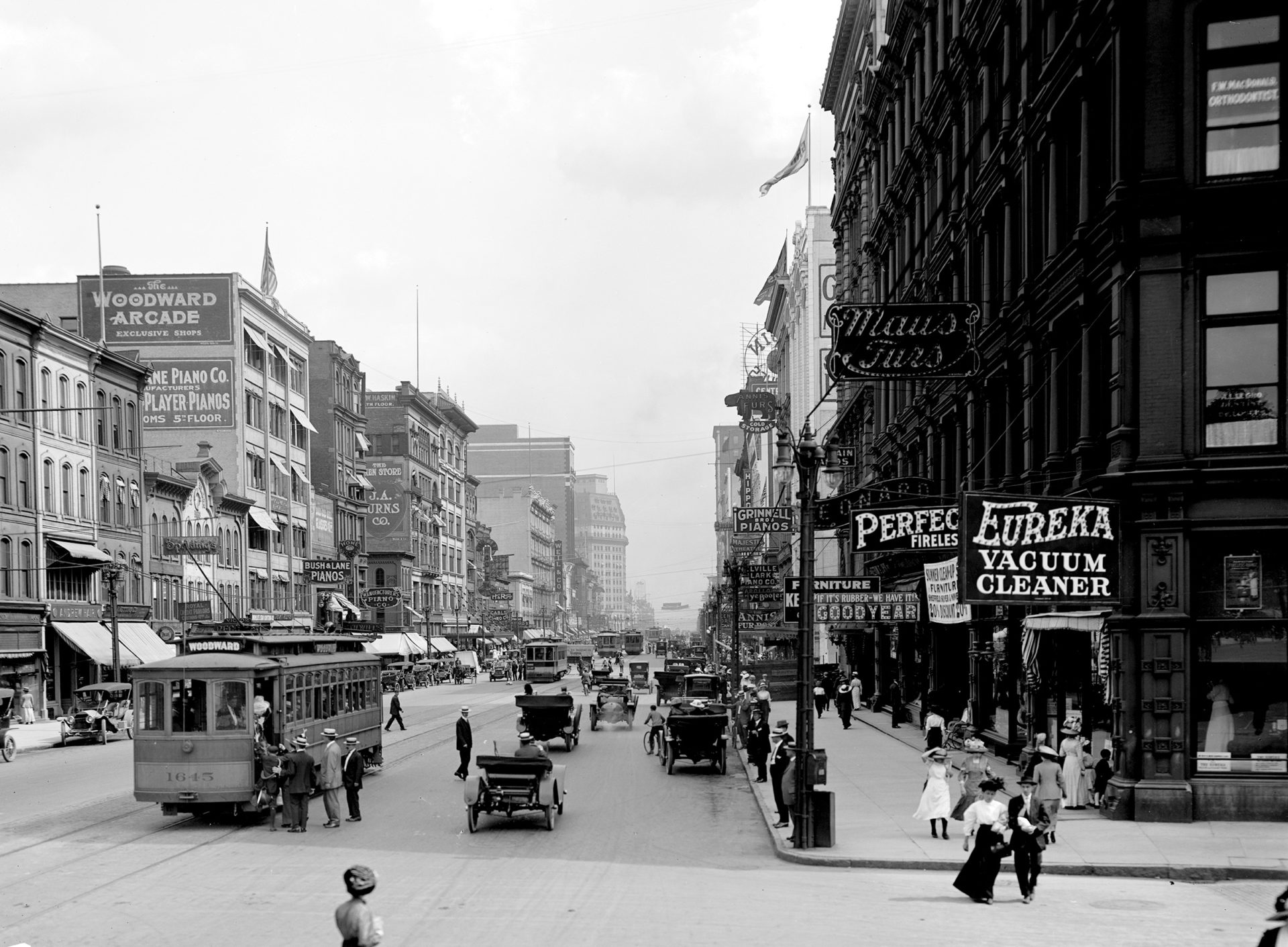
Real urban neighborhoods that feature a diversity of buildings on a scale small enough that they can be appreciated by people on foot still exist in the parts of the U.S. that were developed before the current systems were put in place, such as in Georgetown, D.C., or Charleston, South Carolina. They also can be found more readily in other countries with different rules and regulations.
“Experiencing smaller-scale buildings in places like Japan or places like Europe that are new buildings built with modern materials, but are much more interesting to walk past and provide a much richer pedestrian experience, shows that it’s not about architecture so much as it is about the scale at which we are building,” Payton Chung, a developer and land use expert, told me on the phone. “A lot of that does come down to things like finance or building codes that operate well under the radar even of professionals in the industry,” he said.
What’s needed is development that takes place lot-by-lot, not via massive projects. It requires development on a human scale, involving not just spread-out single-family homes or giant commercial towers. It means having main streets that have buildings with three to five stories, with a mix of uses.
But throughout the United States, mixed-use three-to-five-story buildings, even where they are legal to build, are very difficult to finance.
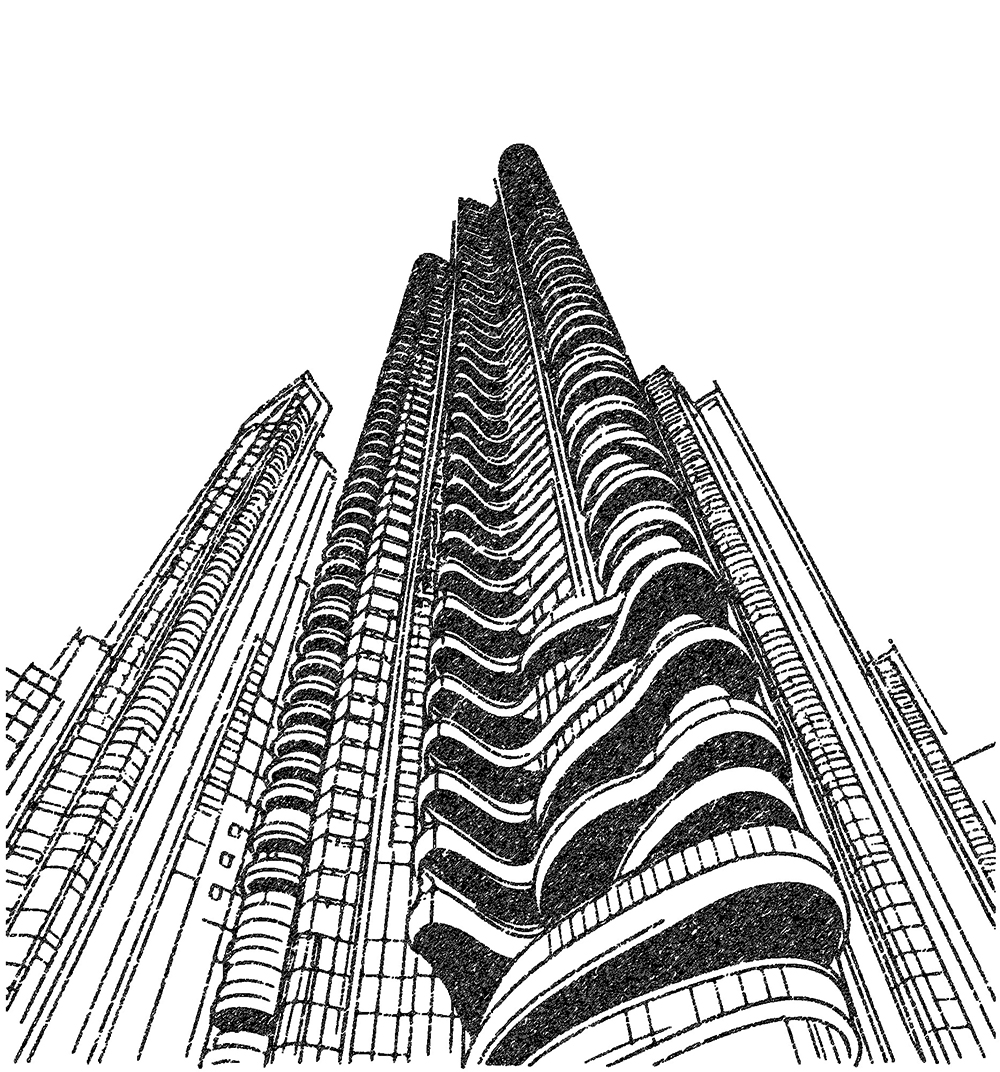
Let’s take a closer look at the sorts of buildings that are the hallmark of traditional neighborhoods: buildings with apartment units on the top floors and retail on the ground. Three to five stories is the size for a building that naturally fits a human scale, according to people who try to build what is often called traditional neighborhood development.
Neighborhoods built with a mix of three-to-five-story buildings can be dense enough to sustain a wide range of uses, such as stores, cafés, restaurants, churches, theaters, and much more. But they are also small enough that people can get around the neighborhood, and up to the top floors of the buildings, on foot.
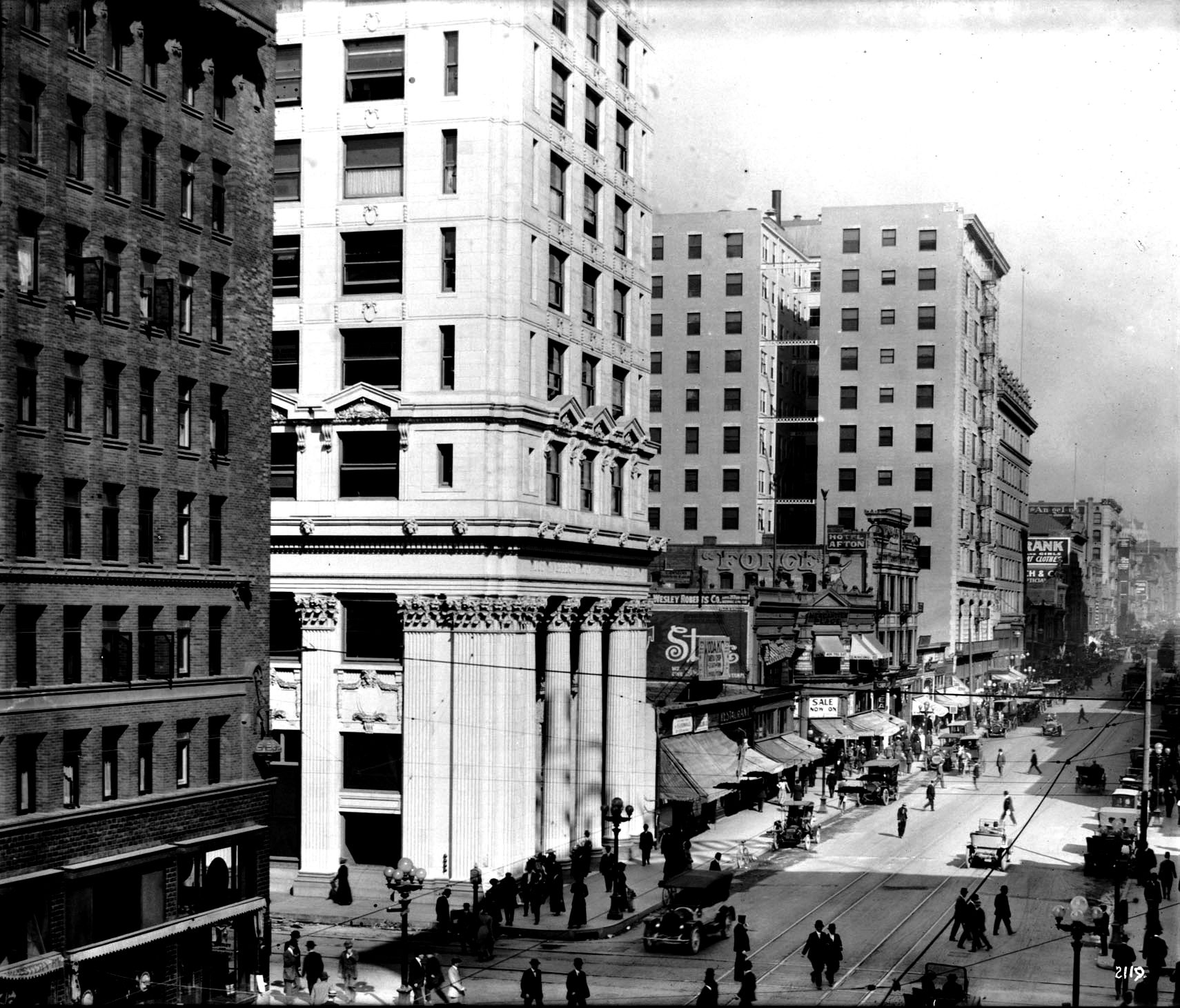
“A lot of America works really well at a three-story level,” said Ward Davis. So why are these mixed-use neighborhoods not being built?
Of course, it is difficult to build anything in many cities today. The U.S. is suffering a major housing shortage. Estimates vary, but the nation is short at least 1.5 million housing units and possibly up to 20 million. As a result, the U.S. housing market is like a water balloon: it’s under tension, and if you squeeze one side, it bulges out on the other.
The greatest pressure is in the closed-off coastal cities like Boston, New York, the Bay Area, and Los Angeles. There, local land-use laws block most projects. So when developers are permitted to build, they are obligated to build the biggest, tallest buildings the city will allow. The underlying pressure for housing is released upward.
The other release valve in recent years has been areas outside of cities in parts of the country where there is still abundant space, such as in the Sunbelt and in Texas. There, the pressure for more housing has resulted in a rapid expansion out more so than up.
In the Dallas–Fort Worth metroplex, for example, one of the fastest-growing metro areas in the country, housing is being added at a tremendous clip. There, where housing is built at the margin, the difficulties with financing mean that many of the most desired kinds of places — mixed-use three-to-five-story buildings — don’t get built at all. Instead, developers opt for single-use tracts.
Single-family home construction in the suburbs has provided a decent life for hundreds of thousands of families in recent years. There’s no doubt that it’s much better than nothing. But it’s worth exploring why, despite pent-up housing demand across the country, traditional neighborhoods are the hardest to finance.

In an unassuming office building just a few blocks from the U.S. Capitol in Washington, D.C., is a nonprofit organization called the International Code Council. Although the vast majority of Americans will never hear about it, the ICC exerts tremendous influence on their lives by publishing codes that shape the buildings they work and live in.
Neither the ICC nor the federal government has the power to force cities to use its codes. But over the years, all fifty states and countless jurisdictions have adopted them in some form.

For mixed-use properties, the relevant code is the International Building Code, or IBC. It provides standards for almost every aspect of a building: its size and dimensions, materials, safety features, plumbing, inspections, and much more.
Builders of detached single-family homes generally don’t have to worry about the IBC: residential structures are subject to different, much less prescriptive, residential codes, as long as they are no more than three stories tall. But buildings become subject to the IBC when they have three or more separate dwelling units, or four or more stories.
Thus, developers who opt against a single-family home and for a mixed-use building are likely going to have to contend with a set of onerous IBC rules. For example, they would face much more stringent fire sprinkler requirements and would have to include fire escapes.
Perhaps most importantly, codes generally require that buildings more than three stories high have at least two separate stairwells that can be accessed from each floor. Staircase requirements are a prime example of regulations that have unintended consequences. As with much of the code, extra staircase requirements are a fire safety measure, on the theory that egress would still be possible if one stairway were filled with smoke, although that logic has been questioned.

The requirements have had far-reaching consequences for the look of American cities. They are largely the reason the U.S. does not have European-style “point access block” apartments, which feature a layout of units wrapped around a single stairway, perhaps with an elevator shaft.
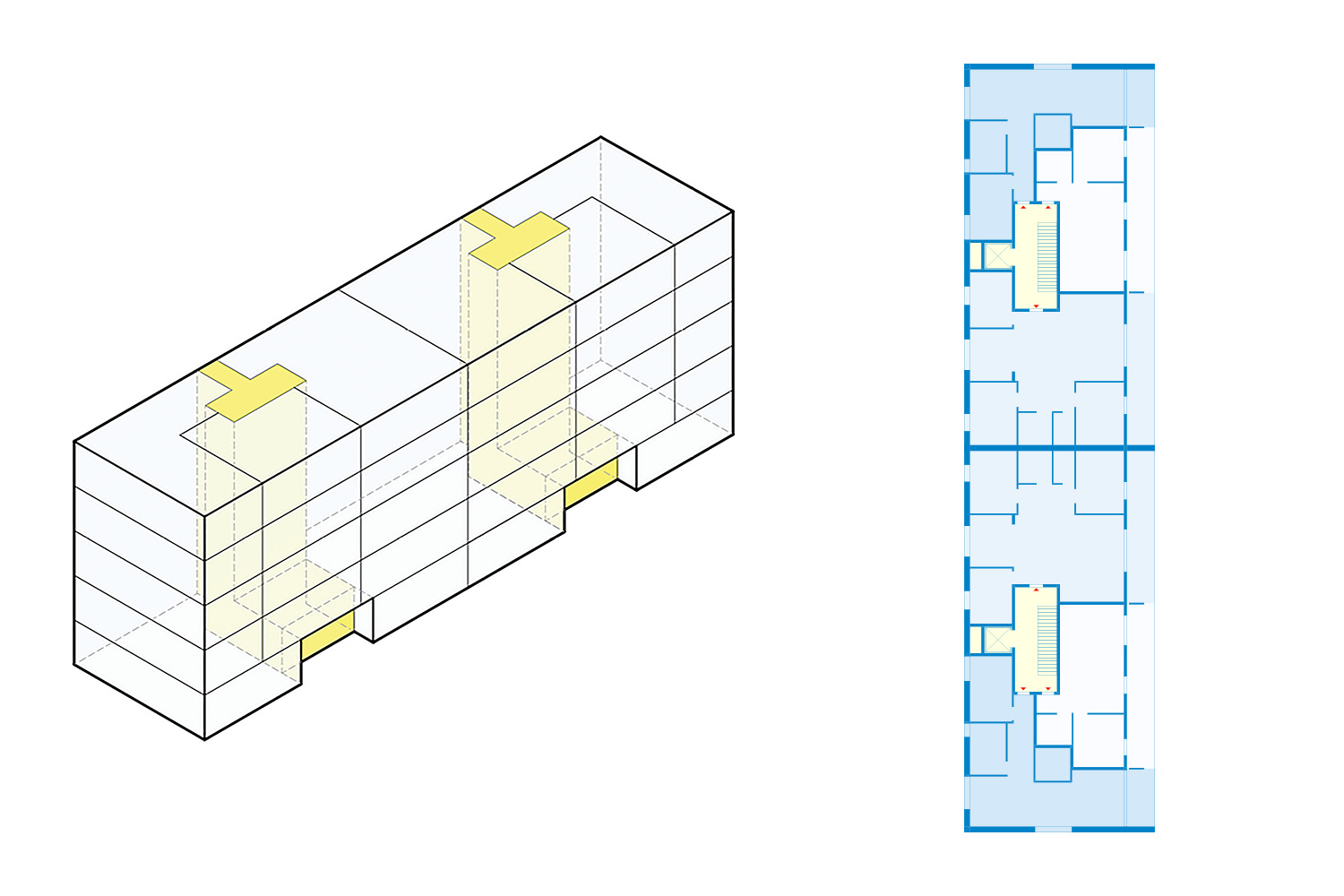
Instead, the requirement to have multiple stairways often forces a specific design choice, namely to have a longer corridor with stairways at both ends and units on both sides of the hallway. Those units, which thus will have windows on only one side, are much more likely to be studios or one-bedrooms, or to feature windowless “dens.” It’s worth noting, too, that the small elevators characteristic of modest-sized apartment buildings in cities like Paris are not a possibility in the U.S., thanks to federal accessibility laws that set onerous size and maintenance requirements.
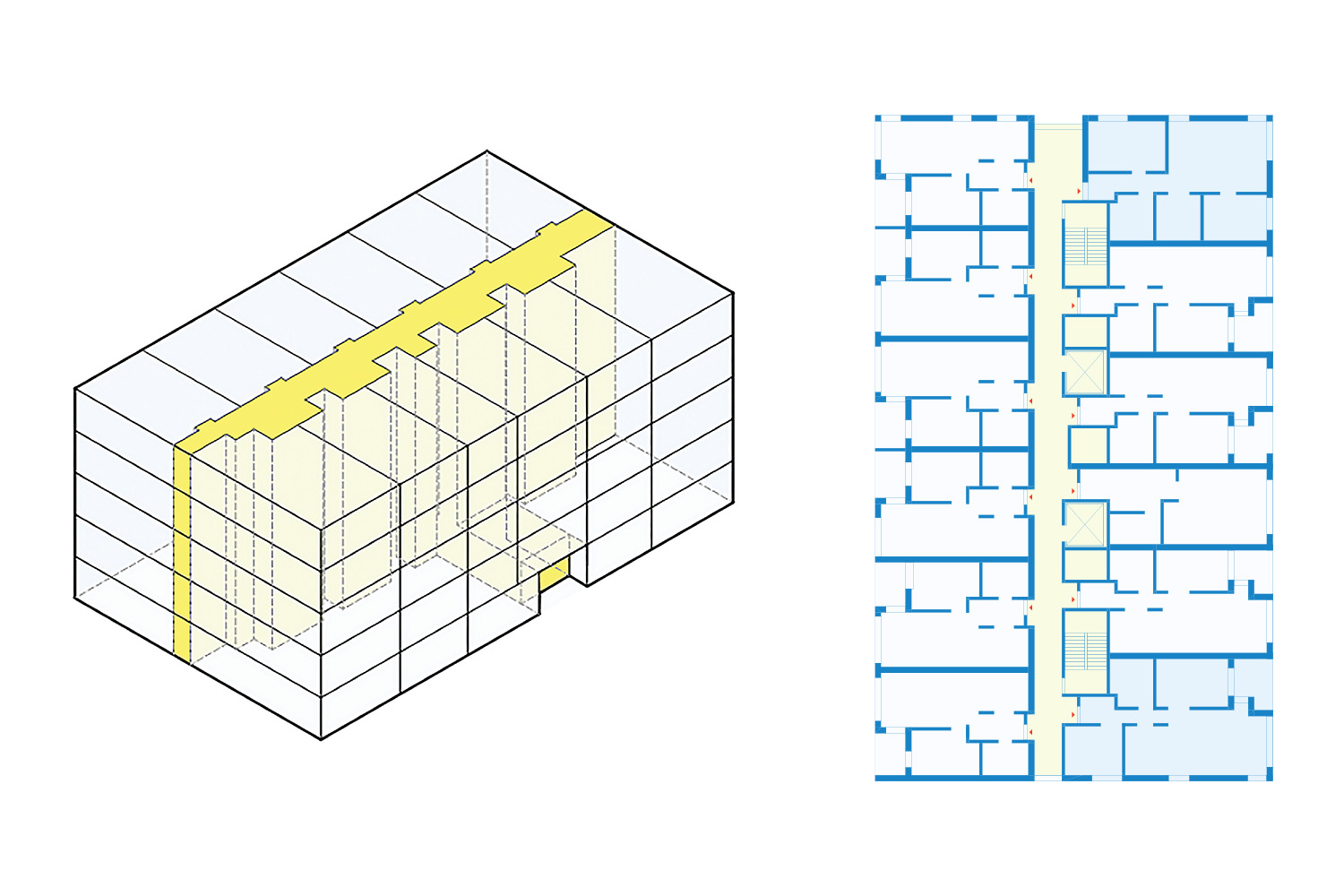
This set of rules alone goes a long way toward explaining why so many of the multifamily developments that are built today in U.S. cities tend to look like big squares that are slightly too large for the streets they’re on — and seem uninspiring to the people who live in them and walk by them every day.
The rules also make Main Street–sized buildings hard to finance. They place “much greater burdens on a slightly larger building,” the developer Payton Chung told me in a phone interview, “and make it much more difficult to make a profit to even have that building pay for itself.”
Adding features, such as two stairwells, entails a major step up in costs when going from a three-story to a four-story building. Not only do they mean forgoing some income-producing units and spending more on materials, but they also necessitate much more of what developers call “soft costs,” meaning the costs associated with consultants, inspectors, and all the other services involved in getting approvals for construction.
All these requirements “favor the bigger stuff because they can spread the cost over more units,” said Bret Jones, a lawyer in central Florida who specializes in land-use law, by phone. In that way, it can be easier to pencil out a project that has 10 units or 50 units than one with four. In other words, the requirements favor projects that can be financed and built at an industrial scale, rather than at human scale.
That is no accident. Providing for economies of scale was a reason for the promotion of building codes in the 1920s, a stated goal of then–Commerce Secretary Herbert Hoover when his agency promoted codes across the country. It was hoped from the beginning that codes would allow large builders to produce housing at a massive scale without having to worry about the unique requirements of each town.
But to the same extent that they facilitate massive scale for builders, such codes make it harder to finance buildings just above three stories tall.
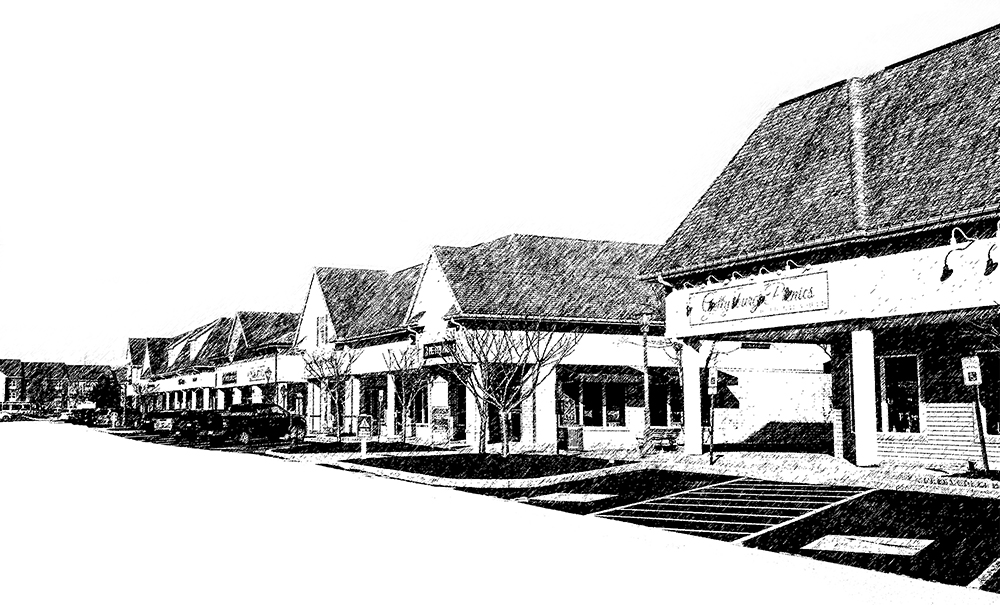
A number of developers interviewed for this article said they struggle to obtain financing for mixed-use developments because of requirements imposed by government agencies on loans.
Bret Jones, the land-use lawyer in Florida, said that he brought a proposal for a $5 million loan to build an infill town center — that is, a new development in an already built area — that would be structured like a traditional neighborhood. He was rejected. The bank said that the loan was too small to be of interest.
Jones explained that if instead he had proposed building 35 to 40 single-family homes on the 10-acre property, the financing would have been available. The properties could have been set up to be eligible for home loans insured by the Federal Housing Administration (FHA) or other government agencies. Or the loans could have been made by banks and then sold to the government-sponsored enterprises Fannie Mae and Freddie Mac.
But, Jones recalled his banker telling him, “because you don’t want to do all this regulatory stuff and you just want to do something old-fashioned and small and nuanced and appropriate to the area, I can’t fit it into one of my traditional financing boxes.”
Developers who favor more traditional neighborhoods argue that such projects are not inherently less profitable. When they are able to get them financed, they say, they have provided strong returns for investors. The problem is getting funding in the first place.
Take the town center concept as an example. A traditional town center involves a mix of uses right next to or on top of each other: apartments above restaurants, pizzerias next to shops, and hotels next to condominiums. But mixing uses makes it harder to access lending assistance offered by the federal government — which makes it harder to build.
That’s true when it comes to federal programs, such as those administered by the FHA, the Department of Housing and Urban Development (HUD), or the Small Business Administration. It’s also true of programs that provide support for investment in housing, such as through the Low-Income Housing Tax Credit.
Perhaps even more important, though, are the restrictions imposed by Fannie Mae and Freddie Mac. Fannie and Freddie, which have been wards of the federal government since 2008, exert indirect but tremendous influence over the entire housing market. They do not make loans, so most people do not come into direct contact with them. Instead, they buy loans from original lenders on what is called the secondary mortgage market, package them into securities, and sell those securities to investors, with a guarantee in case they go bad.
Loans backed by government-sponsored enterprises, chiefly Fannie and Freddie, have come to account for about two-thirds of the roughly $15 trillion in outstanding single-family mortgages. For multifamily mortgages, they account for a half.
Fannie and Freddie are distinctly American institutions, with few parallels in other countries. The advantage of the secondary market they sustain is that it boosts liquidity, meaning more people can get loans. The disadvantage is that Fannie and Freddie wield massive influence over what gets built and how. When lenders go to originate a loan, they are very often thinking about whether it will be eligible for purchase by Fannie and Freddie. Whatever terms Fannie and Freddie impose on them they are likely to accept.
In this way, housing choices are subtly but decisively shaped by forces unseen by the end users. When a family relocates to a new city and finds that a 2,500-square-foot house in a suburban subdivision looks like the best option, they won’t know the unit was built by a developer who anticipated that the loan for the house would eventually be bought by Fannie or Freddie. Nor would they realize that the options for apartment rentals were guided in significant part by what terms the government was imposing on the developers.
The “real hurdle” facing developers, said John Anderson, a developer focused on traditional neighborhood design, is bank underwriters who review deals offered by loan officers. They are always looking at whether there is “some way we could make this loan in such a way that it could go to Wall Street,” he said.
All the lending programs offered by the federal government, at least up until very recently, limited the amount of commercial construction included in any project. Mortgage insurance offered by HUD, for example, comes with the stipulation that no more than 25 percent of the rentable space in the project can be accounted for by commercial uses.
Fannie and Freddie for decades set similar caps, of 20 or 25 percent, on the space in a project that could be allotted to commercial uses, or the income that could come from commercial renters.
Why would these giants of the mortgage market place limits on commercial activity? Because they were chartered to help promote homeownership, with their origins in the foreclosure crises of the Great Depression. Congress, accordingly, wrote a focus on housing into their charters — although, as I have previously reported in these pages, they in fact do not boost homeownership effectively, if at all.
But the traditional limits of around 25 percent meant that, oftentimes, the sorts of buildings that populate traditional neighborhoods would not be financeable. A three-story building that featured a ground floor of retail with two floors of apartments above it would have run afoul of the lending rules in most years, as it would be 33 percent commercial by space and possibly more than that in terms of income.
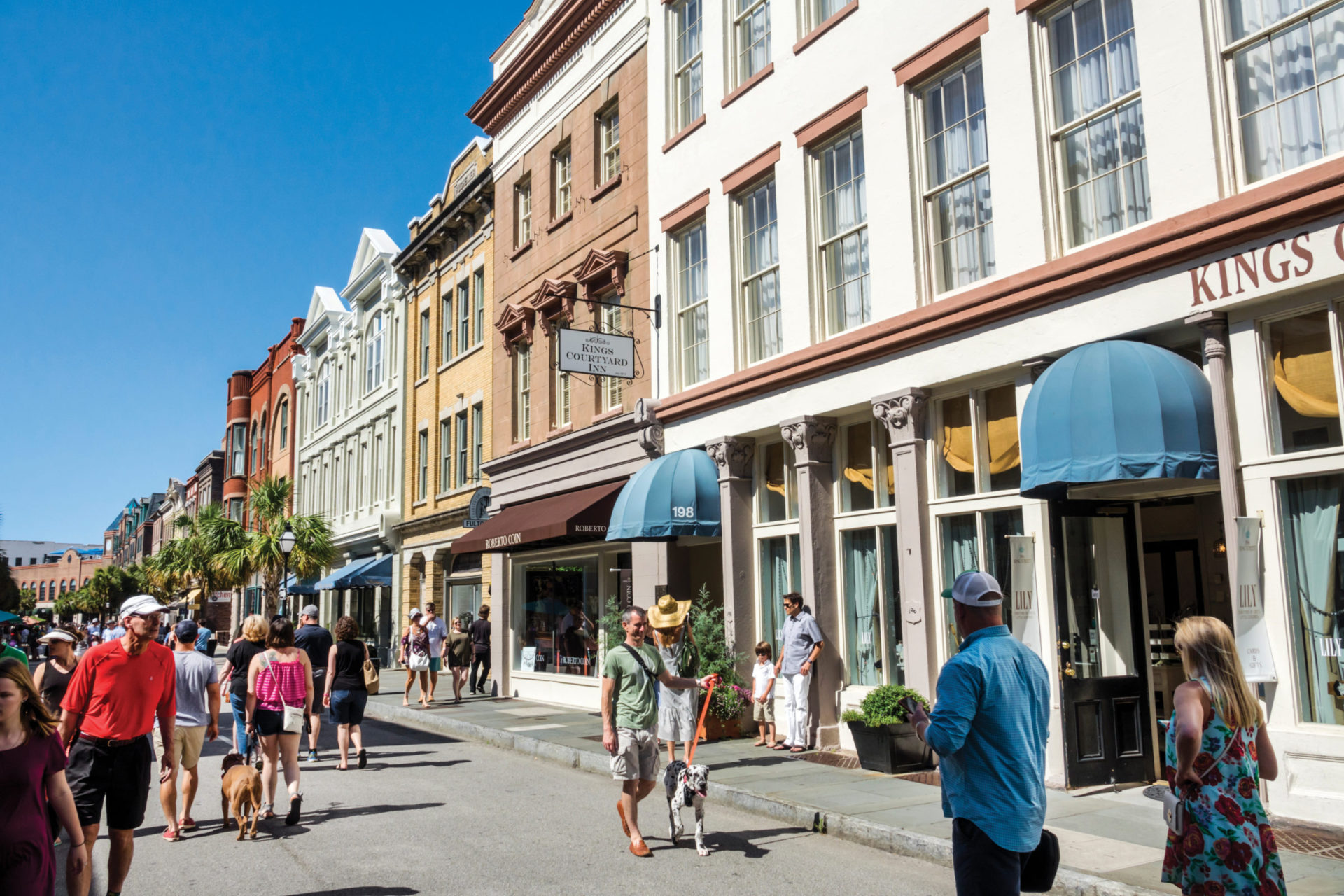
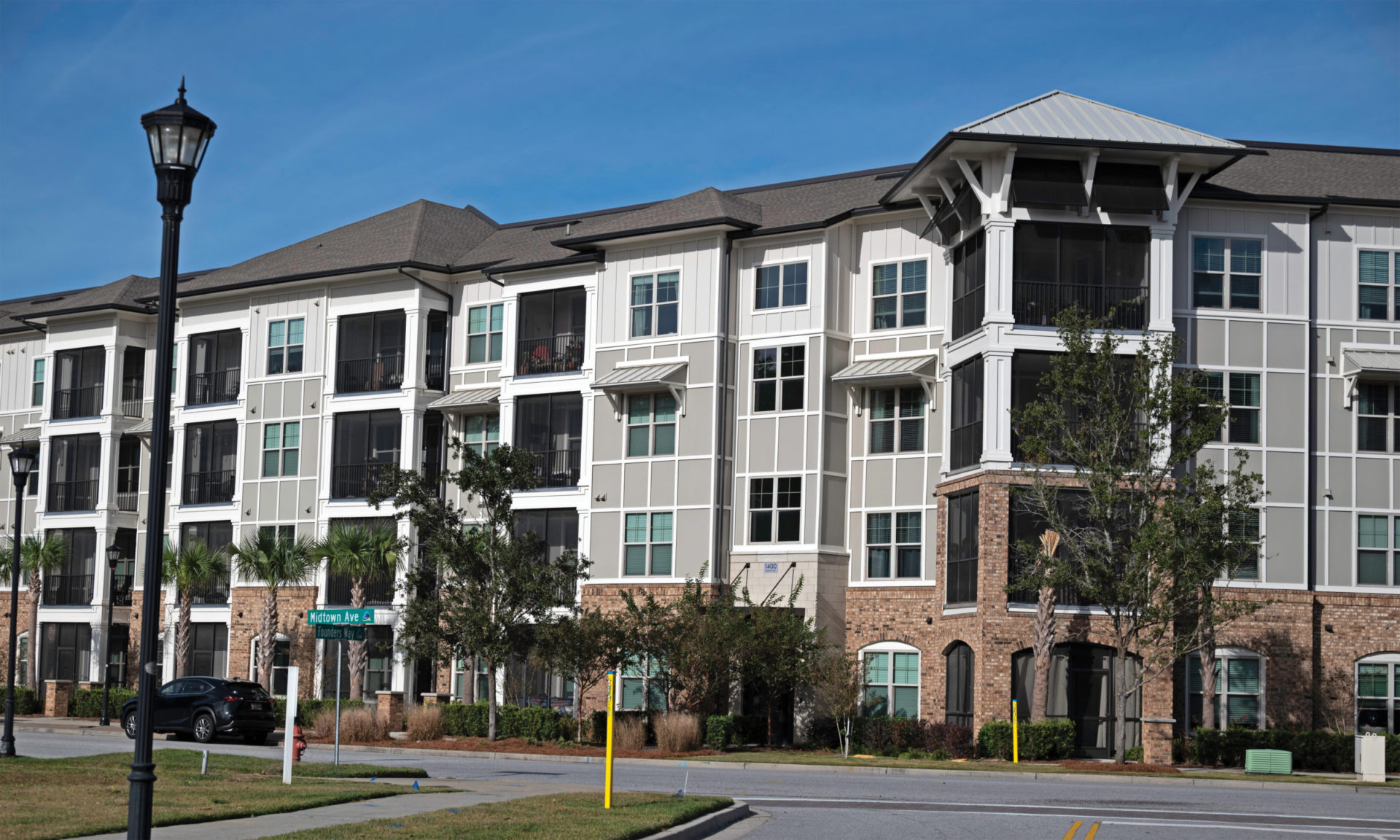
So, for example, the apartments above retail on historic King Street in Charleston — a destination for bachelorette parties and Instagram influencers — is the kind of arrangement that would have struggled to get financing over the past several decades. The giant apartment building off Route 17 outside of the city, however, accessible only by car and not within walking distance of anything, could get financed.
“When you have a formulaic financing approach, you get formulaic assets financed by that approach,” Ward Davis of High Street Real Estate & Development said by email.
Some developers I spoke to said that Fannie and Freddie have heard the criticism. An online guide from Fannie Mae shows that its current restriction is that commercial space is capped at 35 percent, which is just enough to allow financing for a three-story building with one floor of commercial space. Freddie Mac’s current guidebook says only that the percentage must be acceptable to them. Neither company provided a response to requests for clarification.
Notably, none of the developers I spoke to knew what the current rules were for either company.
Payton Chung compared the secondary mortgage market to the market for apples. Apples that fit a certain profile, whether they are Red Delicious, Gala, or Granny Smith, can be sold by the orchard to Albertsons or Costco, and from there to the consumer. Apples that don’t quite fit the mold, because they are misshapen or have blemishes, can maybe be sold in a niche market, like at the farmer’s market or for cider. But because they cannot be sold to the massive distributors, there will be less demand for them. From the perspective of financial markets, he said, smaller mixed-used buildings are like those imperfect apples.

Over the decades, as local land-use rules have grown to disfavor building traditional neighborhoods, so too have banking practices.
The role of a banker is fundamentally to understand and quantify the risks of a loan. Bankers learn the risk profiles of different projects through experience. And, for generations now, they have gotten much more experience with single-use projects.
Just like developers, bankers have grown acclimated to a separation of uses in real estate since 1926. That was the year the Supreme Court issued a decision in the case Euclid v. Ambler, upholding zoning as a valid exercise of states’ power. The zoning ordinance in question divided up the Cleveland suburb of Euclid, Ohio, according to use, effectively preventing industrial and commercial uses in residential neighborhoods.
It was also the year that the Hoover-led Commerce Department published a revised Standard Zoning Enabling Act, which states could use to authorize zoning in their cities and towns. Between the court case and the federal government’s encouragement, most of the country would have zoning in just a matter of years.
American Euclidean zoning entails the separation of uses. It is the child of a marriage of convenience between two separate interests that favored splitting residential housing from other types of buildings, each for their own reasons.
The first interest was a group of urban theorists and progressive reformers who favored the development, or redevelopment, of cities to be divided among uses — residential, commercial, industrial, and agricultural — as a means to promote order and health.
The second was business interests who sought tools to exclude competition by immigrant or ethnic rivals in the crowded urban markets of the early 1900s. For instance, some of the first zoning laws were enacted in California to limit Chinese laundries from white neighborhoods. The landmark 1916 New York City Zoning Resolution was passed at the behest of Fifth Avenue merchants, who wanted building height requirements to stop the encroachment of garment factories. In other words, the prohibitions on uses such as laundries were really backdoor restrictions on specific people.
Herbert Hoover favored zoning and building codes in part because of the chaos he saw in cities like New York, bursting with migrants living in substandard housing. He was also interested in facilitating large-scale development through rules that provided consistency and predictability to builders.
A similar motivation lay behind the federal government’s interventions into the banking system in the Depression years. Facing both mass foreclosures and fears about housing affordability, Uncle Sam would implement major new laws meant to prop up homeowners and to allow lenders to make mortgages available at a mass scale.
The measures were well-intentioned. But they would have the unintended consequence of creating standardized loan products that favor specific patterns of development. The single-family suburban home, in particular, became a sort of government-approved product.

For decades prior to the Depression, regulations had banned federally chartered banks from making residential mortgages, on the grounds that they were uniquely risky and hard to monitor. The housing finance system was relatively meager, characterized by building and loan associations — the kind of mutual-support financial institution featured most memorably in It’s a Wonderful Life. A smaller role was played by savings banks, or thrifts.
As a reaction to the mass foreclosures of the Depression, though, the federal government rapidly set up major programs to backstop mortgages. Those included bills signed by Hoover, as president, and by Franklin Roosevelt and Harry Truman to provide direct and indirect lending programs, including, eventually, through the FHA and Fannie Mae. By the 1950s, the federal government would be dominant in housing finance. In the postwar years, the FHA alone insured up to 70 percent of the multifamily market. Government agencies combined to insure more than 40 percent of all residential real estate loans throughout much of the ‘50s and early ‘60s, and as much as half in the immediate postwar years.
The years after World War II saw the creation of entire suburbs created to be sold to buyers using loans insured by the FHA or the Veterans Affairs administration, which got into the business on a mass scale thanks to the GI Bill. For example, the entrepreneur Frank Sharp planned the community Sharpstown outside Houston to be the world’s largest residential development, featuring single-family houses on curved streets, accessible by car. Launched in 1955, it was planned to have 25,000 houses available for sale via FHA and VA mortgages.
This was a financial product offered at an industrial scale that would have been impossible if not for the scaffolding created by the federal government to allow lenders to offer insured 30-year fixed-rate mortgages.
In the years to come, bankers would specialize in this kind of product and in other single-use products, David Horwath, the president of Land Innovations, a development company focused on creating town-based communities, told me by email.
“For nearly 70 years, banks have become highly effective at establishing risk profiles for single-purpose real estate, subdivisions, strip retail, hospitality, apartment complexes, etc.,” he wrote. “Euclidian-based zoning has reinforced that model, creating a feedback loop that favors predictable, siloed forms of development.”
Take, for example, a single-use development in the Dallas–Fort Worth metroplex, where homebuilders can sell as fast as they can get the houses built.
A project in Wylie, Texas, for instance, less than 30 miles northeast of downtown Dallas, might involve a developer getting an approval for an entire subdivision at once. Then, a homebuilder can buy individual lots and advertise that the homes are large and comfortable, in a good school district, and “just minutes” away by car from a range of attractions.
Crucially, the homebuilder can even set up his own mortgage company to originate loans for homebuyers, connecting them to government-backed loans. That’s the ultimate specialization: a lender that does nothing but originate loans for purchase from a single-family housing builder, to be sold to government agencies.
In other words, the government has made it extremely easy and efficient to lend to single-family housing developments.
“Banks are much more comfortable with these sort of homogeneous products of a bunch of houses all of the same type,” Emily Talen, a researcher at the University of Chicago, said in a phone interview.
Talen conducted a survey of developers who would like to build mixed-use projects, and found that they overwhelmingly say they encounter significant trouble getting financing because of financial regulations, a lack of knowledge among lenders, and the rules imposed by government-sponsored enterprises like Fannie Mae and Freddie Mac.
Put it this way: from a purely material perspective, a commercial development might not be so different from a residential one. Both will have four walls and a roof, be made out of some combination of concrete, metal, and wood, and have electricity, plumbing, and heating and air conditioning.
From the perspective of the government, though, they are different products. And they are treated differently by a number of financial rules.
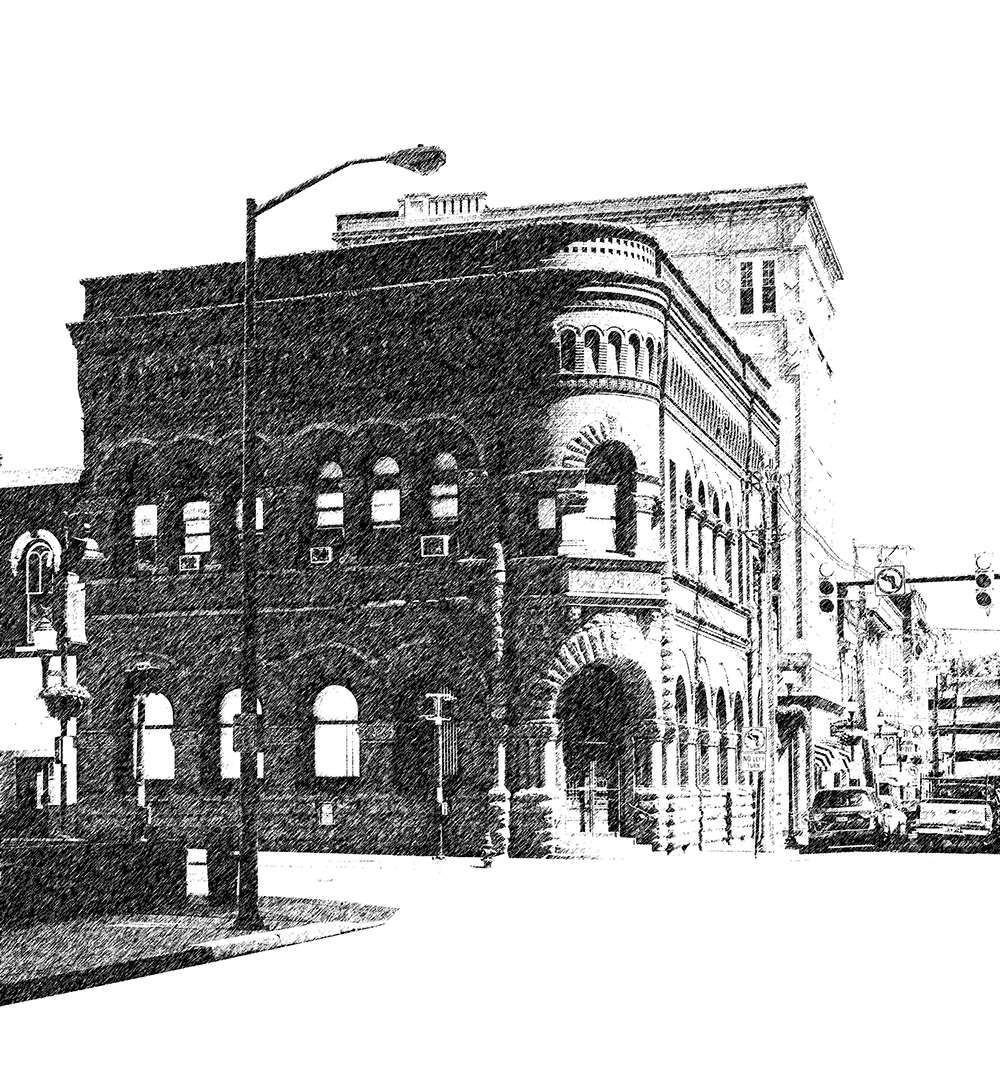
From the perspective of a banker, the developer John Anderson said by email, “selling a loan to this weird mixed-use stuff means we can’t sell a loan to someone developing the single use projects we are quite comfortable with.”
Why are bankers more comfortable with single-use projects?
One reason is that capital requirements limit banks from taking on too much debt. Modern capital requirements, implemented by the Federal Reserve, Federal Deposit Insurance Corporation, and Office of the Comptroller of the Currency in Washington, vary by loan type, essentially discouraging bankers from issuing too many loans viewed by regulators as riskier.
Under the post-2008-crisis rules, residential mortgages are favored. They are generally treated as about half as risky as a typical, well-performing business loan. Commercial real estate, however, is treated as just as risky as a business loan, or riskier. And some categories of commercial real estate are counted as 50 percent riskier.
These rules amount to a thumb on the scale against projects that are multifamily or mixed-use. It’s not that such loans are banned. Instead, it’s that a banker might think twice about extending a commercial loan at the margin.
The same is true of regulatory guidance, put out by the banking agencies during the housing bubble and financial crisis, that was meant to protect banks from a collapse in commercial real estate. Because banks are more likely to keep commercial loans on their own books — as opposed to residential loans, which are often sold on to Fannie or Freddie — federal supervisors worried that a downturn in commercial real estate would cause banks to blow up. This regulatory consideration, too, is a form of nudge on bankers to specialize in single-use products.
Altogether, these considerations mean that the single-family housing development is simply a much easier product for the financial system to handle. And, as a result, so too are single-use retail and other commercial products.
“With mixed-use it gets a little tougher, because … you’ve got really two different types of properties you’re looking at in the same project,” said Brian Gehres, chief credit officer at Richwood Bank in Ohio, in an interview. To handle a mixed-use project, he said, banks will rely on more detailed appraisals, which require more work.
Putting it all together, the rules and regulations that have accumulated over the past century have made conforming to the norms established by Washington a major consideration for lenders and thus developers. In contrast, the most beautiful and unique neighborhoods in the country were built when none of that was a factor.
Traditionally — before the Great Depression financial reforms — a development might have been sited near a river ford or a railroad crossing, and the residential, commercial, and industrial buildings would naturally be in the same place.
Today’s off-highway retail strip, on the other hand, is “developed as a package deal,” Bret Jones told me. “You can go to a commercial banker that needs to hit his or her annual goal, and they’re several million dollars short, $10 million short of their $80 million goal, and so they will help you, your lender, the loan officer will help you underwrite that, so you can then present it back to him or her so they can present it to the loan committee to get it financed,” he said.
“It’s like the finance drives the supply, and the demand will come later,” he added.
In theory, community banks are well positioned to avoid this problem. A smaller bank that focuses on one town or city and engages in relationship-based lending likely has expertise in local zoning laws, permitting processes, business trends, and much more that allow it to take on more complicated projects.
Mixed-use developers should be “looking for a bank that is a jack of all trades, so they have the flexibility to understand residential and commercial, they have the creativity to see how those can fit together,” said Jill Castilla, the CEO of Citizens Bank of Edmond in Oklahoma, which has financed mixed-use projects. While other banks have niches, she said, community bankers are more likely to understand all the business sectors in a city, and to help developers navigate the landscape.
But the trend for years in the banking industry has been toward consolidation and away from community banks.
The rise in concentration has been pronounced. Since the 1980s, the number of banks with less than $10 billion in assets has fallen from more than 17,000 to around 4,200. The share of total bank assets held by those banks fell from about 70 percent to 14, according to FDIC data.
The reasons for bank consolidation are hotly contested. Conservatives generally blame added regulations for strangling smaller banks with compliance costs. Liberals instead fault waves of deregulation that have made it easier to create megabanks via mergers and takeovers. Whatever the cause, the ongoing consolidation in banks has made it more difficult for developers to find willing partners for projects that require more local knowledge.
It’s not impossible. Developers with a record of success, or that are in markets that already have mixed-use developments or are booming economically, might find it easier to get mixed-use projects approved. The problem, they said, is for developers to get their foot in the door.
“Once a borrower has established a track record with the local community banks, the underwriting process gets easier for both parties, but the first couple projects by a small developer are always underwritten more conservatively,” Anderson wrote.
The architect Louis Sullivan, a mentor to Frank Lloyd Wright, is credited with coining the term “form follows function.” The phrase was interpreted as meaning that the use of a building, place, or object should inspire its design, as for instance the Guggenheim art museum’s spiral layout guides visitors on a continuous ascent. The museum is credited with inspiring generations of modernist architects.
In reality, though, form doesn’t follow function. Form follows finance, in the phrasing used by John Anderson, the small-scale developer.
The forces that favor cookie-cutter, mass-produced, uninteresting buildings and neighborhoods in the United States are often not poor design or simple neglect. Instead, they are more likely to be arcane financial rules and building codes put in place long ago that were never intended to shape how towns look or what daily life in them looks like. The isolation and ugliness of American life that so many lament today comes in no small part from the failure to think these innocent-seeming rules through.
The essay series “The Lonely Neighborhood” is supported by grants from Fieldstead and Company and from the National Endowment for the Humanities. Any views, findings, conclusions, or recommendations expressed in this series do not necessarily represent those of the National Endowment for the Humanities.
Exhausted by science and tech debates that go nowhere?