The Tyranny of Now
There’s no time like the present to revisit the warning of forgotten media theorist Harold Innis: “Enormous improvements in communication have made understanding more difficult.”
During a January speech at the World Economic Forum’s annual meeting in Davos, Switzerland, Donald Trump called Greenland “Iceland” several times. The flubs were hardly surprising for an elderly, jetlagged man who likes to go off-teleprompter. More surprising was his administration’s immediate denial that he had said anything wrong. “No he didn’t,” press secretary Karoline Leavitt replied to a reporter who pointed out the president’s mix-up on social media. “You’re the only one mixing anything up here.”
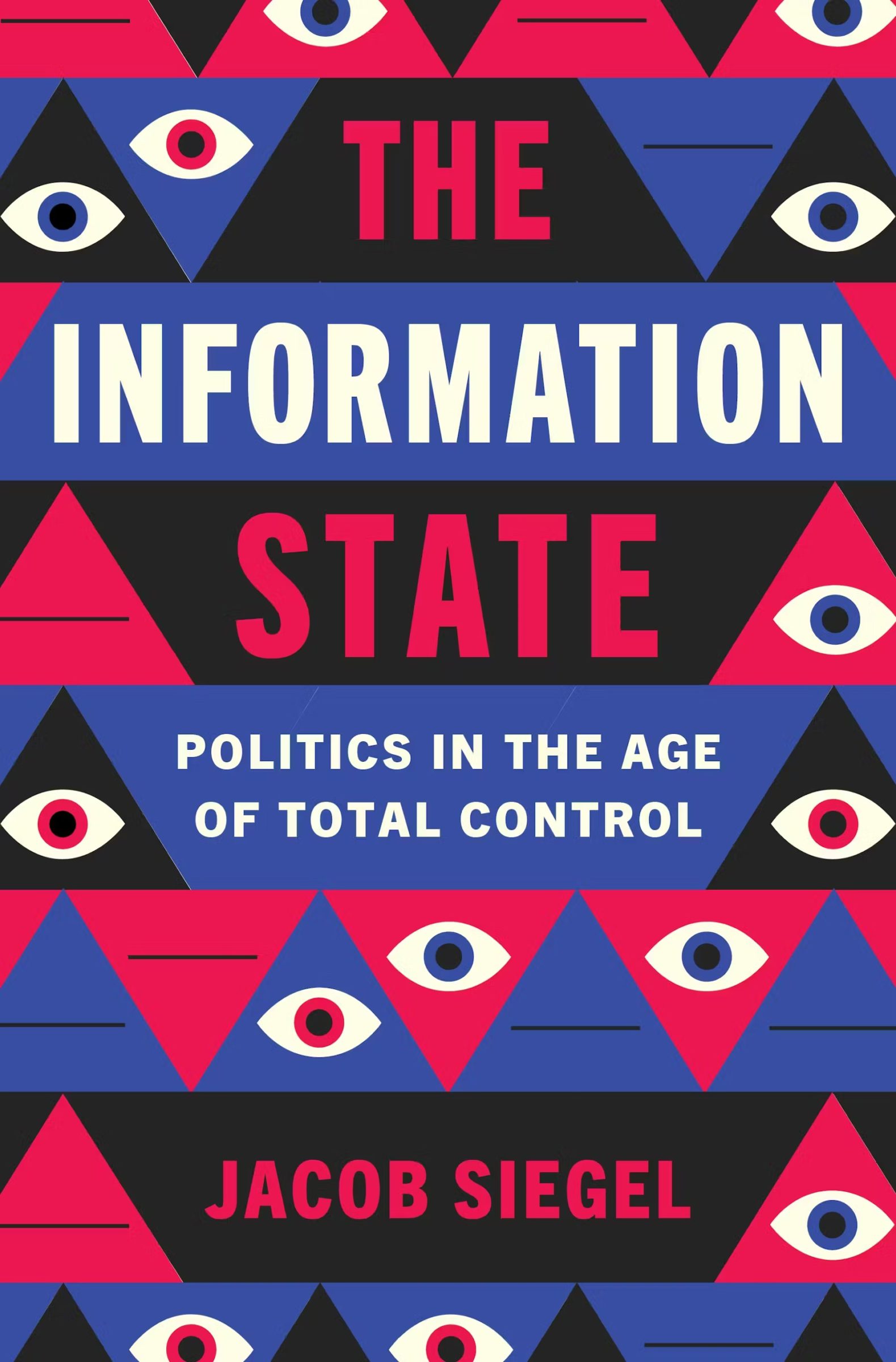
What Leavitt did brazenly — deploy governmental authority in an attempt to gaslight the public — has been going on covertly in Washington for a long time. In The Information State, Jacob Siegel offers an expansive new history of governmental subterfuge. Building on ambitious earlier works like Jacques Ellul’s The Technological Society (1954) and James Beniger’s The Control Revolution (1986), Siegel’s account is as much about technology as politics. As systems of communication and computing have advanced over the last century, politicians, bureaucrats, and spies have deployed the tools in ever more elaborate schemes to monitor citizens, control the information they see, and shape their views. Recent administrations’ use of the Internet and social media to track people’s words and filter their messages may mark an expansion in thought control, but it builds on a well-established foundation.
For Siegel, a journalist and editor at Tablet, the story begins more than a hundred years ago, in 1917, when America entered World War I. To support the war effort, President Woodrow Wilson created a propaganda ministry, called the Committee on Public Information, that ran a massive, multifaceted media campaign to, as we would say today, control the narrative. Mobilizing journalists, artists, photographers, filmmakers, and tens of thousands of volunteer speakers, the CPI relentlessly promoted Wilson’s view of the war as essential to defending democracy. It also worked to curb dissent, both in the press and among the general public. One of its ubiquitous posters urged Americans to report to the Justice Department anyone “who spreads pessimistic stories.” The committee’s overarching goal, as its director, the journalist and Wilson ally George Creel, put it, was to use all available communication tools to “weld the people of the United States into one white-hot mass instinct.”
Woodrow Wilson, a progressive Democrat, was a professor of history and political science before he entered politics. (He remains the only American president to have earned a Ph.D.) In a revealing 1887 article, “The Study of Administration,” he argued that, in a democracy, a “multitudinous monarch called public opinion” stands as the main obstacle to social progress. The first job of a reform-minded politician, he continued, is to educate the “selfish, ignorant, timid, stubborn” masses. An effective leader “must first make public opinion willing to listen and then see to it that it listen to the right things. He must stir it up to search for an opinion, and then manage to put the right opinion in its way.”
Politics is the art of persuasion, of course, but the idea that there is one right opinion that enlightened politicians must implant in the unruly public’s collective mind would come to excuse all manner of governmental overreach in the decades to come. “The American century that began with the First World War,” Siegel writes, “erected a ruling class ideology built on two pillars: progressive technocracy and secretive national security bureaucracies, both carried out for the supposed benefit of the public.” As with Wilson’s Committee on Public Information, surveillance and propaganda efforts usually begin during wars and other states of exception, but their technical and administrative infrastructure almost always remains in place after normalcy returns. Introduced as temporary measures, they become permanent fixtures of government, easily adaptable to the ideologies of those in power.
In the second half of the twentieth century, technocrats gained a powerful new weapon to deploy on the information battlefield: the digital computer. In automating the core bureaucratic function of data processing, computers vastly expanded the information that authorities could collect, store, and analyze. A new philosophy of social engineering emerged, reflecting a belief that even the most complex problems can best be solved by getting the right data into the hands of the right experts equipped with the right computers. Information makes everything transparent — and tractable.
The philosophy was given its first test on an actual battlefield: Vietnam. Early in the conflict, Robert McNamara, President Kennedy’s Harvard-educated defense secretary, recruited a team of “whiz kids” from universities and think tanks to plot war strategy. Working in Washington and in “combat development and test centers” in Southeast Asia, the team conducted extensive behavioral research aimed at developing communication programs to gain the support of local villagers. At the same time, it worked on incorporating computer technologies into weaponry. American planes were soon dropping thousands of motion, sound, and chemical sensors into enemy territory to create an “electronic fence” to track troop movements and guide bombing raids. “I see battlefields that are under 24-hour real- or near-real-time surveillance,” said Army Chief of Staff William Westmoreland in 1969. “I see battlefields on which we can destroy anything we can locate through instant communications.”
But even as he spoke those words, the United States was in retreat, defeated by guerilla fighters armed with little more than guns and walkie-talkies. The Pentagon’s high-tech strategy failed spectacularly. It neither changed the minds of the Vietnamese population nor provided a military advantage. But rather than triggering an honest assessment of the flaws of large-scale data mining, the fiasco had the opposite effect. The problem wasn’t that computer-based decisionmaking had limits, the technocrats concluded. The problem was that the computers weren’t supplied with enough data.
This conclusion would, as Siegel shows with example after example, turn into a perverse tenet of the information age: Every failure of automated data processing becomes an excuse to collect even more data.
After the 9/11 attacks, the perversity came into high relief. America’s spy agencies, having failed to anticipate and prevent a terrorist plot on U.S. soil, were rewarded with vast new powers to gather information indiscriminately, on American citizens as well as foreign actors.
In addition to the sweeping Patriot Act, passed by a panicked Congress a month after the attacks, the administration of George W. Bush launched a raft of clandestine surveillance and propaganda programs, with names like Total Information Awareness and The Office of Strategic Influence. Flouting the Privacy Act of 1974, which had imposed tight controls on the federal government’s ability to collect personal data on citizens, intelligence agents began downloading Americans’ phone records, text messages, credit card transactions, library records, medical charts, and, as Siegel puts it, “anything else that could be fed into the maw of the super-surveillance machine.”
But the crucial figure in Siegel’s story, and the object of his particular scorn, is Bush’s successor, Barack Obama. A progressive, cerebral politician with a technocratic bent, Obama is portrayed in The Information State as a modern-day Woodrow Wilson, determined to use the principal communication tools of his time — now, the Internet and social media — to implant the right opinions in the wayward public mind. “Informing the public meant to him roughly the same thing it had meant to Wilson,” Siegel writes. “It was an instrument of indoctrination, useful to promote acceptance of decisions that had already been made by unelected administrators serving the party of expertise.”
Siegel carefully avoids the fraught term “deep state,” but that’s what he’s talking about when he refers to those “unelected administrators serving the party of expertise” — and it’s the subject that dominates the polemical second half of his book. Even though his depiction of recent history can be strained, as when he suggests that Obama ran the country through a “Soviet style” nomenklatura, his delineation of the tight links between Obama’s executive branch and big Internet companies is vital to understanding the fractious state of the country ever since.
Obama began courting Silicon Valley years before he won the presidency. In a pilgrimage to Google’s headquarters in 2004, he found himself mesmerized by an electronic globe that portrayed in swirling multicolored lights the flow of Internet traffic around the planet. It seemed, he wrote in his campaign book The Audacity of Hope, “as if I were glimpsing the early stages of some accelerating evolutionary process, in which the boundaries between men — nationality, race, religion, wealth — were rendered invisible and irrelevant.” Everyone on the planet, he sensed, was being “drawn into a single, constant, thrumming conversation, time and space giving way to a world spun entirely of light.”
Obama’s techno-utopian rhetoric reinforced the tech industry’s messianic sense of itself, and the industry responded by showering him with support and money. Google’s then-CEO Eric Schmidt hit the campaign trail on behalf of his new friend. After the election, he became a fixture in the Obama White House. Over the course of Obama’s two terms, some 250 staffers moved between jobs in the administration and at Google, Siegel reports.
When the Obama administration expanded the scope of PRISM, the National Security Agency’s notorious online surveillance operation, the big Internet and telecommunications firms fell into line, allowing the NSA to download the information flowing through their servers and networks. With access to “virtually all information online,” writes Siegel, the NSA “collected everything.” At the same time, Obama introduced a new, Internet-based, public–private anti-terrorism program that operated under the rubric “countering violent extremism,” or CVE. Its emphasis was not on military action but on information control. By monitoring online communications and circulating carefully targeted messages, the program aimed to change the thinking of would-be terrorists before they resorted to violence. To “counter the state sponsors of terror,” wrote Jared Cohen, a CVE architect (and future Google executive), the United States “must become a state sponsor of anti-extremist networks.” Though initially restricted to foreign operations, the CVE effort was soon expanded to target domestic extremists as well.
There’s a case to be made that broad surveillance and propaganda programs were warranted in the face of the Al Qaeda attacks and the later expansion of the ISIS caliphate. The problem, as Siegel demonstrates, is that the programs experienced mission creep. The definition of “extremism” kept expanding, and the efforts to control it grew to encompass domestic surveillance and censorship. Under Obama and even more so during the Biden administration, executive-branch administrators and their proxies pressured social media companies, as well as traditional journalists, to emphasize messages expressing the right opinion — that is, progressive orthodoxy — on everything from American history to Russian election interference to Covid lockdowns to immigration to Hunter Biden’s business dealings to the meaning of gender. Dissenting opinions were defined as “disinformation” — or, in the Biden administration’s even more nebulous formulation, “malinformation” — and filtered out of the media stream.
In the end, the Democrats’ self-righteous attempts to police speech backfired. They fed the populist rebellion that brought Donald Trump to power in 2016 and again in 2024. Social media, it turned out, is not a beast easily brought to heel.
The Information State offers a damning indictment of the intellectual and moral hubris of progressives who used their power, both political and technological, to stifle disagreement and sidestep debate. But Siegel’s desire to pillory progressives is so fervid that it at times warps his argument. In one unfortunate passage late in the book, he downplays the assault on the Capitol by Trump partisans on January 6, 2021, through a specious comparison to the riots following the killing of George Floyd. It’s entirely fair to criticize the left’s reluctance to condemn violent rioters, but that criticism in no way lessens the enormity of violating the heart of American democracy itself.
More generally, Siegel goes soft on Trump’s chicanery, glossing over his aggressive use of state power and media technology to spread propaganda and purge dissent. His press secretary’s denial of the obvious is the least of it. Since the start of his second term, Trump has imposed ideological litmus tests on university research, punished law firms that have represented his political adversaries, and insulted reporters who write things he doesn’t like and banned them from the White House. His Federal Communications Commission chairman, Brendan Carr, has threatened to revoke networks’ broadcasting licenses if they air stories critical of the president and his policies. His War Secretary, Pete Hegseth, has sought to blacklist the AI company Anthropic for refusing to allow its technology to be used for the mass surveillance of Americans. His White House underlings have posted doctored photos on social media and used AI to generate grotesquely cartoonish memes to pump up support for the Iran War.
The titans of big tech have tacked with the political wind. The CEOs of Apple, Microsoft, Meta, Alphabet, Amazon, and OpenAI line up for White House photo ops and cut checks to fund Trump’s projects of self-glorification. Twitter, long a trumpet for the left, is now, in its guise as Elon Musk’s X, a trumpet for the right. Mark Zuckerberg, once a milquetoast supporter of progressive causes, has refashioned himself as a MAGA bro.
Trump is about as far from a technocrat as you can get. Yet history may show that he and his followers were the real experts in deploying digital media’s distinctive qualities — in particular, the way algorithms reward impulsiveness and provocation and penalize prudence and subtlety — for political and personal gain. Originally promoted as a medium of reason and objectivity, the Internet has revealed itself in the social media era to operate under a definition of truth so flexible it would make a postmodernist blush. The huckster, not the technocrat, is its true master.
Keep reading our
Summer 2026 issue
Against REITs • Covid origins • Tech–Trad obit • Staying human • Subscribe
Exhausted by science and tech debates that go nowhere?