Families are not about moving fast and breaking things
A new alliance between tech and the family?

“Why now?” Rita Koganzon asks in her review of my book The Dignity of Dependence. “Why revive a thirty-year-old ‘ethics of care’ critique of liberalism?” The simplest answer is: because it is true. It is hard to build a just society if you start with a false account of the human person. My book is aimed at two specific errors. First: the false idea that women’s political and social equality with men is premised on our being interchangeable with men. Second: that men and women are autonomous such that dependence is an interruption of our proper way of being.
I disagree strongly with Koganzon’s claim that “the autonomous individual is barely a scarecrow in current debates” and thus attempting to offer an alternate understanding of the human person is superfluous. I also disagree that taking dependence seriously puts the reader at risk of succumbing to the temptations of socialism or nationalism. My focus is on the radial networks of care — the mother turned inward by her baby’s need; the family and neighborhood drawn toward her, as her baby’s need makes her needy.
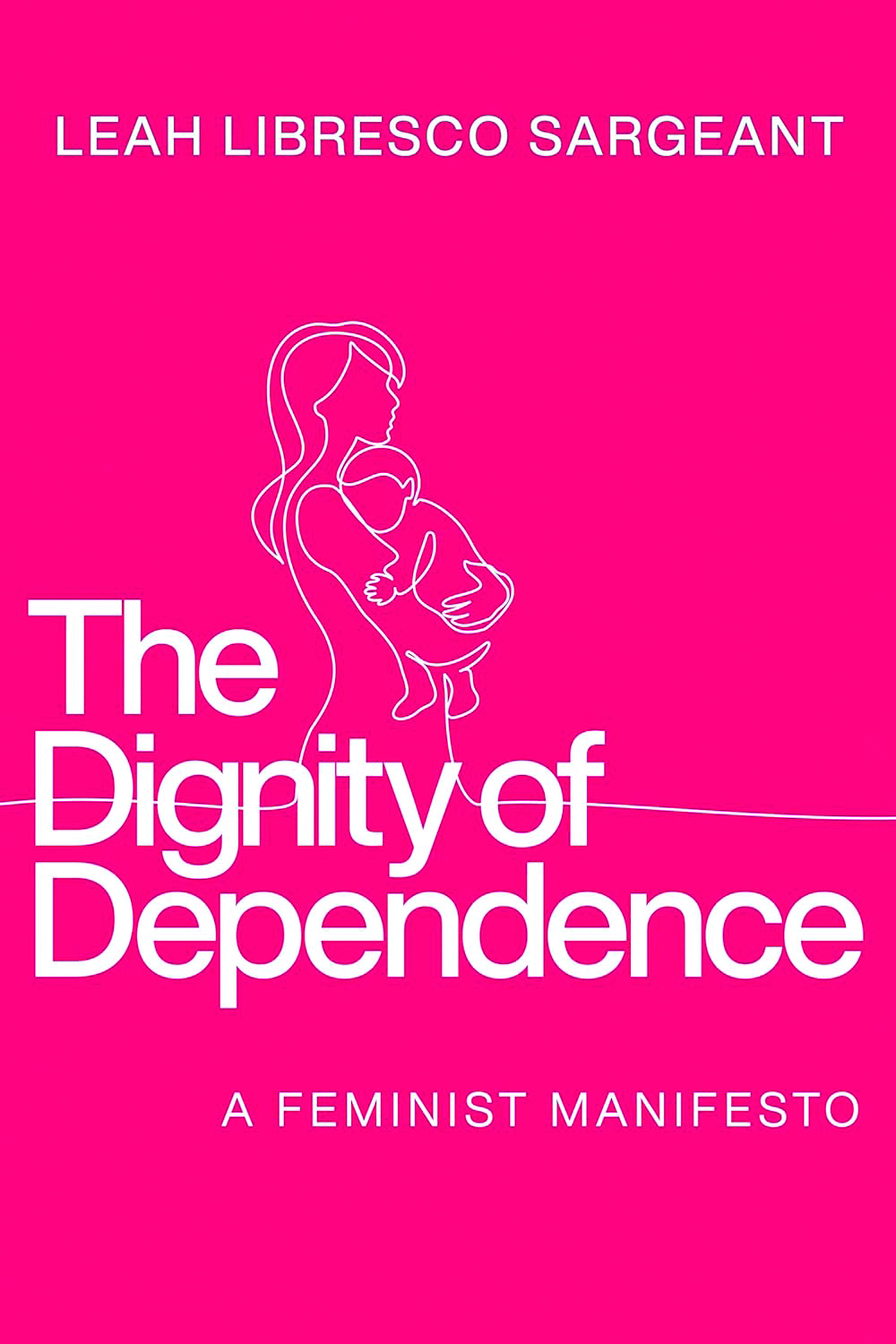
As a public policy researcher, I am deeply interested in where the government can make people freer to, in Eva Feder Kittay’s terms, give a yes to someone who needs them. The government can help by removing barriers to natural relationships of care — for example, allowing mothers to apply child care vouchers to their own time at home with an infant, or ending financial penalties for disabled adults on Supplemental Security Income when their parents make them dinner. It can also help parents and other caregivers have a little more financial slack, through the use of family benefits like the Child Tax Credit. The principle of subsidiarity can help channel government programs to avoid them becoming intrusive or totalizing.
Koganzon and I are perhaps most in agreement when she says that my book is not novel. None of the three books I’ve written (on prayer, on building community, or on men and women) are breaking new philosophical ground. My goal is articulating the same old truths anew, in a way that helps people internalize and apply them. I am interested in where the same old truths create friction in a changing world.
It is for this reason that The Dignity of Dependence has citations to Caroline Criado-Perez’s Invisible Women, Claudia Goldin’s Career and Family, and Matthew Crawford’s The World Beyond Your Head, but not to Carol Gilligan or Sophie Lewis (or Friedrich Nietzsche). All of these writers are on my bookshelf and shaped my thinking, but only the first half appear in my bibliography. Writing a trade book for an academic press, I am less concerned with situating my work within an intellectual genealogy, and more interested in where a lay reader is invited into philosophy through her experience of embodiment and the design of the physical world.
When we measure ourselves against the place prepared for us, we must consider the questions “Who counts as fully human?” and “Who is treated as a rare, regrettable aberration?” As I detail in the book, women are frequently treated as defective men. Airbags are miscalibrated to women’s heights and inflict avoidable injuries. Medicines are miscalibrated to women’s weight and hormonal cycles and cause higher rates of side effects. Career tracks are miscalibrated to women’s fertility and distort family life. Each of these choices about how we design the world makes an implicit claim about what “normal” human beings look like, and an implicit accusation against those who do not fit the Procrustean demand.
My goal is to begin with the reader’s lived experience, and then take a step upwards into abstraction, considering what underlies these feelings of being unwelcome in the world as a woman. A pro-life reader and a second-wave feminist will open the book with very different examples in mind of what it means to be hostile to women. However, I hope the book will spark some new understanding and opportunities for collaboration, as I try to connect both their complaints as examples of a world that demands women make themselves interchangeable with men. I am more interested in giving my reader a way to talk to their neighbor than a door into the academic literature. Philosophy is an amateur pursuit — natural to all of us when we ask “why” in good faith.
If Koganzon is looking for a defense against totalizing solutions, she will find it in my book’s praise of embracing the natural volatility of life. Fertility and family life cannot be made tame or trivial. As I write, “A woman’s fertility and biology generate friction in a world that demands smooth stability.” Women should not accept demands to flatten ourselves to better fit standardized solutions, whether from the state or society at large. I prefer the approach of disability activists, who push for adaptive designs, which can adjust to suit the user. A woman should also not be expected to contort herself to fit a narrow “normal.”
Leah Libresco Sargeant
Author, The Dignity of Dependence
Other Feminisms (newsletter)
I dredge up the obscure academic past life of Sargeant’s arguments for female difference and its political demands not in the spirit of a “Reviewer #2” who demands to see his preferred citations in every peer-reviewed article before he approves it for publication, but only to note that these arguments were advanced before, and that their main political effect was to lay the groundwork for a hard socialist turn on family policy on the left.
Why was it so easily hijacked? Perhaps because, if the problem is overwhelming pressure on women to meet the needs of all who depend on them with minimal support, then meliorative policies like childcare vouchers for stay-at-home mothers quickly come to look rather pitiful compared with the possibility of socializing all childcare. When the primary goal is increased care for all dependent persons, when need is the lodestar, the boundaries around families begin to seem arbitrary and even obstructive. In the absence of a defense of the private realm, or of the family itself for that matter, care ethics bleeds into statist demands for government to do the work of the family in the place of the family.
For Sargeant’s pro-life and Catholic readers, such a defense of the value and integrity of the family is likely unnecessary. But for the secular feminists with whom she is hoping to collaborate, it is not clear what makes her proposals more attractive than the more thoroughgoing visions of the socialists and family abolitionists. On the other hand, for fusionist conservatives, there is little reassurance about, or even recognition of, the possibility of state tyranny.
Of course, arguments that failed to gain traction in the past can, in new moments and political contexts, turn out to be unexpectedly but perfectly suited to the times, and I would not rule out the possibility that Sargeant’s will be among them. I have no objection at all to her insistence on sexual difference and the many ways that the world could better accommodate women’s bodies and needs. By all means, design airbags that won’t kill me! I worry only that in the absence of any articulated boundary between the family and the needy world, the family will be drowned in a sea of need.
Rita Koganzon
School of Civic Life and Leadership,
University of North Carolina at Chapel Hill
Author, Liberal States, Authoritarian Families: Childhood and Education in Early Modern Thought
Exhausted by science and tech debates that go nowhere?