An Ozempic in Every Lunch Box
Big Pharma and MAHA are fighting over how to treat childhood obesity. In the meantime, what do we tell our kids?
I bit into the best tomato I’ve ever eaten on the National Mall in Washington, D.C., in the shadow of the hulking headquarters of the U.S. Department of Agriculture.
It was the first week of August, and the USDA was hosting the Great American Farmers Market to promote their vision for agriculture in America in the leadup to the nation’s 250th anniversary. Small-scale vendors from twenty-eight states had set up tents flanking a food truck packed with freebies from Chobani, one of the largest yogurt companies in the country. More abundant than the food, even, were the mixed messages.
Health and Human Services Secretary Robert F. Kennedy, Jr. and USDA Secretary Brooke Rollins staged a photo op at a booth run by Foot of the Mountain, a family-run vegetable farm and bakery from Pennsylvania that claimed to practice something called “regenerative agriculture.” “You guys are the model,” Rollins effused. “Your story is inspiring, so we’re going to work to try to make it so more families like yours can have this opportunity.”
“I hope we’re not just the dog-and-pony show,” the farmer responded. He said he believed “free-market agriculture” would “make America healthier, and make the land healthier.” He added, “We’re all breathing the same air, we’re all sharing the same water. We’ve got to take care of it.” Kennedy nodded and smiled, then performatively bought a bag packed with produce, tomatoes radiating redness on top. Once the bodyguards cleared out, I bought a pint as well, to see if they lived up to the hype.
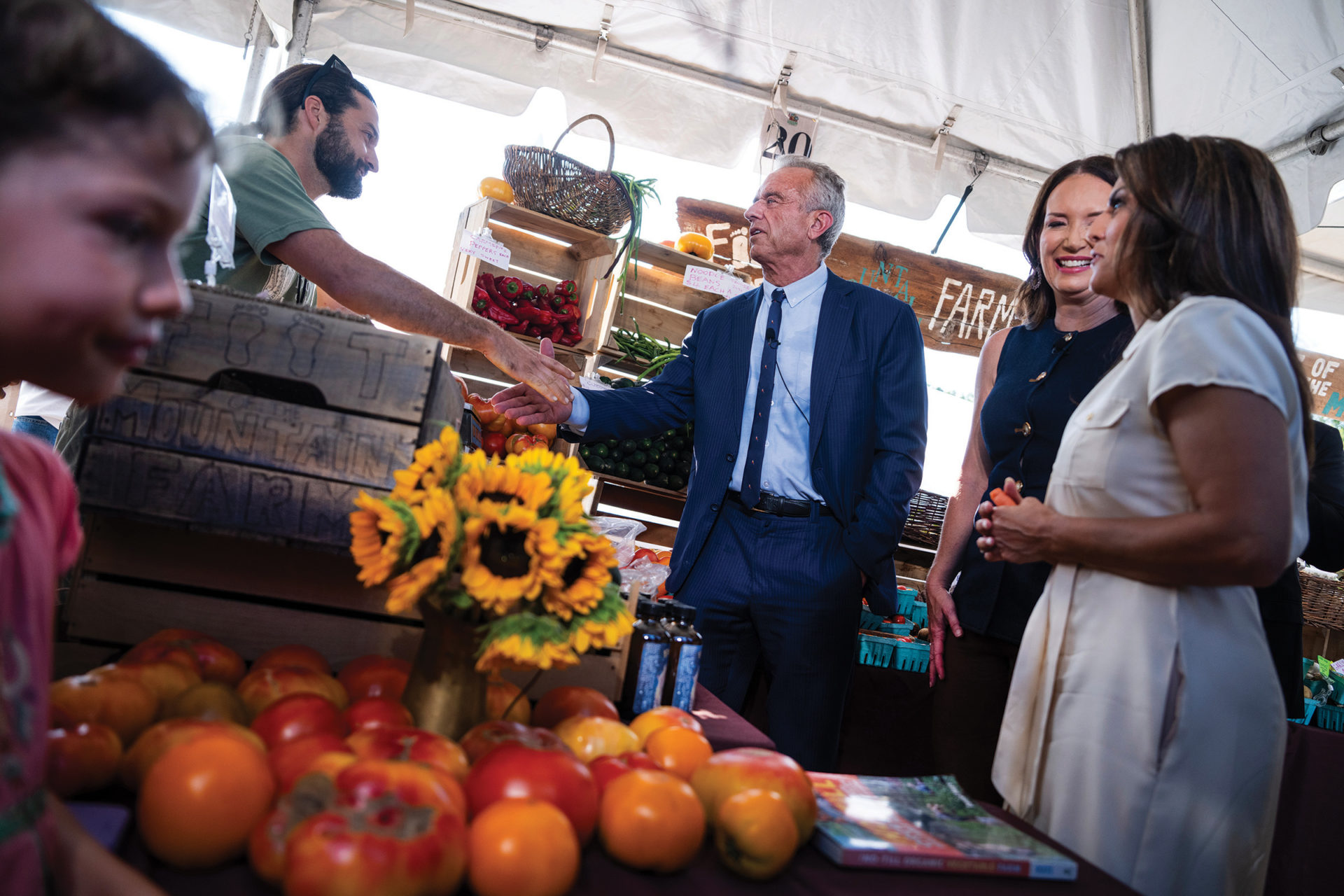
This farm hadn’t been chosen by accident. Kennedy is known for promoting whole, clean foods and alternative farming practices in his effort to Make America Healthy Again. Back in his lawyering days, he won major litigation against pesticide companies. If all Americans followed his MAHA eating regimen, the market for raw milk and grass-fed beef, spray-free tomatoes and organic sourdough would rival the country’s big corn and soy conglomerates.
But even in the MAHA era, the reality of American agricultural policy and the economy it supports does not look friendly to Kennedy’s favored farmers. Instead of restricting pesticide use, the Environmental Protection Agency and the administration recently assured agrochemical companies that they had no intention of going after their products. While the USDA and HHS were touting wins on strong-arming states to ban junk food from food-stamp programs, Kennedy’s critics noted that he was just loudly asking big food companies to play along with the MAHA agenda by abandoning dyes, instead of promulgating regulations that would actually require them to do so. Their assumption — a cynical one, but one with plenty of political precedent — was that, whatever Kennedy’s personal views and MAHA’s vision may be, the administration is leery of angering ag lobbyists who want to preserve the status quo.
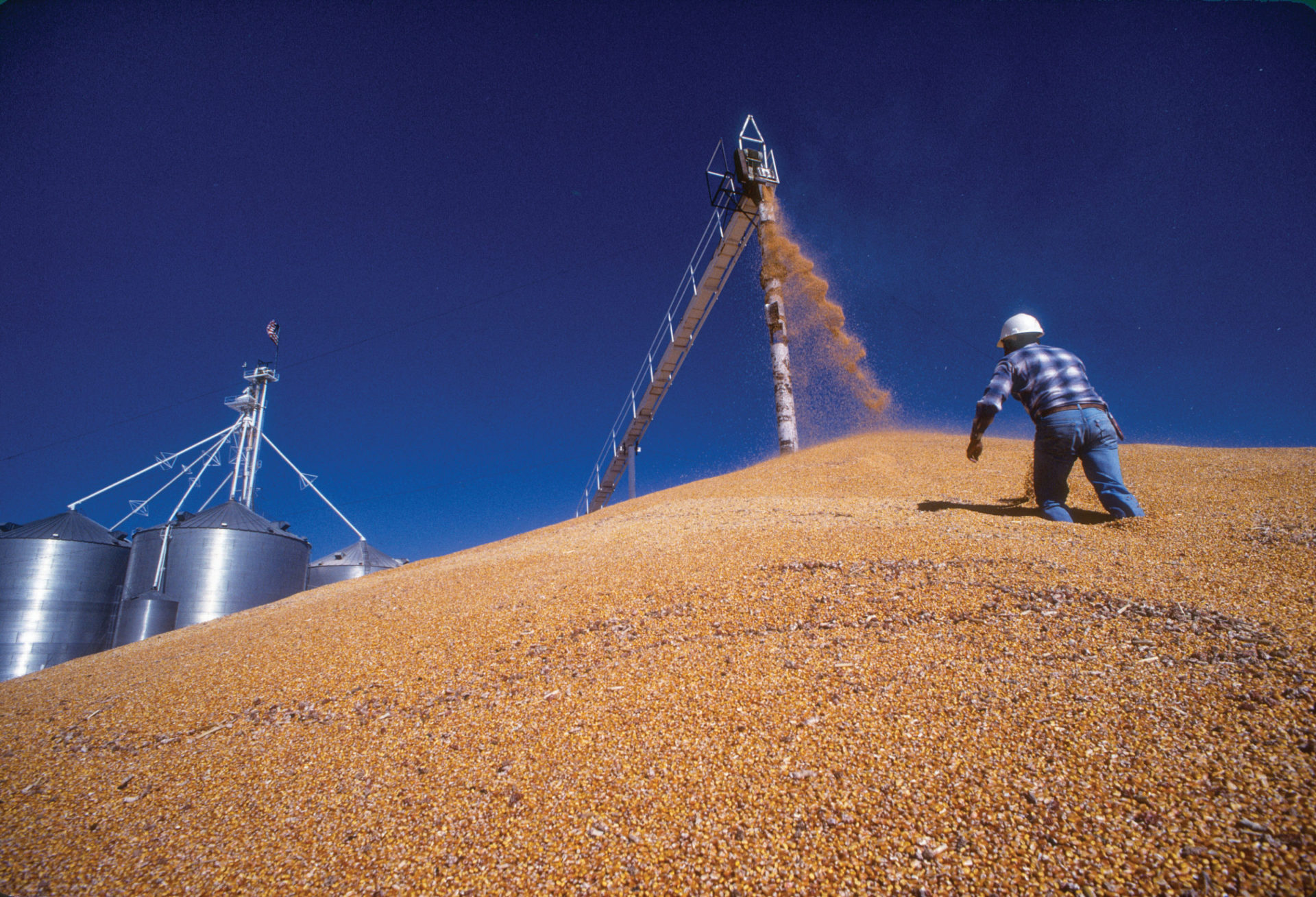
And the status quo for American agriculture is represented by a different model. Just yards from the photo op, a massive new tractor sat gleaming, freshly painted solid gold. Secretary Rollins signed her name on its front. This model of farming — what is often called “conventional” or “industrial” — is the kind that claims to “feed the world” using each era’s new technological innovations: novel pesticides, bigger combine harvesters, and now an AI app for everything. In the drive to maximize yields, farmers have for decades been pushed to expand to keep up: lease bigger and more expensive machinery to farm more acres, buy more seed that is genetically modified to produce larger crops, go further into debt to buy out your neighbor if he hasn’t already been bought out by a foreign corporation, sign on for all the latest tech and hope by the end of the year to break even once the federal subsidy payments come through. Value is in volume, not variety; quantity is king over quality.
This model doesn’t make money for the average small farmer, and not all that much actually feeds anyone. The majority goes to animal feed, ethanol, and other nonconsumable products. And yet in a press release for the market, Rollins presented a nostalgic portrait of the American citizen farmer: “America was founded by farmers,” she said, “ordinary citizens who tilled the land, fed their families and neighbors, and built a nation rooted in freedom and self-reliance.”
Of course, it makes sense for political reasons why USDA would paste an image of the Washingtonian citizen-farmer over a reality in which Big Ag, not ordinary citizens, owns the land and decides how it is farmed. So it would be easy to write this all off as politics: the old American ag policy dressed up in a new MAHA costume. Donald Trump, after all, brought Kennedy into his administration in large part for his anti-establishment ethos. But the president is really quite friendly with various kinds of big business, including Big Food and Big Chemical. Regenerative farming faces opponents inside the government and out, and no matter how pure the sourcing on Kennedy’s salads, food policy is ultimately set not at HHS or USDA headquarters but in Congress, where lobbyists battle for the future of ag policy behind the scenes.
In short, there are a lot of people who don’t like various aspects of the conventional model, but a lot of reasons why it exists, and a lot of money and power behind its persistence.
But those tomatoes. They transcended politics. I couldn’t help myself: I returned to the tent to ask how they did it.
Political headwinds or no, regenerative agriculture is having a moment thanks in large part to MAHA, and I planned to spend the fall taste-testing it to see whether it could expand beyond the estimated 3 to 5 percent of farmers currently following at least some of its principles. Who knows what regenerative farming actually looks like, though? I, along with an increasing number of consumers, had seen bits of buzz about it in the parts of the Internet resisting the expanding reign of Big Tech in agriculture. But if quizzed, many of us could likely offer only vague impressions like “organic, but for real this time,” plus maybe something about soil health.
In researching this article, I would visit farms across Virginia, Maryland, and Pennsylvania to see whether regenerative agriculture was a Luddite purity dream, a reactionary response to the inevitable forces of technological progress that would never be more than a niche market for crunchy consumers, or instead a prophecy that my local Safeway would soon stock tomatoes that taste like the ones grown at the Foot of the Mountain. I had to see for myself whether this kind of agriculture could feed America, and how.
On a bright morning in mid-September, I grip my five-month-old in one arm and a fistful of straw in the other while Joel Salatin trundles his tractor up toward the pastures of Polyface Farm, nestled in the Shenandoah Valley.
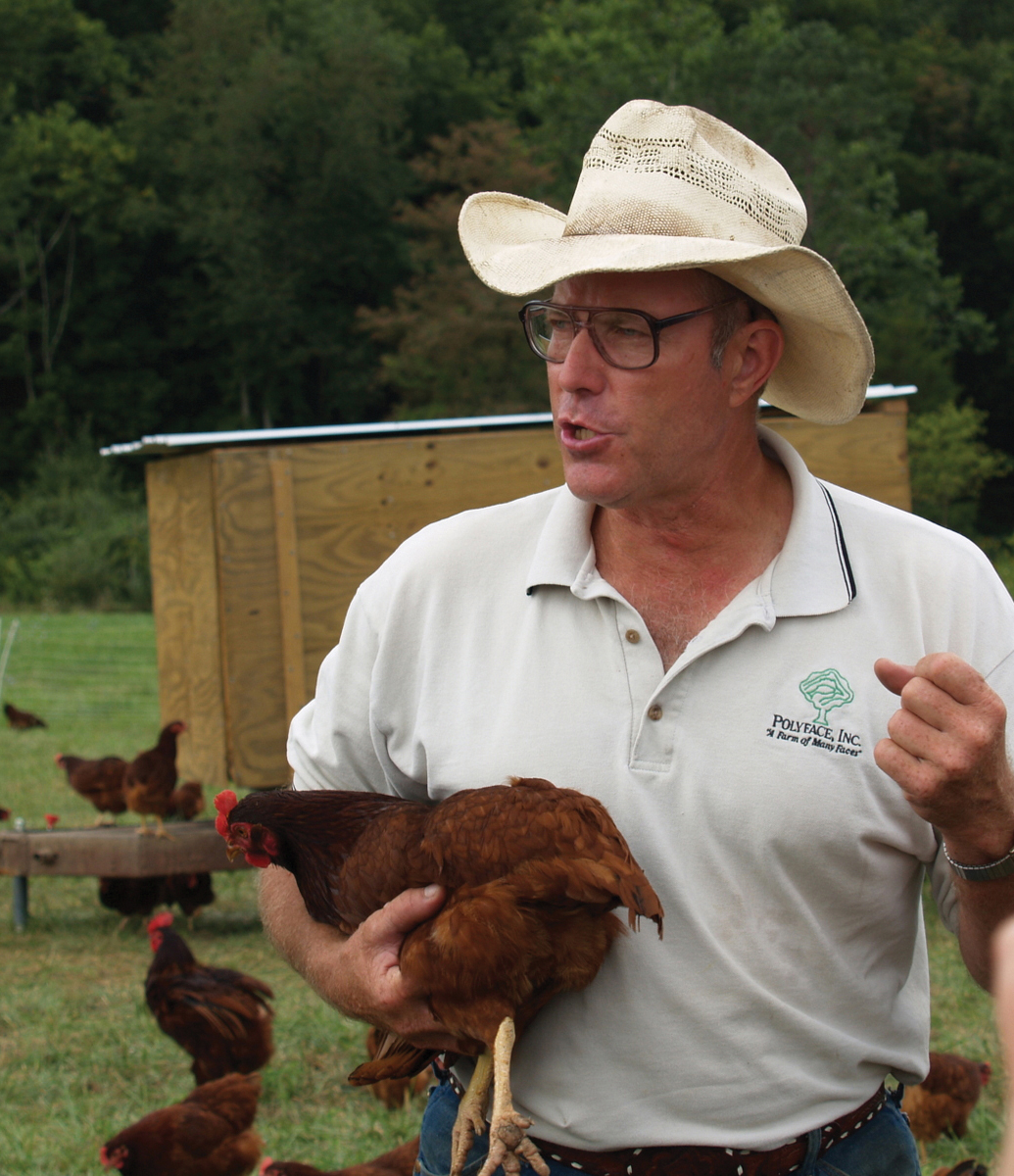
The last tour of the season is a big event. More than one hundred people, a mix of Northern Virginia suburbanites and rural families from downstate, have paid $25 a head to pile onto three haybale-laden trailers and witness the farm in action. Polyface is one of the best-known regenerative farms in the country, and Salatin is something of a godfather to the movement. Or maybe a crazy uncle: he calls himself the “lunatic farmer” and has the larger-than-life personality to prove it.
And the farming operation, too. When the tractors line up next to a row of chicken houses, it soon becomes clear that this is a well-rehearsed performance. Salatin gabs into a microphone headset while he demonstrates the movable chicken coops that he’s famous for. “One person can move 4,500 birds in sixty minutes with nothing more than that little tool, no machines, no petroleum,” he says, using a dolly to pull the house onto wheels and sliding the whole operation a few yards up the pasture to the green grass underneath. “Now they have a totally new salad bar. New bedding,” he says. “Fresh bugs, fresh grass, fresh place to land.”
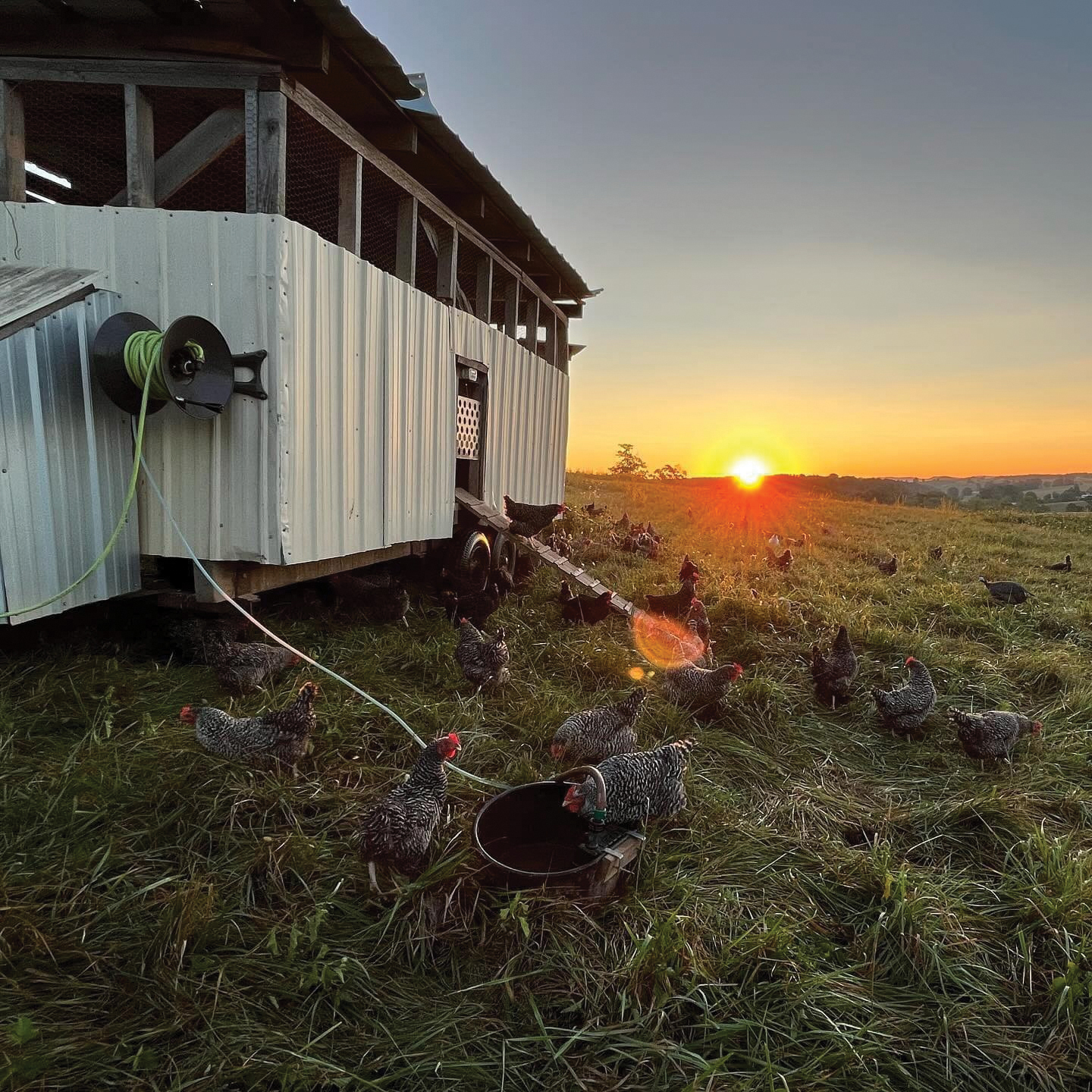
Salatin’s pitch seems to be that regenerative agriculture is not just better farming, but also easier. The chickens, he says, feed a virtuous cycle of fertilization: they eat fresh grass; they feed that grass with their droppings. The chickens eat well and the pasture becomes greener, the soil more fertile. And it’s cheap and flexible, which is essential for an agricultural system whose biggest barrier to entry is the ability to get land. “Number one, it’s mobile,” he summarizes. “Number two, it’s modular.” It’s a model that can be easily scaled up or down depending on the size of the operation. Some people raise ten chickens this way; others tens of thousands.
These coops represent the regenerative farming model in miniature. During five more stops on our tour, Salatin introduces us to hogs, turkeys, sheep, cows, and compost. The pigs demonstrate why, contra the “plant hedgerow to hedgerow” mindset of many conventional producers, forested acreage is just as valuable as open ground. The pigs are in hog heaven snuffling up acorns, roots, and bugs in their movable paddocks. “What we’ve learned from our chefs is that all of our meats cook fifteen percent faster than conventional,” he says. “The reason is because our animals are happy.” Apparently, pork tastes better when free of the stress that tenses up the poor creatures raised in industrial-scale operations: overcrowded, overmedicated, miserable from birth to butcher.
In most regenerative operations, these animals are a rotating cast, literally: the goal is to move the animals over as much land as possible. Their grazing, when timed right, stimulates the grass to grow and to pull up from deep in the soil nutrients for future seasons, when a given pasture may be used to grow crops. And the link that completes the virtuous cycle is compost. To farm without chemical fertilizers requires a lot of natural fertilizer, and fortunately the animals are more than capable of contributing. Other things most people would consider waste are fodder for the compost pile as well: straw, animal carcasses, all the way down to coffee grounds.
If all of this sounds like a lot of work, it is. But to Salatin, it’s only natural — and beneficial — that regenerative farming would lead to a need for more farmers. “Duplication is the way nature increases stuff,” he explains. “If nature wants more humans, it doesn’t make a bigger human, it makes babies. If nature needs more tomatoes, it doesn’t make a monstrous tomato plant, it expects people to plant more tomatoes.” The analogy with small-time farmers versus massive industrial operations is obvious. The former is healthy, the latter is abnormal — farming like Frankenstein.
As the tractors crawl back into the parking lot, I wonder how much “lunatic farming” had changed since Salatin got started. In the early-aughts, he had famously refused to ship Michael Pollan a steak when the food writer profiled him for his book The Omnivore’s Dilemma. Transporting meat across the country, he said, violated the entire point of a local farm. But while looking up Polyface’s tour schedule, I had noticed a page on the website featuring a farm store that offered shipping nationwide.
Polyface used to be “cultishly local,” Salatin acknowledges when I ask him about the incident. Principles aside, the quality of the meat would suffer on its way to California. But then shipping became really good. Salatin describes the shipping machine on his farm with admiration: “The scale thing zips out the shipping label, you slap that on the box, and the UPS truck comes and picks it all up at four o’clock, and it’s gone. It’s incredible.”
Today, Pollan’s steak would have arrived at his front door in Berkeley within a couple of days, still frozen in its insulated bag. “I think we’ve only had to replace two packages in five years,” Salatin says.
Polyface launched its shipping operation just months before the Covid shutdowns, and during lockdown people were quick on the uptake: a year’s worth of inventory was bought up in six weeks. Shipping now accounts for almost half of Salatin’s sales. So Polyface Farm has been in the right place at the right time to take advantage of global developments in delivery technology and logistics.
But he remains stubbornly provincial. When Pollan asked whether this kind of agriculture could feed New York City, Salatin threw the question back at him. “Why do we have to have a New York City?” he asked.
I pose the question to him again this fall. “I still feel the same way,” he replies. The change Salatin wants is something like a return to the Founders’ vaunted agrarianism, a country of lunatic farmers. Scaling up, for him, still means scaling back.
Regenerative agriculture is entering a new era, it seems, but clearly the questions of whom it can serve, and how, remain very much open.
Daniel Shirk’s cows amble over to greet him through the driver’s-side window of his old navy-blue Tahoe. He has graciously agreed to show me around his four-hundred-acre regenerative farm near Newburg, Pennsylvania, on the recommendation of the vegetable farmer I met at the USDA market.
But it was a tough sell to let a journalist tramp around on his farm: “At first, I said, ‘No, not interested,’” when his friend, the vegetable farmer, had mentioned my interview with him and said I was looking to tour more regenerative farms. So I wonder how much is reticence and how much regret on that mid-October morning as I grasp for questions while we bump between the paddocks: How many pigs? Thirty this year. Sheep? Sixty, seventy ewes. Cows? Usually twenty-five to thirty. What do they eat? Well, grass, obviously. He sells grass-fed beef, after all.
And then there are the fields: sorghum, wheat, rye. Some are planted with cover crops, some with soybeans or other plants for animal feed, and the rest is for human consumption. What’s in any given field varies by season. That’s the best way to keep the soil full of nutrients. With this heavy rotation, Shirk is close to achieving the regenerative ideal, I gather: a closed loop, from grass blades to cud to compost, using the products of the farm to fuel itself and continuously improve the fertility of the land. A virtuous cycle.
As I stutter through a question about breeds of cattle, I watch a cow from the passenger seat. She has a long, white nose and thoughtful black eyes, lashes thick like those of the baby staring from my lap. I am wondering rather wildly whether befriending one’s dinner makes it taste better when the baby bursts out with a sudden “yawp!”
The cow bolts. Shirk and I laugh; his wife Lois, in the back seat, tells me about her grandchildren. Their three boys farm with them, and Ryan, their oldest, has five little ones.
We breathe more easily as we climb down from the Tahoe to tour the flour mill. It lives in a semi-trailer next to the barn; Shirk grates open the metal door to reveal a benign, long-necked contraption that he introduces as a hammer mill. “Stone-ground” is a buzzword for many of the bakeries he sells to; it signals pure sourcing and natural processing. But he says that stone mills can actually damage the flour, because the stones can overheat the berries. The hammer method is just as natural, preserving the precious bran and germ of the wheat that makes fresh-milled flour so much more nutritious than the conventional, refined version. And the mill can do all this at impressive speed, pounding through seven hundred to a thousand pounds of wheat per hour.
So who gets the privilege of eating this premium flour? “Most of our sales would be wholesale,” he says, to bakeries like Bread Furst in D.C. “They’re our biggest.” I laugh again. Bread Furst is one my family’s favorite bakeries; it’s right up the street from where I live. We’ve been eating Shirk’s grain for years without knowing it.
As we walk to the house, Lois explains how wheat has changed since the beginning of conventional farming practices. It used to be taller, but has been bred to be shorter and produce more by volume — feeding the world. But farmers who don’t cycle their crops like the Shirks do have to use chemicals on the plants to offset the depletion of the soil, and then the flour is processed to remove the nutritious bran and germ and make it shelf-stable. By the Shirks’ lights, the supposed gains are dubious at best.
As we settle in at the Shirks’ kitchen table, Daniel says the matter is rather worse. Conventional farming uses herbicides that not only reduce nutritional value but make people sick. “Glyphosate is a chelator, which grabs on to minerals,” Shirk explains. “So it’s grabbing on to a lot of the minerals in the soil and especially the micronutrients and ties them up so the plants” — the weeds it’s intended to kill — “can’t get nutrition.” Crops grown in fields treated with glyphosate have progressively less nutritional value because nutrients are locked up by the herbicide, year after year, in a vicious chemical cycle. And this, among other potential effects of herbicides, leads to health problems.
I had heard of glyphosate; it’s a common target among those in the MAHA movement who say the U.S. government has allowed the pesticide and herbicide industry to sell dangerous chemicals that may cause cancer and other diseases. The FDA and EPA insist that they’re safe, but, critics argue, many of those studies are funded or influenced by agrochemical companies.
Wherever one lands on that argument, it’s clear that consumers are queasy about heavy chemical use in farming, largely because many of them are connecting health problems — allergies, acid reflux, and, in the case of glyphosate, non-Hodgkin lymphoma — to conventionally grown food. These days, you can test for some of these things. Shirk tells me about someone he knows who found high glyphosate concentrations in his body because of the oats the family was eating.
So if consumers want cleaner food, why don’t more farmers do what he does? Perverse incentives, for one, says Shirk. Even if people accept that cleaner food is better, a deeper problem has to do not with the crops but the land beneath them: who owns it and how the government incentivizes those owners to treat it.
Ryan has thoughts on this topic. He comes into the kitchen, apparently between chores, and asks Shirk if he’s told me about subsidies. “I keep telling her all the time,” Shirk replies.
So, it’s complicated. Ryan says the government’s attempts to improve farming practices can backfire: “Small farmers, if we don’t have crop insurance or we’re not subsidized by anything, what we have to do has to be profitable.” But for decades, the federal government has offered insurance for corn and other crops deemed essential to American consumption and exports, and now many farmers rely heavily on those crops to make ends meet. While this system was established to insure against serious drought and other crises outside human control, it has metastasized and now includes loopholes that can be exploited.
A recent racket Ryan describes in their county, Cumberland, is one example among many. In brief, it worked like this: Rich farmers buy poor land on one side of the county and harvest payouts tied to expected corn yields that are based on the more fertile limestone soil on the other side of the county. For the first few years, before they have a yield history to report, they collect their checks. Then they sell the farm to a buddy, and the cycle starts again.
Gamesmanship aside, this practice is bad for the land. “Around here, growing corn for grain is not reliable or necessarily profitable,” Ryan says. “And so when you have subsidies and crop insurance, it can really create scenarios where farmers are doing something that isn’t profitable.”
“Or sustainable,” he adds. “That can kind of be the same, you know, where it doesn’t support itself.” This is how subsidies skew the system: “If you have that backup subsidy check or the insurance check,” Ryan says, “that makes it so much harder for the farmers that aren’t doing that because it raises land values and rent values.”
The frustration among farmers like the Shirks reveals deeper tensions between those who own the land — often not farmers themselves, but widows and other heirs to generational operations, or construction bigwigs who want to park their wealth in land — and those who farm it. The Shirks, in fact, straddle both sides: they own part of their farm and rent the rest. Success depends on finding the right arrangement, often with a landlord who is not directly involved in agriculture. But it’s a cutthroat game. Even here in Amish country, many have sold out and gone into construction.
By now the baby is fussing with hunger; Lois offers help. She opens a mason jar: “This is organic applesauce from our tree this year.” I slide the baby into a well-loved Graco high chair and buy us a few more minutes of conversation.
“Do you read much?” Shirk asks. There’s a book he wants to give me that explains American agricultural policy. Sure, I read, but I don’t want to take his favorite book. Oh, he’s got more, Lois assures me. Anyway, he insists. He pads out of the kitchen to grab me a copy.
The book is Execution by Hunger by Miron Dolot, a memoir about the Holodomor, when Stalin stripped Ukrainian peasant farmers of their land and millions starved.
I drop the book into my bag. The Shirks ask me if I’d like lunch as well, but this afternoon I have a visit with Robert F. Kennedy, Jr.’s favorite farmers.
Before Lorenzo and Jessica Varisano show me around Foot of the Mountain Farm in Concord, Pennsylvania, they quiz me on my morning with Shirk: “What would you say the takeaway from Daniel’s farm was?” I note my surprise that he sells flour to my neighborhood bakery back in D.C. Most people don’t know how good they’re getting it when they buy bread from there.
“Nobody does it quite like Daniel,” Jessica says. “He’s pretty unique. He really tries to full-circle it” — chasing the regenerative ideal of creating a complete cycle of plants, animals, compost, soil, and around again.
But can it be replicated? And does that matter, or is one farm that does things right worth a hundred farms that don’t? These are questions that, I soon realize, apply to the Varisanos as well.
Lorenzo’s style as tour guide as we walk around is to pick assorted fruits and vegetables and hand them to me to sample. For more than twelve years, he and Jessica have farmed the land behind a stone house that is older than the country. It’s only around two acres of greenhouses, open-air gardens, a bakery, and a few fenced plots up the mountain, but it’s positively overflowing with flora.
“Have you ever had real celery?” he asks. “I tell people it’s medicinal grade.” I can smell it from across the greenhouse and assure him, after my first herby, spicy crunch, that I had not, in fact, had celery until today. He nods confidently: this is not a compliment but a fact.
But he smiles at my reaction to the grapes. Their flavor is intense — sweeter than candy. The vines, which run the length of one of his greenhouses, produce more fruit than he can handle: “There’s so many that we just kind of gave up.” But the kids like them.
The Varisanos have five children, ages four to fourteen. We edge around sandboxes, forts, and their youngest son’s irrigation experiments, all integrated into the farm. I tell Varisano that this place would have been a wonderland to me growing up. He nods again: this is also self-evident. Some small farmers, he says, are more into optimizing every inch of space, but he likes to leave some room for whimsy. Honestly, the farm is already too productive, he tells me. The more they grow, the more they have to harvest and load and ship and sell.
As he leads me up the slope behind the greenhouses, he tells me that he might scale back what he grows up the mountain. The plots up here aren’t much bigger than a large garden: turnips, the remains of tomato vines, buckwheat and rye as cover crops. The irrigation is run by solar power. The panels turn out just enough wattage to power a sprinkler, and that’s all the land needs. And the land gives him more than he needs.
We wind back down to the greenhouses, picking our way among maple trees that Varisano says he taps when he has the time. Again, everything here is food for someone or something. We stop in the bakery, Jessica’s domain, where bags of flour from Shirk’s and other farms in the area — mostly Amish farmers who have for generations handed down seeds that have never touched a pesticide — are piled near two bread ovens almost as tall as the ceiling. I stand gratefully near a wood-fired stove and ask: Is it true, as Shirk said, that the Amish are getting squeezed out by conglomerates?
Yes, Varisano says. The demand for their grain is still strong, as D.C. bakeries sourcing flour from Shirk and others show. The superiority of their product is indisputable, pure and flavorful, packed with nutrients that many have forgotten even belong in bread: protein, fiber, antioxidants, and healthy fats. But tradition alone can’t fight the engines of progress.
And the engines of progress can ensnare people as much as they can free them. Varisano doesn’t use a newfangled “AI agronomist” app or follow an online farming guru. Instead, he uses the Internet to find a solution to a problem. “We take that for granted,” he says. “The Baby Boomer generation had to take what was spoon-fed to them through the media.”
The best technology for Varisano’s operation is less tech than tool. What looks like a strip of stapled cardboard stretches out into a honeycomb-like grid the size of a large cookie sheet with hundreds of little hexagonal paper pots. He spades soil into the pots and then dumps a handful of tiny spinach seeds onto a sheet of plastic gridded with tiny holes; they drop neatly into the soil-filled grid of paper pots below. When it’s time to plant, he loads the tray into a transplanter that looks like the world’s narrowest wheelbarrow with a chute at the end, and walks down the row as a string of paper pots unwinds and slips neatly into the ground.
His weeding tool is similarly simple, a design based more on regular use and proper application than any high-tech invention. “To keep it weed-free, you don’t need the world’s greatest, newest, fanciest technology,” he says. “I’d rather have a farm that’s been weed-free for years than all the technology in the world.” This is not Luddism; it’s the understanding that the value of technology depends on its proper application.
In a way, it seems that this small-scale and targeted, low-tech approach has freed Varisano. Obviously, he doesn’t have enough land to support a conventional corn or soy operation, even if he wanted to. And for better or worse, he didn’t inherit his land with the baked-in pressure to do what dad and grandpa did — which for most farmers at this point means not only the tradition but the infrastructure and economic incentives to farm conventionally, even if at great cost to the land.
There are, of course, traditions of resourceful small-scale farming. That’s why many of his tools are French and Japanese. There’s simply not much space to farm in those countries. “The old saying — not ‘the mother of innovation’ … what is it?” Varisano asks as he seeds more spinach. Necessity is the mother of invention.
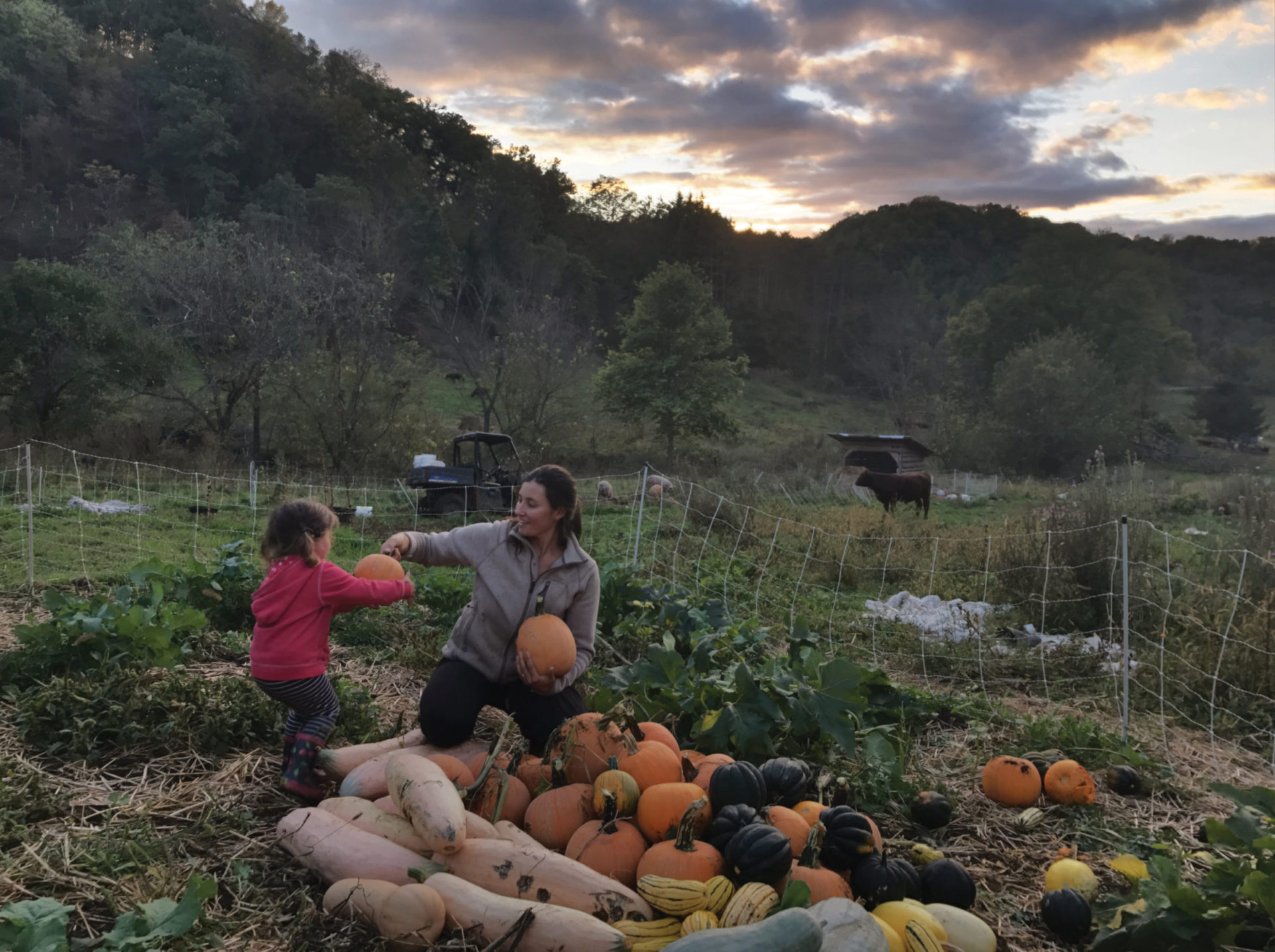
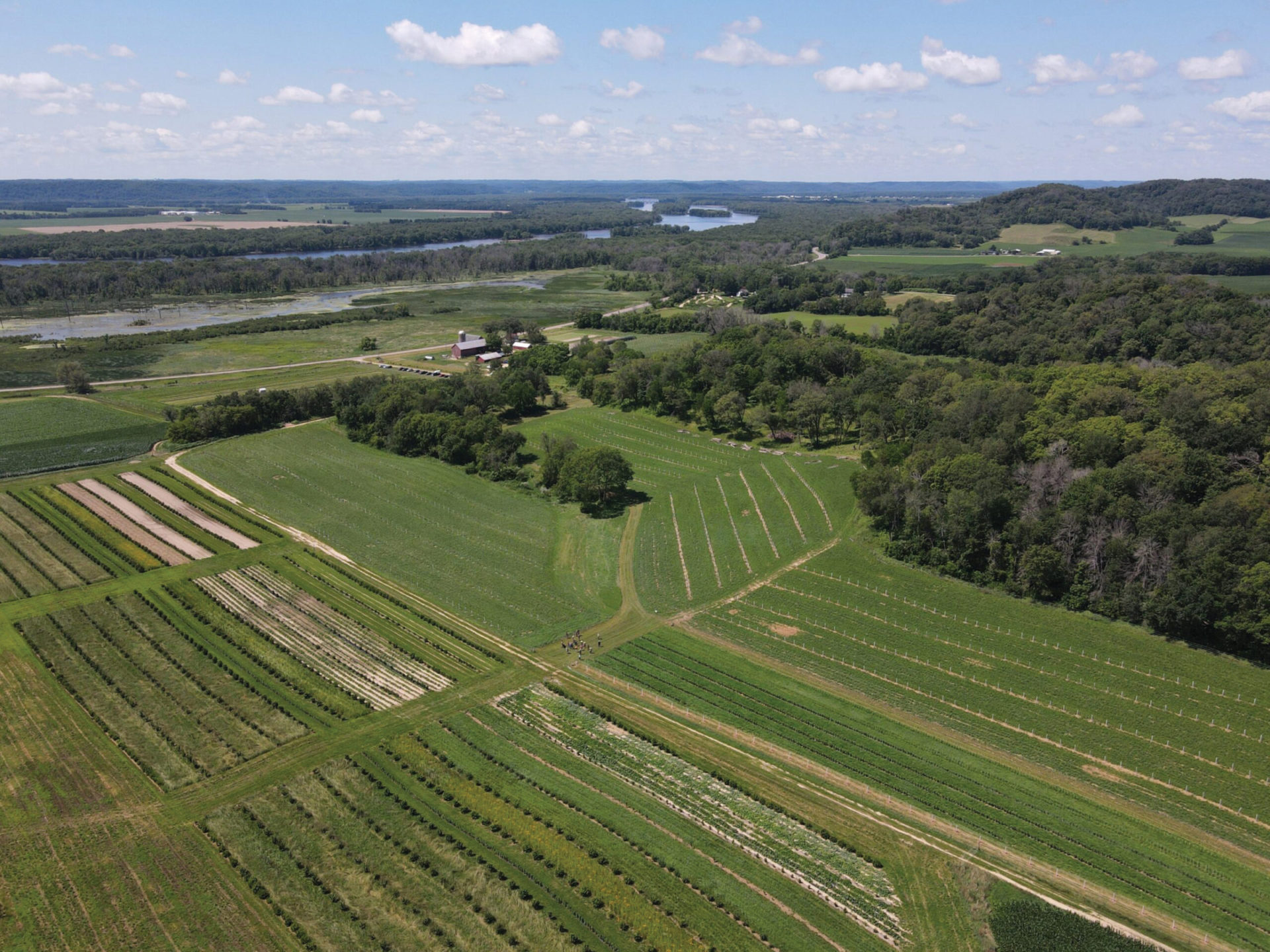
It’s possible, then, that America’s real problem with scale in agriculture is not that there’s too little land for practices like these to have taken root, but too much. Varisano’s example suggests that the country could be even more productive if there were more farms like this one, on land that efficiency-maximizing combine harvesters can’t touch.
For now, though, American agricultural policy is so focused on mass production that it classes most of what the Varisanos grow — the vegetables and fruits that should make up the majority of our diet — as “specialty crops,” and offers less support to farmers who grow them than to conventional producers of “commodity crops” like soy, wheat, and corn. There’s a way of looking at this imbalance as simply a missed opportunity.
But there’s much more at play here than maximizing yield. There is something about growing food this way that I can’t describe using any other word than “magic.” Even if the world could be fed on commodity crops alone, it seems impossible to mass-produce the kind of spark that animates this farm. I am reminded at the Varisanos’ that food is not manufactured, it is made: guided, tended, gardened into abundance.
The Varisanos send me home with a bag of baked goods and the last of the summer’s tomatoes. I eat one on the drive home, a sunburst of magenta and orange dripping down my chin.
By the time I enter the shed on the edge of Living Pastures Farm, blood is dripping from the necks of the final batch of chickens for the day. I’ve driven an hour into Northern Virginia the week after Halloween to watch Jonathan Elliott process his last poultry of the season. Despite being raised with a chicken coop in my backyard, I’ve never seen a squawking bird turn into neatly packaged raw material for dinner.
“I’d shake your hand, but — ” Elliott chuckles as he wipes specks of blood and feathers on a gray crewneck sweatshirt that says “VIRGINIA.” I don’t have a free hand anyway; I’ve wrestled the baby into a carrier on my chest and am wondering whether we will emerge bespattered as from a war zone.
Killing a chicken goes like this: Elliott lifts a flapping bird out from the crate in the back of his truck, pops it upside down into one of eight inverted metal cones arranged in a ring, and slices its neck with a knife. The chicken joins its dead cousins in the other rings, jerking gently, draining out.
When the bodies are bloodless, he tosses them into a scalder filled with hot water — “150 degrees,” he says — churned by a spinning wheel, to loosen the feathers. Once soggy, the bird goes on a rough ride in what looks like a side-lying clothes dryer with pegs. The feathers fly off, and the bird is naked, already looking nearly clean enough to cook and eat.
But first it has to lose its guts. Elliott’s helpers, a team of five high-schoolers, disembowel the birds around the kind of metal table one sees in industrial-grade kitchens. Nothing is wasted: the heads are sold to someone who feeds them to his dogs; the feet have lots of collagen and are used to make stock. The intestines aren’t for eating but will be used for compost.
Once cleaned out, the chickens are sorted by size. If you weigh more than about 4.5 pounds, you get sliced up and sold by the piece: breasts, legs, tenders, and the back for bone broth. If you’re less than that, you get your legs tucked up into your chest cavity, a plastic bag wrapped around you and dipped in hot water to seal you tight, and you’re sold whole, in a neat little regenerative package.
One hundred six birds are being processed today, making a total of around 2,300 for the season. The whole process takes about four hours, and it all runs like clockwork. Elliott is quietly expert at every step. He hardly watches his fingers as he runs the knife parallel to the breastbones, parceling out the pink flesh.
I had worried that the baby and I would end the morning covered in chicken feathers; in reality, the shed was cleaner than my kitchen, all thanks to a few hoses, dish soap, and fresh air. I think about how part of the reason Joel Salatin calls himself a “lunatic farmer” is the regulations he has to work around to process poultry; at least back in the early 2000s when Michael Pollan was profiling him, customers bought the live bird and then picked it up after Polyface Farm had just so happened to process it, as a courtesy. For Elliott, chickens don’t require a crafty workaround. “As long as you’re doing under twenty thousand birds in Virginia,” he says, “you can pretty much just do it on the farm.”
It’s with larger animals like pigs and cattle that the USDA’s rules can cause trouble: “Anything bigger — so pigs, goats, lambs, cattle, bison, whatever — it has to be at something that either falls under the state inspectors or USDA.” Sometimes regulations can change without warning, or without consideration for smaller farmers’ operations. “Our butcher had to stop making bacon for like three months because of changes to USDA requirements in terms of curing and smoking meats,” he says. “They still can’t do ham because they’ll have to get a blast freezer in order to meet the new requirements for chilling the meat fast enough.”
These kinds of requirements are intended to preserve food safety, but they can punish small farmers, most of whom can’t afford to turn on a dime and buy a new refrigeration system but all of whom are far more incentivized than the massive meat producers to assure food safety for a simple reason: they sell directly to consumers instead of through the middlemen of the supermarket. Someone who gets sick eating a local farmer’s meat knows exactly whom to sue, and while Tyson has a team of lawyers to fend off lawsuits, Elliott and small farmers like him have only their reputations as collateral.
The rules also seem to be built for the convenience of the enforcers, not the producers. “We’re allowed to process chickens,” Elliott says. “But somehow if I process pork, that would be like a danger to society.” If he takes his hogs to Adams, the state facility nearby, he can sell the meat in Virginia but can’t cross state lines. “But why are the state standards okay for Virginians but not for Marylanders?” he asks.
It turns out that the repetitive work of parceling out chicken parts is excellent for puzzling over questions like this. Elliott describes how he and his wife Ellen started renting this farm in 2019. He was fortunate: his landlord is so on board with regenerative farming that he converted an old house on the property into the farm store next to the shed. The store is open two days a week. Elliott sells meat and eggs while others offer salad greens, kombucha, honey, coffee, tea. The store is a co-op, he says; there’s no need to fight over profit margins among friends.
With the store and a sweet gig selling chicken to the Washington Commanders football team at their training facility, Elliott, like Varisano, has more business than he can handle. He grazes animals on eight properties, some connected, some not, about 450 acres in all.
Are his customers mostly local, I ask, or do they travel from D.C.? “There’s quite a few customers who are coming out from Leesburg, Fairfax, Arlington, D.C., Stafford,” he says. They’ll drive out on a Friday or Saturday afternoon and stock up on a month’s worth of meat. Salatin may not think he needs a New York City, but a metropolitan market can be a big asset. In fact, competition for land and startup costs aside, regenerative agriculture may have more room to expand near cities. Close to an urban area, there are more potential customers than in, say, the sparsely populated Plains states that produce the majority of the country’s corn; more flexibility to grow diverse crops, more potential for partnerships with other small producers.
And, frankly, more potential customers with money and time to spend on premium food but little ability to produce it themselves. The biggest task that Elliott and farmers like him have in finding new people to buy regenerative is to persuade them that locally grown, direct-to-consumer food is worth the added cost — not just the money but the time. Following Elliott’s model, a customer in D.C. has to be sold enough on regenerative farming that she’s willing to make a day of it and drive out to Elliott’s farm to stock up. Granted, this, too, can be pitched as an asset: part of what regenerative farmers offer is the contact with food that has touched grass, the sight and sound of good food enriching its taste. The popularity of farm tours like Salatin’s and the viability of farm stores so far outside the city suggests that this is part of the draw.
But beyond agritourism, Elliott and others believe direct-to-consumer sales are actually the future of retail. Because selling in most grocery stores involves high regulatory hurdles, local producers have had to find customers where they are — which, in recent years, has been down various rabbit holes on the Internet. Other distribution models are catching on, similar to Salatin’s online store. Whiffletree Farm in Warrenton, Virginia, for example, run by friends of Elliott’s, drives online orders to two dozen dropoff points across Maryland, Virginia, and D.C. But for the consumer, even that requires an extra drive, or extra cash for delivery, and it’s only available once a month. Not everyone has that kind of time, or interest, or foresight, even if theoretically they want cleaner food. And Safeway is open seven days a week. The Internet is good at helping people find their niche, but it’s also good at siloing off people and products. For now, the mass market is still the chain supermarket, and it remains hard to reach.
Today, though, Living Pastures Farm’s bounty falls into my lap. Elliott sends me off with a chicken and a pound of sage sausage for my older daughter. As I strap the baby into her car seat, one of his daughters dashes over from the farm store and asks breathlessly if I’d like a doughnut her mom made as their reward for finishing up the chickens: “They’re so good.”
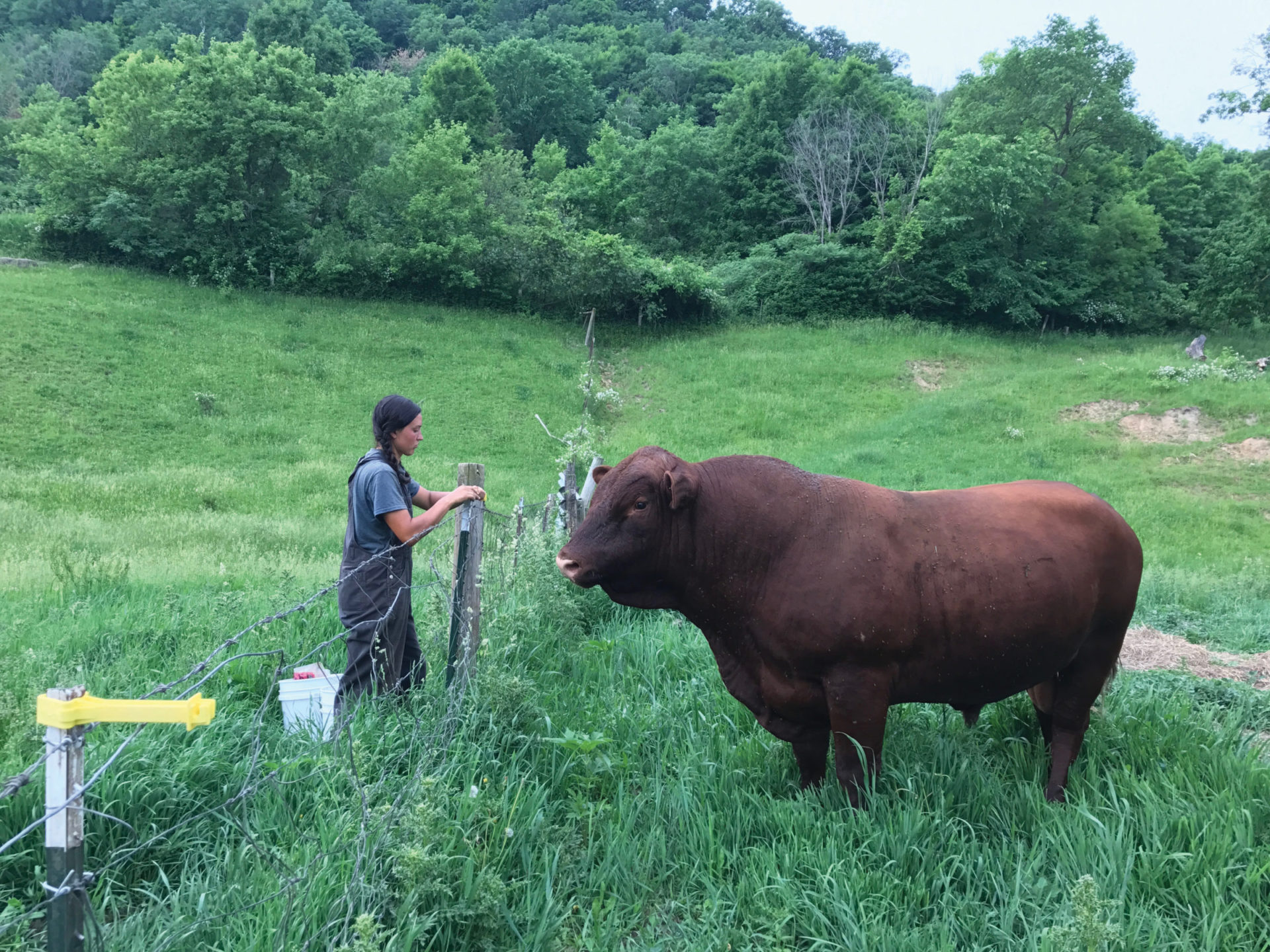
I visited Doug and Sheila Garrison’s farm a summer or two ago to meet the family of my sister’s boyfriend. His older brother had fed the hogs, and he had spooked my toddler by pulling a chicken out of the coop for her to pet. But I hadn’t known what I was looking at.
In the middle of corn country in southeastern Nebraska, the Garrisons have been quietly regenerative farming since the early 2000s. Shortly before Thanksgiving last year, I called Doug to ask what led him to raise cattle, pigs, and chickens as he does instead of the usual way.
The answer comes in two parts that I didn’t expect to see together: the “lunatic farmer” himself, Joel Salatin, and the USDA. Garrison had worked for the USDA’s Natural Resources Conservation Service since the 1980s, a time when organic agriculture was escaping California communes and garnering interest across the country. The department at the time was quite sympathetic to more “natural” kinds of farming, Garrison says. He discovered Salatin when he came out to Nebraska around 1995 to show someone Garrison was working with how to set up a regenerative farm.
Like Varisano, Garrison is a maverick. When he started out, he knew he loved farming, but he wasn’t burdened by tradition or beholden to the area’s conventional infrastructure. And like Shirk and Elliott, he was fortunate: his father-in-law had land for him to rent. So he followed Salatin’s program and started with chickens, then added ten cows in 2011. Next came pigs. Eventually he left the USDA to farm full time. Now he owns twenty of the farm’s acres and rents the rest. The whole family loves their farm and helps out when they can.
But can regenerative farmers like him feed the world? When I ask him about scaling up, it’s his sons he points to first. “I’m kinda maxed out on my production,” he says. “That’s the challenge I’m at. How can I get this thing scaled up — to give those guys an opportunity?”
The problem of scale for regenerative agriculture, to Garrison, isn’t really infrastructure, marketing, or distribution. He’s busier than ever thanks to word-of-mouth referrals, his website, and the quirky but indispensable clean-farming directory EatWild.com. But one man can only do so much, and right now, at least, the farm isn’t big enough to make it financially feasible for the next generation to join up with him. The people who bear the burdens of labor-intensive farming practices like these are often the “lunatic farmers” themselves.
That they do it for love does not, unfortunately, guarantee it will last. Garrison is of the last generation to have seen the original organic movement firsthand, to have breathed in its ethos deeply enough to try something different. That spirit of alternative farming, of seeing another way of doing it that isn’t just a pipe dream, is something that could pass away. “All the farmers are getting older,” he worries. “I don’t know how much longer you can kick it down the road.”
Still, Garrison takes heart from the fact that science is on his side. He describes how labs can easily test the nutrient levels of his ground beef to show that it’s more nutritious than the store-bought beef. But the problem is a human one. Farmers have to be willing and able to buy in, literally and figuratively. “It’s the six inches between your two ears,” Garrison says, that are the biggest barrier to improving American farming practices.
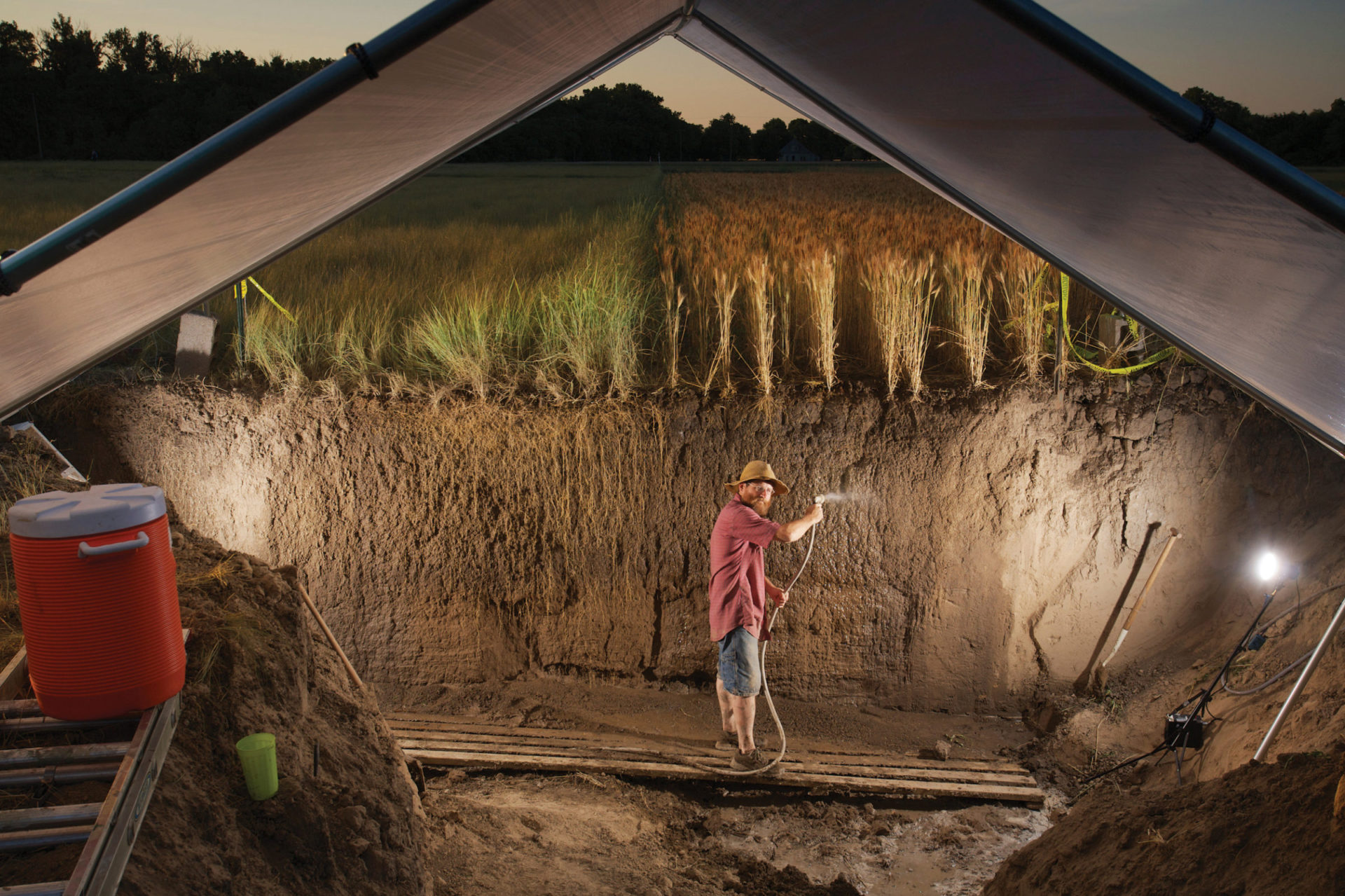
“The biggest problem is between your ears,” says Lance Gunderson, president and co-owner of Regen Ag Lab in Pleasanton, Nebraska. His lab runs the kinds of tests that back up Salatin, Shirk, and Garrison’s claims about the health of the soil and that of the crops and animals who eat out of it. The lab promotes regenerative agriculture the high-tech way, not only testing soil but teaching farmers how to move away from monocropping and heavy pesticide use toward practices that are better for their farms in the long term.
Gunderson acknowledges that regenerative agriculture can be branded as anti-technology, but his lab shows that the more scientists learn about the soil, the more they see that regenerative farmers are right to focus on the roots of agricultural practices and not just their results. And in his view, technology presents reasons for optimism that regenerative farming will win out eventually. For too long, he says, farmers have thought of soil as mere dirt instead of an incredibly complex web of nutrients. “I think of it like a jigsaw puzzle,” he says. “In order to see the picture you’ve got to have every piece.” From his outpost in the fertile Platte Valley, he teaches farmers worldwide how to turn subpar soil into productive farmland.
He doesn’t expect to turn the country into a paradise of regenerative farms. But Gunderson does try to help farmers move in that direction instead of upholding the status quo. “For me, regenerative agriculture is just taking what you have today and trying to make it a little better tomorrow,” he says. Since he works with conventional farmers to gradually improve their practices, his approach is more incremental than Garrison’s, and he probably would accept smaller changes as wins than Salatin ever would. As he sees it, though, he’s playing the long game, helping farmers to adapt as science shows that the old, chemical-based models won’t last because of the high cost to the health of land, food, and people.
All the farmers I visited would probably agree that farming better means more than increasing yields. It means thinking seriously about not just how but why we grow food, and for whom. In Warrenton, Virginia, Tom McDougall runs 4P Foods, a food hub that connects hundreds of producers to wholesale clients, hospitals, schools, and other outlets across the mid-Atlantic region. While Salatin wonders why an agricultural society needs a New York City, McDougall asks how he can fill the massive market gap cities offer for nearby farmers. “New York City does exist today, and it’s going to exist tomorrow,” he tells me in a phone call. The country’s millions of urbanites need farmers producing high-quality food, and so he feels compelled to connect them.
McDougall is involved in the ongoing debate about the definition of regenerative agriculture. As the variety of farms I’ve visited shows, it’s a flexible term. This is a strength, McDougall says. It allows farmers to find the best practices for their farm and their products instead of forcing a one-size-fits-all approach. That was one of the pitfalls of organic farming when it went mainstream. “With a certification like ‘organic,’ there’s a list of things you can do and a list of things you cannot do,” he says. “So you cannot add these chemicals and fertilizers and processes to the growing of this particular tomato. You can’t do these things. And if you do this and you don’t do that, you can get this certification.” It’s this box-ticking mania that explains why none of the farmers I visited are certified organic, though their practices would likely pass muster.
McDougall acknowledges that he’s only able to critique organic agriculture because of its success in raising American food standards in the first place. Still, he prefers an “outcomes-based” framework, in which diversity is not a bug but a benefit. “Producing grass-fed, grass-finished, regenerative-raised ground beef in the foothills of Virginia — it probably is and should look different than doing that same thing in Montana,” he says. “They’re totally different ecological systems. The scale is different. The environment is different. The soil is different. The grasslands are different.”
In addition to flexibility, regenerative agriculture can offer a consideration of shared values that establish standards not just for a few things that don’t go into one’s food but for the whole ecosystem of things that do. The goal is to change not just the food itself but the practices that affect producers and consumers.
As the movement grows, he believes, regenerative certification shouldn’t stop with just checking boxes, the way organic did when it went mainstream. “Let’s all go for outcomes that we can maybe collectively agree on, like human decency and nutrient density and healthy food and resiliency and mutual aid,” he says. “We could collectively agree on a set of food system values that align with our collective human values.”
This seems like a tall order for what most customers, if they notice it at all, will treat like little more than another health claim, a nice little thumbs-up on the back of the box. Even so, labels are starting to appear: Regenified, ROC (Regenerative Organic Certified), and a number of others. The important thing is that consumers can know what they’re getting when they look for regenerative products, and that they’re able to find and afford them when they do decide to start eating this way. Right now, awareness of the term “regenerative” is still low. According to a recent survey, over 70 percent of consumers said they were only slightly familiar or not at all.
The strength of the regenerative movement seems to be also its great challenge. The demand is high for clean food grown by farmers that consumers trust. But excellence in any art is always in scarce supply. It takes a strong culture, a blend of necessity and integrity and plain old love, to uphold it.
Agriculture is culture, a human endeavor. The kind of food a society produces can’t be separated from the way of life its people lead, any more than the flavor can be taken out of a ripe tomato. The fact that a wedge has been driven between those things — flavor and function, harvest and health — is a sign that we may be missing the point of farming in the first place. At its core, it’s not just about measuring yields and maximizing profit margins but about growing the things that make us who we are. The problem, and the solution, is in the six inches between our ears, and the fist-sized muscle behind our ribs.

Keep reading our
Spring 2026 issue
Happy meals • Ugly cities • Weak families • Powerful drones • Subscribe
Exhausted by science and tech debates that go nowhere?