For Whom Shall We Build?
Marc Andreessen wants us to go faster. But what does that matter if nobody’s left in the car?
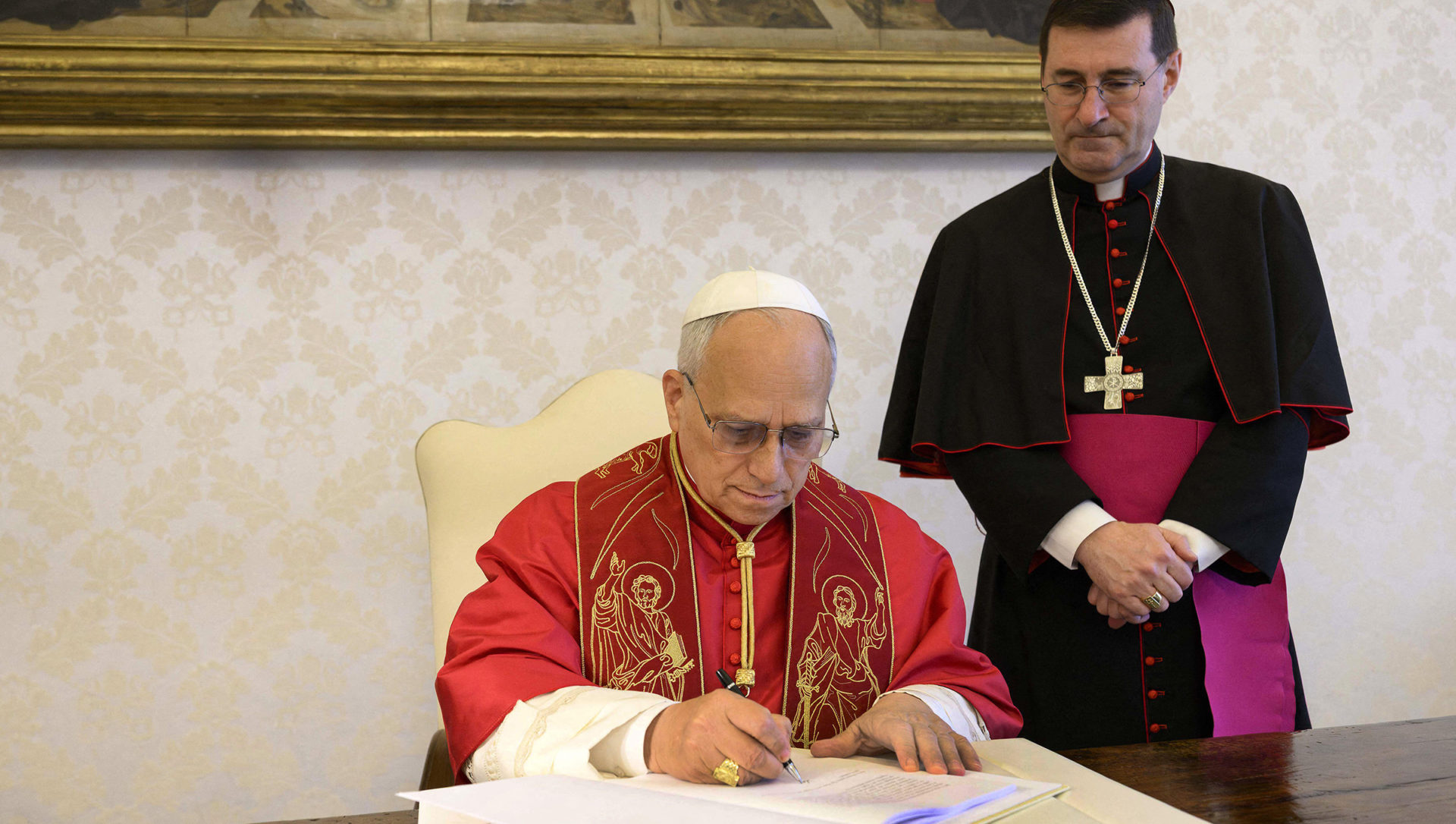
Since the beginning of his papacy a year ago, Pope Leo XIV has held out the promise of offering the world some much-needed wisdom on living well with technology. His very choice of name hearkened back to Leo XIII’s unmatched moral and intellectual leadership in framing the case for human flourishing in the face of the indignities of the industrial age. And his ambition has seemed directed to offering similar guidance, rooted in the same enduring conception of the nature of the human person, to a world coming to terms with artificial intelligence.
His first encyclical, Magnifica Humanitas, released to the world this past Monday, certainly reflects that ambition. But it also reflects the difficulties posed by the sheer magnitude of the moment. Comparing AI to capitalism is no flight of hyperbole. In its scope and consequences, the era of change now dawning could well be as transformative as the Industrial Revolution. And it is much too soon to hope to get our arms and heads around its implications.
This is one unavoidable conclusion from reading Magnifica Humanitas. Leo XIII did not offer his guidance at the dawn of the industrial age. He thought and wrote near the end of the nineteenth century, when the character of industrial capitalism had become readily evident, and the nature of the benefits it offered and the challenges it posed could be articulated and classified. Leo XIV does not have that advantage. He is, like the rest of us, straining to grasp the contours of the still-emerging age of AI.
His perception of it is powerfully shaped by the experience of the digital age we have been living through for a generation, although he recognizes that AI is something altogether different from the Internet and social media. And it is even more powerfully shaped by intellectual categories forged in the second half of the twentieth century — which are by no means useless for coming to terms with artificial intelligence but are also hardly sufficient to the task. The result is a document that does more to illuminate what we lack in this moment than to provide it, at least to the eyes of this peculiar reader.
I am Jewish, not Catholic, but my Jewish moral anthropology renders me quite friendly to the general modes of thought of Catholic social teaching. And I am about a generation younger than the Pope, which means I’m blessed and burdened with the maddening equanimity of middle age: I’m pretty sure the world did not begin yesterday and will not end tomorrow, so I think all of you should calm down.
This should all render me a very friendly reader of Magnifica Humanitas, and I left the document immensely impressed with its author. But ultimately, the encyclical strikes me as a missed opportunity, and even as a failure to grapple with the scope of what awaits us in the coming years.
I admit my Jewish heart did joyfully skip a beat when I saw that Magnifica Humanitas begins by contemplating two metaphors of construction drawn from the Hebrew Bible.
What shall we build, and for whom, are the right sorts of questions to ask in this moment. And the Pope’s choices of the Tower of Babel in the book of Genesis and the rebuilding of the walls of Jerusalem in the book of Nehemiah as stark alternatives to contemplate have a lot to offer us.
Pope Leo plausibly draws from those two sources a warning about the need to tether our pursuit of technological progress to the proper anthropology. And he insists that this conception of the human person points to the need for both moral and legal restraints on that pursuit. Babel, he argues, “reveals the limits of any effort that, however grandiose, arises from self-affirmation, sacrifices human dignity for efficiency and aspires to reach heaven without God’s blessing.” Nehemiah’s rebuilding of the walls of Jerusalem, on the other hand, is an example of a project pursued not only with such divine blessing but also with prudence about human affairs. “Therefore,” he concludes, in our time,
the primary choice is not between a “yes” or “no” to technology, but rather between constructing Babel or rebuilding Jerusalem; between a power that claims to dominate the heavens and a people who work together in the presence of God to rebuild the walls of fraternal coexistence.
This amounts to a call for restraint and responsibility, rooted in the fertile soil of Biblical religion and Catholic social teaching. Recognizing the need to address the builders of our time, Pope Leo directs this appeal to them:
With the heart of a shepherd and a father, I ask everyone to abandon the construction of yet another Tower of Babel and to join forces in building up the common good, so that humanity will never lose its beauty, and the world once again will come to recognize the human heart as the place where God desires to dwell.
All of that is, of course, a persuasive and powerful Christian approach to the ethics of technology, and not specifically directed to artificial intelligence. And indeed, a fair portion of this document is directed broadly to digital technology and not specifically to AI. It offers warnings about data privacy, sexual exploitation online, the need for age limits on the use of devices and platforms, the dangerously concentrated power of tech companies, and other now-standard concerns.
Some of these are more persuasive than others (this papal encyclical could have done without a fashionable digression on the inadequacy of GDP as an economic measure, for example), but they are all very familiar by now, and all implicitly treat the AI revolution as an extension of long-running technological trends without distinguishing its particular character. It is our next step, to be sure, but it is more than merely one more step.
When he does turn to AI in particular, the Pope begins by acknowledging that he can’t take up every facet of this emerging power. He writes:
I limit myself to recalling a few essential elements for a moral and social discernment that safeguards the primacy of the human person, in order to ensure that it will always be human intelligence, with its conscience and freedom, that guides technical innovations and responsibly determines their use and limits.
And then, in a passage well worth quoting at length, he suggests that a definition of his subject may actually only be possible in the negative:
It is not possible to provide a single, comprehensive definition of AI. What can be stated, however, is that we must avoid the misconception of equating this type of “intelligence” with that of human beings. These systems merely imitate certain functions of human intelligence. In doing so, they often surpass human intelligence in speed and computational capacity, offering tangible benefits across many fields. Yet this power remains entirely tied to data processing. So-called artificial intelligences do not undergo experiences, do not possess a body, do not feel joy or pain, do not mature through relationships and do not know from within what love, work, friendship or responsibility mean. Nor do they have a moral conscience, since they do not judge good and evil, grasp the ultimate meaning of situations, or bear responsibility for consequences. They may imitate language, behavior and analytical skills, or even simulate empathy and understanding, but they do not understand what they produce, for they lack the affective, relational and spiritual perspective through which human beings grow in wisdom. Even when these tools are described as capable of “learning,” their way of doing so is different from that of a human person. It is not the experience of those who allow themselves to be shaped by life and grow over time through choices, mistakes, forgiveness and fidelity. Rather, it is a form of statistical adaptation based on data and feedback, which can be very effective, but does not imply inner growth.
This is a fascinating but also frustrating approach to the subject. At the heart of this encyclical, Pope Leo wants to insist that we ought not imagine that AI has human characteristics. The danger, he suggests, is that we mistake it for ourselves, and thereby mistake ourselves for something less than human. But he does not offer guidance regarding how we ought to think about what AI actually is.
He may be right about what this technology is not, though his claims here strike me as too confident given his inability to even define his subject. But whether he is right or not, this approach suggests a profound uncertainty that he would have done well to at least articulate more concretely and acknowledge more openly.
With no further effort to describe what he means by the term, he then warns against AI’s excessive penetration into various domains of human life. In our personal use of the technology, Pope Leo writes, “three aspects in particular deserve careful consideration: the ease with which results are obtained, the impression of objectivity and the simulation of human communication.” All three again raise the prospect of substituting AI for human judgment and action and leaving us human beings less capable of such judgment and action, and less desirous of it.
“The danger,” he says in one intriguing passage, “is not so much that a person may believe they are communicating with another person, but rather that they may gradually lose the very desire to form genuine human connections.” Again, the risk is negative: It is about making sure we don’t mistake AI for something only we can be and so devaluing what only we can be.
When taking up other technologies in this document, the Pope is very concrete. But regarding AI, his approach evinces a genuine bewilderment. It is hard to blame him. Indeed, this may be entirely the right approach. But he does not quite acknowledge that this is what he is doing. Had he been more forthright about it, he might have given himself room to ground his altogether persuasive moral teaching deeper in the soil of the Biblical moral anthropology that he seeks to advance. He might have grounded his warnings in the danger of idolatry, even if he couldn’t perfectly identify the character of the idol that so worries him.
Maybe this is just inevitably where a Jewish response to a profound and wise Christian document like this is bound to point. But from the very outset of Magnifica Humanitas, I wanted the Pope to have much more to say about idolatry than he ultimately did.
He seems to gesture that way very early on. “We must, then, avoid the ‘Babel syndrome,’” he writes just a few pages in, “namely, the idolatry of profit that sacrifices the weak, a uniformity that neutralizes differences, and the pretense that a single language — even a digital one — can translate everything, including the mystery of the person, into data and performance.”
That “profit” is the only idol he can see in an age that absolutely teems with golden calves is frankly staggering. But I found that passage exciting nonetheless because it seemed for a moment as if the Pope was going to pursue his Tower of Babel metaphor much deeper than he did. The phrase “the pretense that a single language — even a digital one — can translate everything, including the mystery of the person, into data and performance” implied that maybe he was about to dive right into the mysteries of the very deepest meaning of AI.
He didn’t, but maybe we should, because it may be in the realm of language that the metaphor of Babel offers us the keenest insight into this moment. To be clear, I find AI at least as baffling as anyone else just now, and I am obviously no more qualified to comprehensively define it than the Pope. But I would highlight a different facet of its significance than he did. The more that I have thought and read and heard about it in recent years, the more it has seemed to me that at its deepest core what we now call AI is a linguistic breakthrough.
There is a reason the underlying models are called large language models, after all. AI has essentially broken all language barriers — not only between human languages but, more importantly, between human language and computing language.
Trained on vast bodies of data built up by millennia of human culture, and equipped with immense computing power, the models can discern deep patterns in those data and extend them. And because human beings have always expressed our thinking in natural language — in writing, speech, and the like — the patterns these models trace and extend are the patterns of our own thought in our own tongues. We English speakers, for example, can communicate with them in plain English. This is one of the most extraordinary things about what AI now lets us do. It allows people and computers to communicate with each other in our own natural language without needing to translate between that language and various forms of computing scripts. This is massively important both for the input of instructions to computers and for the output of computing work. Both have always required translation to and from highly scripted computing languages. Now, both can happen in an unscripted way: We can direct computing power to work on our goals directly, without the intercession of scripting, and we can receive the results directly in our own language too.
As Arnold Kling has brilliantly argued, “By understanding natural language, these models have transformed from tools that require specialized expertise to collaborative partners that can work alongside anyone who can articulate ideas.” This stands to unleash computing power upon our problems and priorities in unprecedented ways. Unscripted computing is an utterly revolutionary force. And it is ultimately made possible by a kind of linguistic breakthrough.
But that breakthrough must force us to confront some hard questions about what we human beings actually do when we think. AI can match an input (a prompt, a request, a question, an instruction) with an output (a reply, a written product, a slide, a video) exceedingly well. And this is part of what our thinking does, too. But we understand human thought as a distinct medium between inputs and outputs — as something that we do to consider a question and arrive at an answer. It seems to us that AI models, because they match and extend patterns of inputs and outputs without the medium of an embodied mind, don’t engage in that interceding thought. There appears to be no semantic meaning they are contending with, and no understanding of content. But there is a matching of linguistic patterns of input and output that creates a very substantial and substantive body of new expression that is very much like what human thought directed to the same subjects would produce. And the ability of the models to do that is getting better all the time.
Maybe the kind of thinking that facilitates the relationship between the linguistic patterns of input and output we have created isn’t something these systems can do. Surely they couldn’t have produced from scratch the vast bodies of data on which they were trained. But is what they’re doing some kind of thinking nonetheless? And is the thinking we humans do more than a language game? If large language models produce more useful and appealing outputs than we do, which they surely sometimes do, aren’t they better at what we use our thinking for than we are? And how sure can we be that what they do is entirely disconnected from any of the sentiments or emotions that accompany the thinking we do between a question and an answer? The Pope himself acknowledges, after all, that “all of us, including those who design them, possess only a limited understanding of their actual functioning.” So how confident can we be of what they are not?
Can we really just avoid these questions? Can we wave them away just by insisting, as Pope Leo does, that AI models just don’t think and feel, and then move on?
We don’t have to avoid these questions. They can be answered, and Pope Leo’s moral anthropology points the way to how. The answers he seems to assume strike me as intuitively right, too. But that is not enough. To be actually answered, these questions would need to be actually taken up, and taken more seriously than they are in Magnifica Humanitas.
To reach these questions in this way is to see that one way to understand the achievement of AI is as something like a reversal of God’s edict to the builders of the Tower of Babel in Genesis. In the absence of all language barriers, can we not create something as great or greater than what God created in us? Could our own creation itself be a kind of God?
Maybe that’s a silly question. I tend to think it is. But it is increasingly being asked by the very people producing these technologies, and by some of those who use them. Pope Leo could have had more to say to them than he did. His negative definition of AI seems too narrow and dismissive to me. And it invites a gross underestimation of the scale and scope of the transformation our society now seems embarked upon. To handle that transformation well, we will need precisely the moral anthropology and the philosophical categories that the Biblical religions can offer us.
The Pope gestures in this direction in the one other spot in his encyclical in which he refers somehow to the concept of idolatry. “Our first task,” he writes while offering sage advice about how to communicate clearly in an age of daunting challenges, “is neither to demonize nor idolize technological tools, but to utilize them on the basis of a fundamental principle, namely that truth is a common good and not the property of those with power or influence.”
Our new technologies are neither demons nor idols, and we must make sure to keep them that way. But it is the challenge of idolatry that will be greatest. It increasingly seems to me that the essential text of the era we are entering will be this opening portion of Psalm 115:
Not to us, Lord, not to us
but to your name be the glory,
because of your love and faithfulness.Why do the nations say,
“Where is their God?”Our God is in heaven;
and does what he wills.But their idols are silver and gold,
made by human hands.They have mouths, but cannot speak,
eyes, but cannot see.They have ears, but cannot hear,
noses, but cannot smell.They have hands, but cannot feel,
feet, but cannot walk,
nor can they utter a sound with their throats.Those who make them will be like them,
and so will all who trust in them.
Ever since I encountered this mysterious poem as a teenager, I have wondered at the image it paints of idolatry, especially in its stunning two final lines. The idols are made to seem human but do not partake of genuine embodied human experience. And both their makers and those who trust in them are destined to become like them — and so less than human — because they elevate them.
These lines have come to seem less mysterious to me in the last few years. They describe precisely the danger to which Pope Leo is pointing. It is the danger of turning our tools into idols, and thereby of becoming little more than tools ourselves. It is a danger that afflicts those who make these idols, and also threatens those who put their trust in them.
The appeal of idols has always been that they offer shortcuts. The God of the Bible demands that you live in a way that forms your mind and heart and soul toward your fullest human potential. This requires hard work but it yields a kind of person both capable and worthy of a flourishing life. The idol offers the material benefits of such a life without that formative work. And if all you care about are the benefits, not the form of your mind, heart, and soul, then the offer is awfully hard to resist.
This plainly rhymes with some of the deepest moral challenges posed to us by artificial intelligence. AI, at least used a certain way, offers us shortcuts around formative work, matching outputs with inputs without the need for the interceding effort of mind, heart, and soul. If all you care about are the outputs, not the form of your mind, heart, and soul, then the offer is awfully hard to resist.
Such temptations of idolatry are ever-present. We resist them, now as always, by allegiance to a higher truth about ourselves that is as demanding as it is liberating. And we resist more actively and assertively, too — with the help of rules of conduct that constrain our appetites, of days of rest that offer us relief from the demands that expose us to temptation, and of formative disciplines of the soul embodied in family, faith, community, learning, work, and leisure toward which we are drawn by well-ordered loves.
All of these require us to choose the long, demanding, formative way through life. But various idolatries offer us shortcuts that promise the benefit without the work: Just turn yourself into a tool and you will be more productive without more effort. This is of course just what Magnifica Humanitas warns of. It is what AI at its most idolatrous and dangerous can offer. That doesn’t have to be what AI is in our experience — not at all. But it can be if we aren’t careful.
This care about the formation of our souls seems to be where Pope Leo wants to point us. But to do so more effectively, he will need to grapple more fully with the potential, promise, and peril of the extraordinarily transformative power now increasingly falling into our hands. Magnifica Humanitas is too dismissive of what this power involves, what these technologies are likely to be capable of, and what that will mean for how we understand ourselves.
The transformation we are now embarking on will humble us. Like a number of prior advances in our understanding of the universe, it will force us to narrow the range of what we take to be uniquely human, but also to sharpen our focus upon it.
That kind of humbling comes with pain, and is most naturally experienced as loss. If we are instead to experience it as a deeper learning about the nature of the human person, we are going to need guidance from people well versed in what that nature consists of. It seems to me, from a distance, that Pope Leo XIV is such a person. I hope that he, and others of his caliber in other communities of learning or faith (including my own), are up to the teaching task before them. It’s not yet clear if anyone is.
More on AI
This article is an online exclusive. If you’ve found it helpful, we have good news:
Our Summer issue features a major new document offering guidance on how to think about AI’s challenge to what it means to be human, plus a set of short pieces on prosecution, coding, work, and opting out. Subscribe here to read it now:
Exhausted by science and tech debates that go nowhere?