
How the Government Built the American Dream House
U.S. housing policy claims to promote homeownership. Instead, it encourages high prices, sprawl, and NIMBYism.
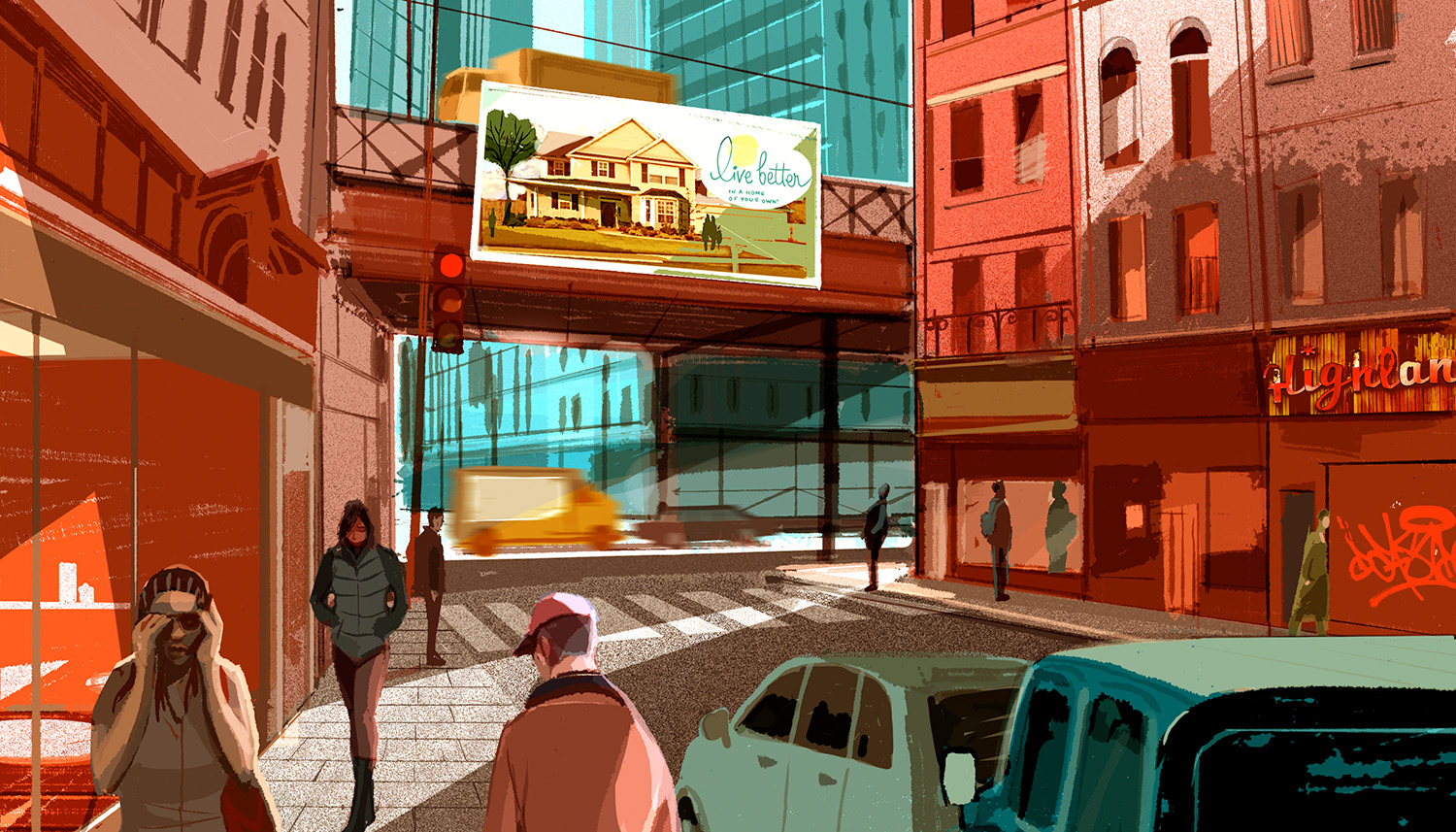
Think of what the typical American city looks like today: its hollowed-out core dotted with parking lots, its run-down inner-city neighborhoods, its sprawl.
How did this happen? Cities weren’t like this a hundred years ago. They were real cities in the sense in which most people would understand the word, with jobs, businesses, houses, churches, and every other institution related to daily life concentrated around a dense center. Today, cities are almost the inverse of that, with a large population settled out in sprawl, and a hollowed-out center where far fewer people live.
Conversations about this transformation typically collapse into a focus on attitudes about cars. On one extreme, urbanists blame an American fetish for SUVs and highway construction for our lack of charming walkable neighborhoods and the destruction of areas that might have developed into such places. On the other extreme, suburbanists view urbanists as anti-car fanatics who want to use government policy to choke off the low-density single-family housing development that has characterized America since World War II.
What they both tend to overlook is that almost all Americans today have spent their entire lives under a set of federal laws and rules that have helped hollow out the cores of our cities. Uncle Sam played a decisive role in creating the distinctive sprawling pattern we all now take for granted.
Yes, the rise of mass-produced cars is a big reason cities today sprawl. But it can’t explain why European cities developed so differently, given that their residents adopted the automobile around the same time as Americans.
The explanation lies elsewhere: in the unintended consequences of a set of well-meaning choices by federal lawmakers in the 1930s and 1940s.
The first choice was an ambitious, even utopian, initiative meant to transform American cities for the age of the automobile and suburbanization. An example of a kind of central planning rarely seen in the United States, these bills were meant to make housing in the city affordable, clean, and safe, and to limit urban blight.
The second legislative choice was a series of bills initially passed to meet the needs of home borrowers during the Great Depression and the aftermath of World War II. Those subsidies, granted at the individual level and thus decentralized, would help build out the suburbs, and come to be the defining characteristic of U.S. housing policy.
Within a generation, the first of the two — the urban renewal and public housing effort — would be abandoned. But the second one — the subsidies for mortgages and private housing — would remain in place.
Americans are now three generations into a set of policies that, on the one hand, provide open-ended subsidies for sprawl and, on the other, do little to ameliorate the problems of the urban core — and maybe even aggravate them. Over time, this has come to seem like an unalterable fact of life and the work of the invisible hand of the market. But in this case, the hand is being nudged by Uncle Sam.
Photos of St. Louis comparing how the city looked in the 1920s to how it looks today show a dramatically different layout.
In 1926, St. Louis was a dense city, not so different from its European counterparts, packed with tenements and factory buildings right up to the Mississippi River. It had neighborhoods with rowhouses made with bricks from the red clay taken from the nearby river valley, neighborhoods anchored by immigrant churches, and a system of streetcars. The city then was not so different from older East Coast cities like Boston or Philadelphia, and by extension like European cities of the time.

Today, St. Louis has a totally different look. It’s been hollowed out to a shocking extent. The population of the city proper has dropped from nearly 900,000 in 1950 to 300,000 today.

True, there are some notable landmarks downtown, such as sports stadiums and, of course, the Gateway Arch. But the most noticeable change is that much of what was previously neighborhoods — full of houses, shops, and businesses, which, whatever their shortcomings, represented urban living — is now unlivable space. Much of it is occupied by superhighways that connect the downtown to the sprawling suburbs, where most of the population resides. More of the space is accounted for by parking lots, which take up over a quarter of the downtown land. And a large amount of downtown St. Louis today is simply open unused land.
St. Louis is like many other U.S. cities. Its urban form is one that most Americans, over the decades, have gotten used to — a core with some big buildings surrounded by sparse, rundown, and unsafe neighborhoods, connected via highways to spread-out suburbs containing the majority of the population.
It didn’t have to be this way. It isn’t in Europe. As a point of comparison, St. Louis’s metro population — that is, the population of the entire built-up area of St. Louis city and the surrounding suburbs and exurbs — is roughly 2.2 million, similar to that of the Cologne and Bonn region in Germany, but it is spread out over an area three times the size.
Something happened to St. Louis between the 1920s and today that diminished its downtown and led its population out to the suburbs and exurbs — something that Cologne escaped even though almost three quarters of it was destroyed by Allied bombing in World War II.
A crucial part of that something is federal government policy.
The prewar development of St. Louis was mostly guided by the free market. As historian Mark Gelfand writes in A Nation of Cities, in 1920 “not a single dollar of federal expenditures” was spent on municipal affairs.
But two long-term trends converged to produce a sea change in American cities that would lead to a federal role in urban development.
The first trend was demographic. In 1920, the urban population outnumbered the rural for the first time. American cities had become the industrial engines of growth, drawing millions of workers not only from the countryside but also from Europe and beyond.
The second trend was indeed the rise of the automobile. As with horses, streetcars, and commuter rail before, cars altered the urban form when they became economically obtainable for the middle class. They allowed workers to live in suburbs twenty miles or more out of town, connected only by highway.
Fearful of the living conditions of people crowded into tenements in these booming cities, Congress passed the Housing Act of 1937, which would be refined and broadened in 1949, the product of years of lobbying by progressive reformers and housing advocates.
Ironically, the aim of the progressive reformers who shaped this New Deal–era legislation was to save cities, by building new, gleaming, modernist urban cores with spacious, clean, well-lit housing for the broader middle class. But when all was said and done, they instead hastened the rise of the suburbs and the exurbs and the decline of the inner city.
For example, the 1949 law would facilitate the razing of St. Louis’s Desoto Park and Carr Square neighborhoods — and similar immigrant and black neighborhoods around the country — as well as the construction in their place of Pruitt–Igoe, a project so ill-fated that it was torn down within 20 years.

For anyone familiar with the history of American cities, Pruitt–Igoe stands out as the archetype of the ghettoization, dysfunction, and undesirability associated with federal projects. It was envisioned as revitalizing the heart of the city and upgrading the existing neighborhoods, which were deemed to have substandard and backward housing stock. A series of towers, it was planned by leading architects according to the latest thinking from the social engineers of the day. In the end, they not only failed to improve the inner-city neighborhoods but ultimately destroyed the possibility of any neighborhood in the area.

The problem, in the eyes of the progressives, was slums.
In her 1934 book Modern Housing, considered the intellectual impetus for the federal legislation to follow, public housing advocate Catherine Bauer condemned the urban neighborhoods of the day, which were filled with migrants from abroad and, increasingly, the black South. The first order of business, she wrote, was to stop the construction of new slums. The second was to set “an entirely new standard of urban environment” via public housing, one that had no place for a Boston triple-decker or a New York tenement but instead ensured that all housing was built to a standard that would eliminate overcrowding and promote social hygiene.
In fact, New York City, which as a modern megacity was at the vanguard of urban trends, had already enacted several major building code laws — a legal novelty — meant to regulate tenements. But Bauer and her progressive allies blamed the ubiquitous dumbbell-shaped apartments for crime, disease, and political corruption. And she and her allies viewed code enforcement, the preferred route of private industry for rejuvenating run-down neighborhoods, as insufficient.
For that reason, the progressive housing movement entailed not just a refurbishing or upgrading of the housing already present in the years before the Great Depression, but a wholesale replacement along modernist lines.
At the time, urban modernism was gaining intellectual currency thanks in large part to a group of planners and designers led most prominently by the French-Swiss architect known as Le Corbusier. Le Corbusier envisioned cities totally remade along scientific-rationalist lines, and even called for tearing down much of Paris and replacing it with modernist structures. His idea of the “Ville Radieuse,” a blueprint for a city built with wide boulevards and tall apartment blocks spaced out to allow for ample green spaces, inspired plans for cities all over the world, including Brasília and Chandigarh. The modernist vision would be the intellectual scaffolding that progressives used for remaking American cities through law.
At the heart of the progressive criticism of the neighborhoods of the day was the idea that slums caused social ills such as disease, crime, and poverty. This was a faulty pathologization — the slums may have been associated with those problems, but they did not cause them — that lives on in popular mythology today.
It is true that the neighborhoods of East Coast cities were disease-ridden by today’s standards, on top of being plagued by crime and political corruption. But the far bigger factor than crowding in accounting for the ill health of the early-20th-century slums was the lack of access to clean water. And the recent experience of Covid, which hit rural areas just as hard as cities, indicates that it is not density per se — in the sense that city planners use the term, to mean the number of people in a given unit of land area — that facilitates the spread of airborne disease (although it does suggest that the poor ventilation of tenement buildings was a problem).
Similarly, it is not density that breeds crime. The success of New York City, America’s one true megacity, in the Giuliani and Bloomberg eras demonstrated that.
Nevertheless, the eradication of slums and reworking of the city was the goal of the progressive reformer. Edith Elmer Wood, a housing reformer who would, like Catherine Bauer, go on to influence the 1937 bill and serve in the United States Housing Authority it created, was motivated in part by the fact that she had experience seeing tuberculosis while living in Puerto Rico. As a response, she wrote a building code for San Juan.
For Wood, the goal was to turn all housing into a public utility, to allow central planners to control the standards for workers.


On their own, progressive reformers like Bauer and Wood could not have gotten federal slum clearance and public housing legislation passed. Throughout the 1930s, homebuilders and other business groups, already on high alert for activist government thanks to the New Deal, were staunchly opposed to public provision of housing.
A few factors, though, sufficiently brought around business interests for the passage of the 1937 bill, after years of wrangling.
The first was a sense on the part of city-based businesses and mayors that action was needed to prevent the decline of center cities. The advent of the suburbs had raised the threat of competition. By the 1930s, some major cities, including Boston, Philadelphia, and St. Louis, were losing population. Worse than crowded slums, to businessmen, was urban blight: that is, areas that, atop whatever social ills were associated with them, were no longer economically productive or tax-producing.
To save the cities, mayors and business owners turned to the car. A representative 1946 Urban Land Institute report from business leaders, including realtors, builders, and planners, endorsed parking as a way to save downtowns. It endorsed zoning rules to require parking and treating parking as a public utility.
The mayor of Detroit, for example, said that “highways would lure residents of neighboring areas to shop” downtown and would “retard the decentralization of business into suburban areas which pay no Detroit taxes.”
The received wisdom was that older cities had to rival the malls and industrial parks offered by the suburbs, said Howard Husock, a housing expert at the American Enterprise Institute and the author of The Projects: A New History of Public Housing, in a phone interview.
“So the whole layout of the city was altered by the focus on the automobile, easy parking, easy commuting via automobile,” he said. Of course, planners then did not consider how prioritizing auto mobility could undercut overall accessibility by reducing the number of desirable destinations.
The second factor that appealed to business owners in the legislation was that it was drafted to limit public housing construction. The 1937 bill stipulated that the construction of public housing units, which would be subsidized by the federal government in the form of capital grants or loans to public housing authorities, must be matched one-for-one by the removal of slum units. The inclusion of this “equivalent elimination” measure guaranteed limits to public housing and thus won the support of commercial landlords, who were otherwise fearful of competition from the government.
Furthermore, to prevent competition with private landlords, the statute put income caps on families that qualified for public housing, saying that their income could not exceed five times the rent.
Those provisions ensured that federally supported public housing would be oriented toward low-income families and necessarily economical, not built for the broader working class.
That wasn’t necessarily a problem, at the beginning, for reform-minded housing advocates. Guidelines implemented by the United States Housing Authority led local authorities to produce standardized modernist architecture using bricks, according to Alexander von Hoffman, a researcher at Harvard’s Joint Center for Housing Studies.
But, over time, the fact that public housing was tied to poverty from the moment it arrived in the United States would lead it to be associated with a range of social issues, especially urban disorder and racial tension. Even the brick construction itself came to be widely associated with poor people’s housing.
And subsequent legislative updates would make it even less like the modernist housing for all classes envisioned by the likes of Bauer and Wood. The National Association of Real Estate Boards, the influential trade group representing realtors, succeeded in blocking the Housing Authority’s request for additional funding beyond what was authorized in the 1937 bill, ensuring that public housing constructed under that legislation would be limited to less than 100,000 units. It then began working on draft legislation that would transform the program into a much larger anti-blight effort to be carried out by the private sector only. They sought around $40 billion — on the order of $1 trillion in today’s dollars — to be provided by the federal government to help tear down all the blighted areas around the country and have them rebuilt in a manner that would allow center cities to compete in the auto age.
While the industry did not agree with the housing reformers on the need for public housing, they did align on the idea that cities needed radical top-down transformation: A 1941 report by the National Association of Real Estate Boards called on the federal government to spurn any “piecemeal attack on the housing question which ignores the basic need of planning.” It also called for creating federal–local partnerships that would harness the financial power of Washington and the eminent-domain powers of localities to transform entire areas at industrial scale — the only scale sufficient to address the problem.
Urban planners, too, led by the prominent planner and zoning expert Alfred Bettman, sought to reorient federal efforts toward the total overhaul of cities. He was part of a group that, according to Mark Gelfand, saw in U.S. cities only “the inappropriate street patterns,… obsolete business districts, and aging factories.” Bettman and planners “dreamed of using the program to reshape American cities in a new image. In this latter view, adapting the city to the automobile would necessitate extensive realignment of urban land uses, such as converting a decaying residential neighborhood into a shopping center with acres of parking space.”
The radical ambitions of the realtors and the planners, though, were tempered by the influence of a Republican senator from Ohio, Robert Taft, who chaired a subcommittee on housing and urban redevelopment.
A key report from Taft stated that federal aid would be provided only to projects that were “predominantly residential.” It was a major defeat for planners who hoped to redo cities altogether, instead limiting the scope mainly to housing. Taft, a fiscal conservative who would later engineer arguably the only significant cut to federal spending in the modern era, believed that the federal government’s role extended only to slum clearance.
The concept of more subsidies for public housing also alienated business groups like the American Bankers Association, which did not want to be put into competition with the federal government. They were able to block passage of the bill for four more years.
But the revamped housing bill passed in 1949, establishing for the first time the goal of the federal government to ensure “a decent home and a suitable living environment for every American family.”
This is a point to emphasize: At the beginning of the prewar period, the focus of Congress and stakeholders was on urban renewal and public housing to ensure that American cities could provide affordable and adequate housing for the country. They had no such lofty ambitions for the various laws that they were enacting at the same time that created insurance for mortgage lending. Yet the mortgage programs would, over time, become the far bigger influence on American patterns of development.
The 1949 law boosted funding for slum clearance, and set a goal of the creation of more than 800,000 affordable housing units over the next six years. It further limited public housing to lower-income earners.
Title I of the law, providing funding for slum clearance, was to be the authority by which neighborhoods across the U.S. were torn down.
It was the law that allowed for numerous projects undertaken by Robert Moses in New York City that significantly altered a number of neighborhoods. It also provided for slum clearance in the black DeSoto–Carr neighborhood of St. Louis to allow for the Pruitt–Igoe complex. This was just one of over 2,000 urban renewal projects it funded across the country.
The law was a sort of ugly compromise between the demands of progressive reformers who wanted to improve the housing stock in line with their own ideals, city planners who wanted to rationalize the layout of the city, and businessmen and mayors who wanted to reverse the decline of center cities relative to suburbs by enticing those with money to live and work downtown.
That proved to be too many goals in tension with each other. “Seldom has such a variegated crew of would-be angels tried to sit on the same pin at the same time,” reformer Catherine Bauer would write a few years later, when it was starting to become clear that the hopes she and other reformers had placed on the legislation would not be realized. The 1937 and 1949 laws were originally envisioned as leading to the construction of the gleaming Le Corbusier–style radiant cities. But, after their provisions were reworked and twisted to mollify all the interests who had a say in the legislative process and implementation, the provisions of the laws ended up having a much different effect. They cashed out as public housing projects for the poor, like Pruitt–Igoe.
The value of those projects would come into question soon after they were constructed.


Some of the projects created by federal urban renewal were initially well received and even beloved by the first wave of residents. One early resident of Pruitt–Igoe, for instance, called it “a big beautiful place, like a big hotel resort.”
But it didn’t last. Many projects backed by the federal government, and thus geared toward poor families, degraded relatively quickly and fell out of favor with both the people they were supposed to benefit and with the government and the public. (Some non-federal housing projects were reserved for better-off families and aged better.) Pruitt–Igoe itself, a project of 33 eleven-story towers set on 57 acres, was celebrated at first as an achievement of modernism. It was intended to be a mix of low-income and middle-income families, and segregated. But after segregation was banned, it eventually became exclusively black and poor.
It developed a reputation as a magnet for crime and dysfunction, and the picture of a dangerous urban “ghetto,” AEI’s Howard Husock told me.
It is worth noting that the association of the inner city with gangs and crime that holds in America is not universal. In France, for instance, it is the “banlieue” suburbs of large cities like Paris and Lyon that have bad reputations. Here, the crime wave of the 1960s explains much of the subsequent flight to the suburbs.
Federal support for the public housing aspect of urban policy, then, began to fade not long after the passage of the 1949 law that spurred thousands of public housing projects. Even in 1954, Congress was already chipping away, passing a housing act that allowed for-profit housing to be part of the mix in projects that involved slum clearance. With the added force of the crime wave to come, by 1973 President Richard Nixon was specifically citing Pruitt–Igoe as an example of a “federal slum” in announcing a moratorium on new public housing projects, soon after demolition of the project commenced.
The moratorium, and legislation that would follow, firmly put the federal government on a trajectory away from public housing. The stock of public housing has stagnated or declined since 1980, while the federal government’s support for affordable housing has shifted in the direction of providing vouchers or subsidizing units through the tax code or credit programs. Today, the concept of federal housing projects is largely an anachronism, and Congress, if anything, is likely to accelerate the shift away from managing units in the years to come.
Why did the federal public housing program have such a short lifespan?
The utopian vision for public housing could never compete with the programs set up in the New Deal to promote private housing. In 1932, Congress created the Federal Home Loan Banks to increase bank home lending. In 1934, it created the Federal Housing Administration, which began to insure mortgages, providing lenders protection from default and increasing overall funding, including for multifamily development. In 1938, the government also created Fannie Mae, then a government entity, to create a secondary market for the loans insured by the Housing Administration. The government’s involvement in mortgage finance would ramp up massively at the end of the war. The Servicemen’s Readjustment Act of 1944, better known as the GI Bill, paved the way for the standardization of the thirty-year mortgage.
After 1949, the suburbs dominated the inner cities in growth — by a factor of ten, according to Alexander von Hoffman. More than half of the suburban homes built after the war were partly financed by federal mortgage instruments. The rise of the suburbs was aided too by the Federal-Aid Highway Act of 1956, which led to the construction of superhighways out of downtowns into the suburbs.
By 1970, just before Nixon’s moratorium on public housing, the United States had become a plurality suburban nation. In the years since, it’s become majority suburban, and the government’s role in mortgage finance is larger than ever, and an outlier by international standards.
Between 1934 and 1960, homebuyers in St. Louis County took out almost 64,000 mortgages, compared to only about 12,000 in the city.
This trend both caused segregation and in part was driven by it. The availability of mortgages to upwardly mobile families aided them in their quest to get out of the center city — and in St. Louis’s case, into a different nearby municipality altogether. At the same time, it left blacks more isolated in the center cities and more likely to end up in public housing.
One factor to be considered, Husock told me, is that the availability of public or subsidized housing undercut landlords and sapped the vitality of other, healthier neighborhoods. And the presence of giant crime-ridden, ill-kept projects gave the city center a bad name, spurring families to leave.
“I have to believe that was just so polarizing, centrifugal, that it pushed people out to the suburbs,” he said.


Urban planners, historians, economists, and others have not arrived at a consensus regarding what was lost when historic neighborhoods were torn down at the bidding of the federal government.
The scant econometric studies that have been conducted on the outcomes of urban renewal are not conclusive, and suggest that the projects might even have been modestly helpful to cities overall in terms of median incomes, population, property values, and other economic variables. It’s also true that cities undertook many slum clearance and redevelopment projects without federal backing, and that some cities, like Houston, spurned federal funding altogether.
On the other hand, it appears that urban renewal likely contributed to segregation — a situation in which black poverty became associated with the inner city and projects — while spurring white flight. Famously, civil rights activist James Baldwin in the early 1960s complained that “urban renewal means Negro removal.” Of the roughly 1 million people that were displaced by urban renewal projects, roughly two thirds were black.
They lost, both financially and culturally. It is far from clear that they were moved from slum living to quality housing. Many who were supposed to be relocated to new projects never were and instead ended up in neighborhoods into which they were never integrated, and many received compensation below what they lost, meaning they bore the costs of the renewal efforts.
Meanwhile, some locations that were spared from renewal have gone on to become some of the most desirable real estate in the country, such as parts of Brooklyn’s Park Slope, or Boston’s South End.
Husock called the failure of the planners of yesteryear to imagine the success of those neighborhoods the “snapshot fallacy.” The planners condemned neighborhoods based on their struggles at one point in time, not realizing that they could come back to life and compete with the suburbs if cities had kept them clean and safe.
At the dawn of federal housing policy, central planners decided on slum clearance and subsidized public housing as the path to pursue for cities.
They could have chosen a different route, Alexander von Hoffman, of the Joint Center for Housing Studies, told me in a phone interview. They could have promoted homeownership, rather than rental housing. They could have embraced plans, offered by the private housing industry, to focus on enforcing building codes and rehabilitating run-down housing, thereby enlisting the private sector in rejuvenating neighborhoods. Or, they even “could have done nothing.”
Other countries have indeed chosen different paths. Indonesia, for example, avoided bulldozing “kampungs,” or informal settlements, and instead, since 1969, has sought to integrate them into formal housing by providing roads, clean water, and sanitation.
In the end, though, the American push for rationally designed new cities of modernist housing failed because it was led by central planners who lacked a constituency for their designs.
“The attempt to revive downtown was to a certain degree contrary to the prevailing trend in American lifestyles,” the historian Jon Teaford told me by email. “Americans in the postwar era wanted development that provided ample parking, was deemed safe, and was racially homogeneous. Mortgage guarantees fit the bill, urban renewal projects less so.”
A critical point is that the urban workers of the first half of the century, many of whom were new to the city, chose to live in low-quality housing because it meant opportunity. By condemning the cheap housing of the day as slums and demanding that housing be constructed to certain standards, planners mandated that families maintain a certain level of housing consumption. The 1949 Housing Act guaranteed American families higher housing standards, but failed to recognize that many families were willing to crowd into dumbbell-style apartments or triple-deckers if it meant access to better jobs or a friendly community.
Catherine Bauer, whose work helped build the reality we have now, ironically foretold this outcome in 1934 in her book Modern Housing. She wrote then that European governments had built newer and better public housing because labor and the public had demanded it: “housing was not bestowed from the top down in Europe any more than it ever will be in America,” she wrote.
Those words proved true, just not in the sense she meant. Americans never did want public housing financed by the federal government. In the decades since it first became available, the only people who’ve lived in it are those who did not have much choice. And even they are fewer in number every year.
Instead, workers and the public opted by the tens of millions to take up the other offer from the federal government, using subsidized mortgages to finance private home buying. Although three generations later this choice seems like one that Americans continue to freely make, it was largely predetermined: the government’s failed public housing reform forced the market’s hand. The result of all this was the transformation of the United States into the suburban nation we see today.
The essay series “The Lonely Neighborhood” is supported by grants from Fieldstead and Company and from the National Endowment for the Humanities. Any views, findings, conclusions, or recommendations expressed in this series do not necessarily represent those of the National Endowment for the Humanities.
Exhausted by science and tech debates that go nowhere?