






















Nuclear Policy and the Presidential Election

by Henry Sokolski

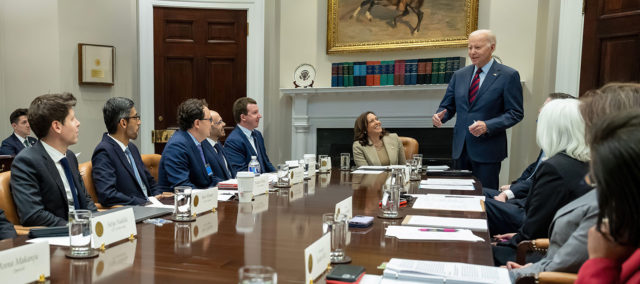
When it comes to nuclear policy, Senators Barack Obama and John McCain sometimes seem to be reading from the same sheet. They share many of the same broad goals for fighting proliferation, negotiating arms reduction agreements with Russia, investing in nuclear power, and more—but there are some important distinctions. Henry Sokolski outlines the four crucial questions shaping the nuclear debate and explains just where the presidential candidates differ on each. READ MORE

Rethinking Public Opinion

by Thomas Fitzgerald

In 1936, George Gallup successfully predicted the re-election of President Roosevelt by means of an innovative population sampling method. Today, public opinion polls derived from Gallup’s method are conducted to illuminate everything from Americans’ political priorities to religious beliefs to what consumers look for in a tube of toothpaste. But has polling technology kept up with the times? Thomas Fitzgerald discusses the problems of polling—and argues that we need to reconsider the elusive concept of public opinion itself. READ MORE

The Changing Climate Debate

Conservatives and the Carbon Tax

by Jim Manzi

If you believe that human emissions of carbon dioxide create a significant risk of harmful climate change, the solution seems obvious: reduce emissions today to prevent potential problems tomorrow. But how should they be reduced, and at what expense? Jim Manzi weighs the costs and benefits of taxing carbon emissions and argues for a more practical, science-based approach.   READ MORE
 

The Polar Bear as Trojan Horse

by Jonathan H. Adler

The polar bear is “the iconic example of the devastating impacts of global warming on the Earth’s biodiversity,” according to attorneys at the Center for Biological Diversity. How can that be, if there are more polar bears alive today than there have been in decades? Jonathan H. Adler recounts how the photogenic polar bear was used to transform the Endangered Species Act into a tool for regulating greenhouse gas emissions.   READ MORE
 

Taking the Earth’s Temperature

by Jordan R. Raney

Discussions about climate change and what to do about it frequently involve comparisons of the “global mean temperature” of various times in the past. But how do we know how hot it was 10,000 years ago? And what does it mean for a single number to represent the Earth’s temperature as a whole? Jordan R. Raney explains the techniques used to gather evidence about our planet’s temperature history.   READ MORE

Donated Generation

by Cheryl Miller

Until fairly recently, children conceived with donated gametes knew next to nothing about their anonymous biological parents. But those children are growing up and speaking out about their wish to know their origins, and a pioneering group of clinics has begun to offer an alternative—“open donations.” Cheryl Miller talks to clinicians, advocates, and parents about the implications of releasing the identities of donors. READ MORE

Montesquieu and the Motives
for Science


MontesquieuThe great eighteenth-century French political philosopher Montesquieu was immensely influential in the development of the ideas behind modern liberal democracy -- but he wrote about a larger variety of subjects than we normally associate with him.
 
The New Atlantis is pleased to publish a lecture delivered by Montesquieu in 1725 on the motives that ought to move free peoples to study the sciences; it appears here for the first time in English. This is accompanied by a commentary essay by the translator, Diana Schaub, professor of political science at Loyola College and a contributing editor to The New Atlantis.

At Home with Down SyndromeAt Home with Down Syndrome

by Caitrin Nicol

New parents confronting a diagnosis of Down syndrome are told of the medical complications and learning problems their child will have in a way that does little justice to the dignity and potential of persons living with a disability. Caitrin Nicol reads memoirs offering a more human view of the experience of Down syndrome.   READ MORE

[Photo courtesy Gifts]

Health Care 2008: A Political PrimerHEALTH CARE 2008:
A POLITICAL PRIMER

by James C. Capretta

Reform of the U.S. health care system is a tremendously complex undertaking, and while it may seem that those who support government-run health care are nearing victory, James C. Capretta argues that proponents of market-based reforms are starting to coalesce around a workable and politically practicable program—one that would make much-needed incremental changes without disrupting existing arrangements for Americans satisfied with the health care they have today.   READ MORE
 
[PLUS: Read Mr. Capretta’s health care policy blog, Diagnosis.]

From the Last Issue...

Pipeline Diplomacy: Russian Gas and Putin's Power

by Adam Blinick

High on the list of motivations for the invasion of Georgia this month was Russia’s desire to protect its investments in oil and gas exploration in the disputed territories. Adam Blinick explains the growing importance of the energy sector to Russia’s economic strength and international prowess.


READ MORE

Is Stupid Making Us Google?

by James Bowman

The new generation of “netizens” are plugged in, wired up, and all tricked out with MySpace and YouTube—but they don’t know how to read. So says Mark Bauerlein, who argues in his book The Dumbest Generation that technological proficiency is replacing fundamental skills like logic and analysis at every level of the education system. James Bowman looks to longstanding self-destructive trends in the Academy to account for this collapse in cultural transmission. READ MORE


We Are the Change We’ve Been Waiting For

by Sebastian Waisman

Can Facebook save the world? Young, idealistic voters who congregate on social networking websites may be marshalling themselves into an unstoppable political force—or maybe they’re mostly just posting party pictures and downloading music. Sebastian Waisman rebuts the deeply silly claim found in the new book Millennial Makeover that social networking websites will help us get beyond outdated democratic policy debates to a new dawn of sharing “everything with everyone.”
READ MORE

Wendell Berry

Technology, Culture, and Virtue

by Patrick J. Deneen

In the era of airplanes and iPods, computers and cell phones, few of us have any understanding of such basic things as where our food comes from. Knowledge of how to care for the world around us is no longer being transmitted through the generations—as commentator Wendell Berry puts it, we live “at the far side of a broken connection.” Patrick J. Deneen explores Berry’s call to revive this lost culture, beginning with a conversation with nature. READ MORE

ALSO IN THIS ISSUE: Wendell Berry on philanthropy and rural revival.

The World Made New

by Rita Koganzon

Coming of Age in Second LifeHave you ever wanted to be taller? Faster? More gregarious? A vampire? A squirrel? Rita Koganzon takes a trip through virtual reality, reviewing two new books about Second Life, the online metaverse where self-invention is the rule. READ MORE


The Brat Pack of Quantum Mechanics

by John Derbyshire

The Brat Pack of Quantum MechanicsIn 1932, the leading lights of physics gathered in Copenhagen to hash out the workings of modern quantum mechanics, and found time for comic relief with a spoof on Goethe’s Faust. John Derbyshire follows the ideas and careers of the central figures in this “struggle for the soul of physics.”
READ MORE


The Prudence of Neuroscience

by Ivan Kenneally

The Prudence of NeuroscienceIn the eyes of modernity, where the piercing mathematical precision of abstract rationality reigns supreme, what room is there for inexact but good old-fashioned common sense? Postmodernity offers it a home in narrative, a favorite repository for the intrinsically subjective, which Leslie Thiele aims to reconnect to empirical reality by means of neural mapping. Ivan Kenneally defends it from this strange marriage in his review of Thiele’s book, The Heart of Judgment. READ MORE

E-mail Updates

Enter your e-mail address to receive occasional updates and previews from The New Atlantis.

Book Discussion

Being Human in the Age of Technology

Eric Cohen on In the Shadow of Progress

From left: Cohen, Kass, Saletan, and Kristol 

New Atlantis editor-at-large Eric Cohen discussed his new book in a July 16, 2008 lecture at the Ethics and Public Policy Center. He was joined by William Kristol, editor of the Weekly Standard; William Saletan, national correspondent for Slate; and Leon R. Kass of the University of Chicago and the American Enterprise Institute.

[Permalink]

Einstein's Quest for Truth

by Algis Valiunas

“Nature,” Einstein once said, “is the realization of the simplest conceivable mathematical idea.” For all the many complications of the famed physicist’s personal life and public career, his scientific work was grounded in his conviction that nature was orderly and harmonious. READ MORE