One to Zero
How to destroy the future
One day, Mrs. Pengelley came to London seeking the assistance of Hercule Poirot, Agatha Christie’s Belgian detective with the mustache, whose “little grey cells” assist him in solving mysteries. With a troubled look, she tells him that she fears she is being slowly poisoned. The doctor doesn’t see anything much the matter, she says. He attributes the stomach trouble to gastritis. She even sometimes improves, but strangely this happens during the absence of someone in her life, confirming in her a certain suspicion.
After listening to her tale with great interest, Poirot agrees to take up the case. He sends the lady back and plans to catch a train the following day to begin his investigation. Discussing the matter with his close friend, Captain Hastings, Poirot admits the case is especially interesting, even though “it has positively no new features,” because “if I mistake not, we have here a very poignant human drama.”
When Poirot arrives the next day, he discovers that the lady has been murdered after unwittingly taking the final dose of poison. Having found the case intriguing enough to look into it, Poirot chastises himself, a “criminal imbecile,” for not having taken her story more seriously. “May the good God forgive me,” he declares, “but I never believed anything would happen at all. Her story seemed to me artificial.” Had he been convinced enough to return with her right away, he might have saved her. All that remains for him now is to catch the murderer.
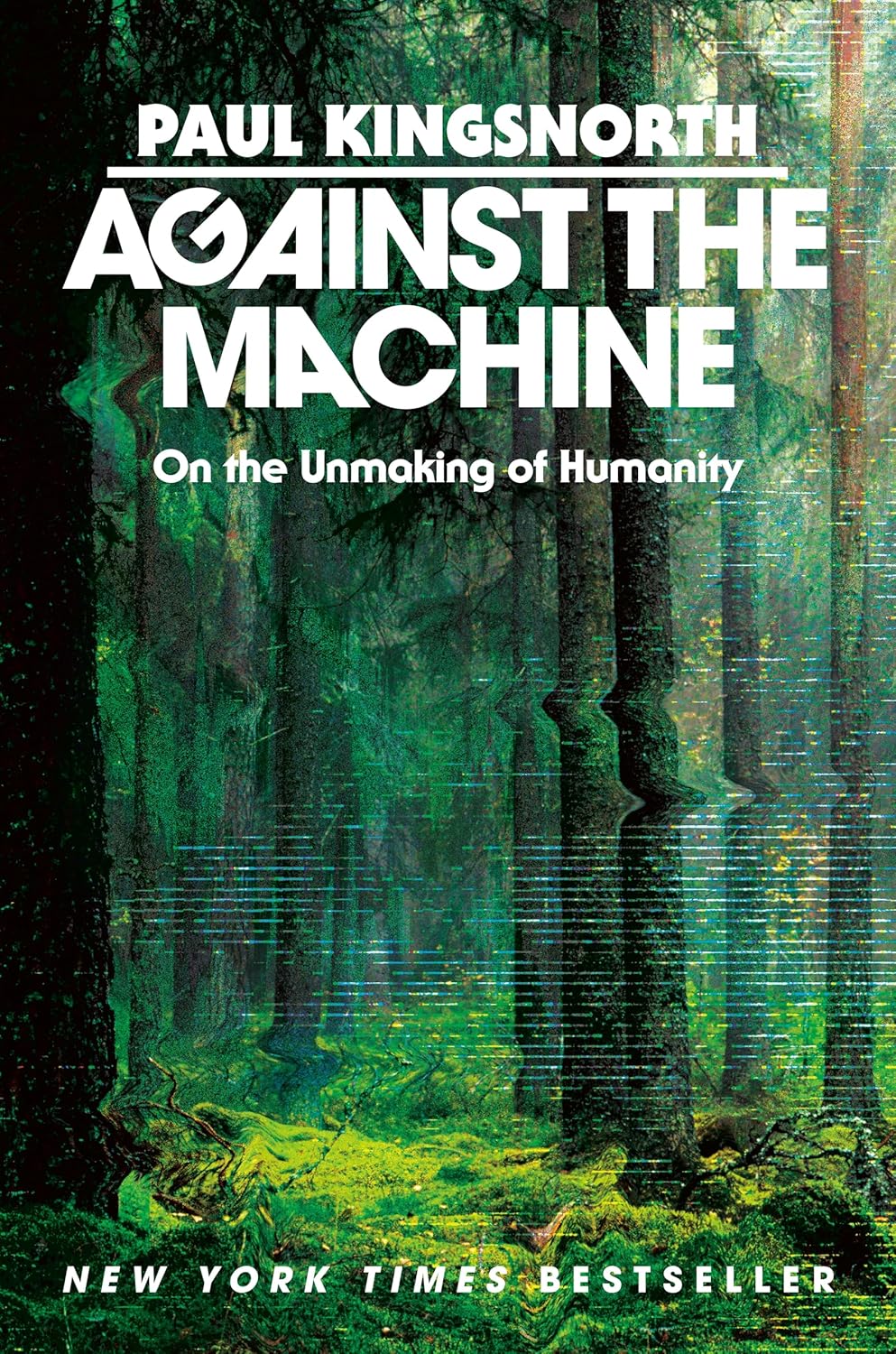
“The Cornish Mystery” occurred to me while reading Paul Kingsnorth’s new collection of essays, Against the Machine: On the Unmaking of Humanity. In the story he weaves, a sinister force has been lurking for some time within our civilization, especially in the West. His suspicion falls upon something to do with science, technology, and how we misapprehend the world. It has been slowly sapping away at our life, creating problems that have been diagnosed as this or that malady and treated with such and such a remedy. Sometimes we feel better. And yet, we sense we are being dehumanized, unmade, that something essential is being destroyed piece by piece. Such a process is hard to pin down. This is the genius of murder by slow poisoning: it leads to doubt and misattribution. There is little ambiguity about a gunshot to the heart. Yet when killing dose by dose, one easily mistakes murderous intent with the body’s frailty, a lingering affliction, or incidental complications: murder disguised as natural causes.
And so, as Mrs. Pengelley appeals to Poirot for help, Kingsnorth appeals to us for our attention. His tale, holding traces of a crime in action, leaves us with a choice: How much do we believe it? Will we take the train today?
Kingsnorth, an Englishman who lives in rural Ireland, has been sounding some version of his warning for over two decades, as a journalist, novelist, essayist, and poet. Against the Machine gathers together some of his more recent essays, coming from both a time of heightened crisis and a spiritually dense period of his life.
We may recall how, beginning in late 2020, journalists, Twitter personalities, and authors found themselves increasingly censored for their reporting on Covid. In one of those moments of perfect alignment, a new online platform for writers had opened its doors only a few years before and now became the place for dissident, fired, and canceled authors to continue their work. Being edgy then had the effect of being listed on the index of prohibited blogs. You were unpublishable elsewhere, which meant you had a growing readership, as many readers were eager to hear and support voices outside the mainstream. It was in 2021 that Kingsnorth began his Substack, The Abbey of Misrule, which is the basis for this book.
His warning at the time was that the global response to the pandemic was “pure technique, all the way down”:
authoritarian control at an unprecedented scale; a narrow focus on an equally narrow set of carefully calculated numbers; official projections guiding social behavior; the anointing of a clerisy of official spokespeople intoning “Follow the Science” like a hushed prayer; collusion between state and media to promote an ever-changing approved narrative and suppress questioning voices …
And so on goes the litany of menacing developments. For Kingsnorth, as for many others, the pandemic response laid bare for all to see some of the underlying forces at work deep within our civilization, and what he saw was disturbing. His Substack, and thus this book, is the record of that discovery.
There is another reason, however, why his Substack marks a new moment in his thinking. Also in 2021, he published in First Things his essay “The Cross and the Machine,” which tells the story of his conversion to Eastern Orthodoxy. Having rejected the spirits of his Wiccan past, not without some spiritual warfare, he found in Christ a radical, revivifying hope. Gradually, his faith began to infuse itself into his writings.
Covid and conversion thus serve as the backdrop for these essays. The lesson Kingsnorth has taken from both is that “the Machine” is as much a physical as a spiritual threat.
The culprit of our slow poisoning is the always-capitalized Machine. So then “what exactly is this Machine, where did it come from and how might we pin it down?” Eagerly I awaited the unveiling of Kingsnorth’s answer. But it never comes in the way you would expect.
In a way, I was not wholly disappointed. Like one of detective Poirot’s cases, there is no lack of hints and traces and evidence. But what they add up to is a great everything pointing in many directions. For example, one answer to the question appears in a reflection on Lewis Mumford’s classic book The Myth of the Machine: “This then, is the Machine. It is not simply the sum total of various individual technologies we have cleverly managed to rustle up…. The Machine is, rather, a tendency within us, made concrete by power and circumstance, which coalesces in a huge agglomeration of power, control and ambition.”
So the Machine is an impulse. But it is also a spiritual presence, a new god we have enthroned, replacing Christian or earlier powers. In the essay “The Universal,” Kingsnorth writes about computers, particularly AI, that they are “not just machines.” They are “a body whose mind is in the process of developing; a body beginning to come to life.” We are not disenchanted but bewitched, enthralled to new and malevolent entities. Every time we look into the obsidian-black rectangles, we are paying our attention to something, and to someone.
The Machine is many other things besides. It defines our “Faustian age.” It is a sovereign “dressed up as mere ‘economy.’” The building of the Machine can be found at the beginnings of civilization, especially the serpent in the garden, and with the Egyptians. Centralized civilizations, “which coalesce into megamachines,” grow and progress and revolutionize, and “like Sauron, they will always rise again.” The Machine emerges through capitalism. Augustine and Thomas Aquinas contribute to it, enabling “the philosophical separation of humanity from the rest of nature, and the rest of nature from the divine.” The city is an omen of its presence: “Once a society becomes primarily urban, it is locked into a process of metastasising growth which will, in the end, lead to the destruction of other ways of being.” “The Machine is the liberal anticulture made manifest.”
One way to read Against the Machine is as a local telling of a world-historic drama, a cosmic sci-fi horror, with menacing black ships on the horizon and rebellious villagers conspiring at the pub, as told by a seen-it-all sage whose loves are bold and whose hopes have cooled but not died.
At his best, Kingsnorth is a storyteller. It is often the images, not the ideas, that linger after reading. For example:
Sometimes I lie awake at night, or I wander in the field behind my house, or I walk down the street in our local town and think I can see it all around me: the Grid. The veins and sinews of the Machine that surrounds us and pins us and provides for us and defines us now. I imagine a kind of network of shining lines in the air, glowing like a dewed spiderweb in the morning sun. I imagine the cables and the satellite links, the films and the words and the records and the opinions, the nodes and the data centres that track and record the details of my life…. I see this thing, whatever it is, being constructed, or constructing itself around me, I see it rising and tightening its grip, and I see that none of us can stop it from evolving into whatever it is becoming.
Best, in other words, to appreciate the series of essays as episodes of an unfolding story than to await an argument Kingsnorth means to defend. As for what the story is, as best as I can make out, it begins the moment mankind wanted to take control of the world and is reaching its crescendo where the control turns around and destroys mankind. The story is old, the villain cunning, and man the gullible victim.
And what is to be done? The answer to the Machine, for Kingsnorth, lies not in the Right or the Left, not in capitalism or communism, not in some ideological system or set of conceptual abstractions. It is all but beyond words, since even the written word, as he has explained elsewhere, may mark the beginning of the Machine age. The human scale Kingsnorth calls for is hard to describe or pin down. “It cannot be labelled,” he writes.
The closest we may get in the book to a description of how to secure a more humane future is the term “reactionary radicalism,” which Kingsnorth borrows from sociologist Craig Calhoun. It is a way of life that thrives on tradition, in a local place, in prayer, among a people. “The moral economy rarely makes rational sense. But it makes human sense, which is what matters.”
Does the book convince — or, like Poirot, will it be just enough to pique our interest but not move us to action?
Many will surely share enough genuine concern about the direction of our civilization that they will, so to speak, buy a train ticket straightaway. For my part, I confess I feel a bit of Poirot’s hesitation. Some of the grand, unoriginal claims give me pause, and I linger. They are too vague to call either correct or incorrect. If, for instance, a drive for ambition and control signals the Machine, then, to quote from the Coen brothers, “who isn’t who is?”
Another reason for my hesitancy is this: I wish Kingsnorth were more open about the disagreements between himself and his interlocutors, the disputes within the story he is weaving.
An instance of his brushing over an important difference can be found in the essay mildly entitled “The West Must Die.” Here, Kingsnorth writes an extended review of Iain McGilchrist’s 2019 book The Master and His Emissary. Kingsnorth observes that “the contemporary Western gaze is the gaze of the Machine; of Enlightenment Man, of cosmopolis, of reason, of money.” The man to help us correct our vision is McGilchrist, whose lengthy and thrilling book about the two hemispheres of the brain describes how we have relied overmuch upon the analytical and manipulatory representation given to us by our left hemisphere and all but abandoned the intuitive and unifying presentation of the world given to us by our right hemisphere. Whereas the left hemisphere is meant to be the faithful aide-de-camp of the right, it has become our master, and our world is becoming a lump of parts for our grasping domination.
There is certainly a good deal of overlap between McGilchrist’s tale and that of Kingsnorth, a great deal of shared sympathy and concern. One of the blurbs for Against the Machine is McGilchrist singing its praises, and Kingsnorth recently hosted an online conversation with McGilchrist as the first in a podcast series to publicize the book. Yet for all their agreement, there seems to be some serious — and fruitful, if explored — disagreements between them, the kind I wish Kingsnorth had mentioned in his book.
Both agree that the left (analytic) hemisphere cannot give a complete picture of the world and can even, when given priority over the right (intuitive) hemisphere, lead to a distorted representation of the world that will imperil our way of living in it and thinking about it. Yet Kingsnorth’s view of reason, science, and technology seems at best ambiguous and more often unequivocally condemnatory. The gaze of the Machine is, among other things, that of “reason.” The “defenders of the West,” he notes, “will defend empire, science, rationality, progress and nuclear fission until the cows come home.” Elsewhere he seems aware of some needful distinction, for example: “We can seek to be reasonable rather than rational, and to distinguish intelligence from wisdom.” There are rare moments where Kingsnorth uses the term rationalism, yet he draws no clear distinction between being rational and being rationalistic, nor is there a satisfying explanation as to why being reasonable is good while being rational isn’t.
This stands in contrast with McGilchrist, who at several points in The Master and His Emissary praises science — properly understood contra scientism — civilization, reason, and technology. At the close of his initial treatment of the two hemispheres, McGilchrist anticipates a confusion:
I do not wish to leave the impression that it might be a good thing if the entire population had a left-hemisphere stroke. I take it for granted that the contributions made by the left hemisphere, to language and systematic thought in particular, are invaluable. Our talent for division, for seeing the parts, is of staggering importance — second only to our capacity to transcend it, in order to see the whole. These gifts of the left hemisphere have helped us achieve nothing less than civilisation itself, with all that that means. Even if we could abandon them, which of course we can’t, we would be fools to do so, and would come off infinitely the poorer. There are siren voices that call us to do exactly that, certainly to abandon clarity and precision (which, in any case, importantly depend on both hemispheres), and I want to emphasise that I am passionately opposed to them. We need the ability to make fine discriminations, and to use reason appropriately.
While Kingsnorth notes that we would ideally use both hemispheres, there yet remain, it seems, some points where he and McGilchrist sharply diverge.
These moments of divergence I often find more intriguing than where Kingsnorth and his sources are of the same mind. I cannot say, for instance, what praise Kingsnorth would sing to reason, whether he would call an Aristotelian definition a good thing for humanity, or whether he would include Boolean logic among the features of Machine thinking or not. This is not to say that he wouldn’t — I am honestly unsure (but a little doubtful). And it is his unwillingness to entertain these difficulties, these moments of ambiguity and possible error, that give me pause.
And yet I don’t find Kingsnorth’s story overall to be specious. Something indeed is afoot, and it may indeed destroy us. And this is the terrible challenge of Kingsnorth’s book. I might wish for a more compelling account. Yet, being slowly destroyed is itself a state of ambiguity, the definiteness of which is found precisely when it is too late. Something is being unmade, and if we wait till we are certain of the details, the risk taken in delay is complete forfeiture. A human future, whatever may come, may depend on taking definite steps before one has complete confidence.

Keep reading our
Winter 2026 issue
Dinergoths • Empty cities • Obesity wars • Killing sports • Subscribe
Exhausted by science and tech debates that go nowhere?